NET Nov – 10th Global Moon Village Workshop & Symposium (2026)
NET Nov - The 10th edition offers a unique opportunity to celebrate the evolution of the Moon Village concept and set the stage for the future of lunar exploration.
Date and location to be announced.
With theme "Turning Conjunctions Into Coordination". Abstracts of up to 500 words will be accepted and must include the precise title of the paper, the topic area of interest, the author’s full name and affiliation, and complete contact information including an email address. The language of the conference is English. […]
Launch Falcon Heavy / Astrobotic Griffin Lander Mission 2: Astrobotic Griffin planned to carry satellites to cislunar space and take commercial payloads to landing near Moon South Pole.
NET Sep — NASA's Near-Earth Object Surveyor space telescope (NEO Surveyor), to help advance planetary defense efforts to discover and characterize most of the potentially hazardous asteroids and comets that come within 30 million miles of Earth’s orbit, planned to be launched this month.
NET 2028 — Firefly Blue Ghost Mission 3 to launch (on vehicle TBD), under $179.6M NASA CLPS award, to take 6 payloads to Gruithuisen Domes, 36.3° N, 319.8° E, for radio-wave observations, neutron measurements, photovoltaic investigation, regolith sampling, Heimdall camera imaging, Lunar-VISE exploration.
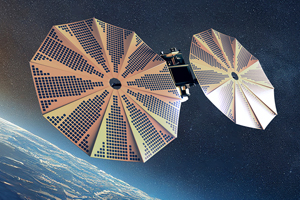
NET March - The MBR Explorer by the United Arab Emirates Space Agency's (UAESA) is a $1 billion, 13-year mission to explore six main-belt asteroids and deploy a lander on a seventh, 269 Justitia, in 2034; launch vehicle / location TBA.
NASA's Artemis 5th flight (4th crewed mission) is planned to send touchdown on the Moon's surface.
NET 2029 — Expected launch of CNSA Solar Polar Orbit Observatory spacecraft to enter a high-inclination orbit around the Sun to observe its poles, via a gravity-assist maneuver at Jupiter.
NET 2030 — Russia hopes to launch Millimetron (Spektr-M) space observatory with a diameter of 10 meters to Sun-Earth L2 Lagrange Point to study black holes, formation of stars, planets, galaxies.