The biggest interdisciplinary scientific convention on space research, the 38th COSPAR Assembly 2010, will be held on 18-25 July in Bremen Germany. At the convention, more than 2,500 representatives from science, government, industry and academia will come together to share the latest discoveries and developments in space research and technology. Topics to be covered at the conference include climate studies, the Earth-Moon system, Solar System research and astrophysics from space. Some of the notable interdisciplinary lectures include Athena Coustenis’s (R) presentation of the exploration of Titan and the Saturnian system as well as Carle Pieters’s (L) discussion of recent Lunar data. The assembly includes a space exhibition expected to attract attendees from over 50 countries. The general public will have access to the space exhibition and selected talks on Tuesday, July 20, “Public Day.” Conference goers will also have the opportunity to participate in a variety of technical visits to sites of Bremen’s space industry and research, as well as space-themed concerts and guided tours to local sites of interest. (Credit: COSPAR, brown.edu, raa.org, NASA, ISRO)
USA Lunar Educational Events at NASA
NASA will continue to forge ahead with educational pursuits aimed to convince students and educators about the importance of Luna exploration. On July 12-16, Goddard Space Flight Center will host ‘Lunar Institute for Educators in Grades 6-12,’ in Greenbelt MD. Several hundred educators nationwide will have the opportunity to explore real data from the Lunar Reconnaissance Orbiter (LRO) mission to incorporate into classrooms. In just a year’s time, the information returned from LRO / LCROSS as well ISRO Chandrayaan-1, JAXA Kaguya and CNSA Chang’e-1 has reshaped our perspective of the Moon. From the recent findings of water to the compilation of several comprehensive maps, students now have the resources to gain a better understanding of lunar science than any generation before. The 1st Lunar Graduate Conference will be held at the Ames Research Center in Mountain View CA on Jul 18. Sponsored by NASA and the University of Colorado at Boulder, the international conference provides a venue for grad students to present research to their peers. Three key areas of focus include the Moon’s nature and history, effects of the lunar environment on terrestrial life and equipment and using the Moon as a future platform for performing scientific investigations. Pictured: Co-organizers for LunGradCon 2010 University of Colorado Boulder students Andrew Poppe (BR) and Adrienne Dove (BC). (Credit: NASA, ISRO, CNSA)
= All times for terrestrial events in local time unless noted. = All times for international terrestrial events in local time unless noted. = All times for space events, and… = All times for international space / astro events in Hawaii Standard Time unless noted. Add 10 hours to obtain UT (‘Universal Time;’ Greenwich, England).
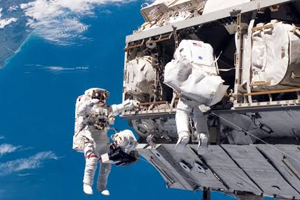
Jul 12 — International Space Station, LEO: E-24 crew members focus attention on maintenance and science activities as well as diagnosing transmitting problems of the Russian rendezvous system, TORU.
Jul 12 — NASA Lunar Reconnaissance Orbiter (LRO), Lunar Orbit: LRO operating nominally in low polar orbit (50km) and continues to return global data of lunar surface.
Jul 12 — Mars Rover Opportunity, Red Planet: Opportunity continues to make good progress on way to Endeavour Crater completing over 70m of driving.
NET Jul 12 — Indian Space Research Organization, Launch PSLV / Cartosat 2B, Sriharikota, India: ISRO Polar Satellite Launch Vehicle set to launch Cartosat 2B remote sensing satellite and secondary payloads.
Jul 12 — International Space University, Strasbourg, France: ‘International Astronaut Panel,’ featuring Reinhold Ewald, Jean-Jacques Favier, Jeff Hoffman, Chiaki Mukai & Bob Thirsk.
Jul 12-16 — NASA Goddard Space Flight Center, Greenbelt MD: ‘Lunar Institute for Educators,’ Educators for grades 6-12 to learn how much our understanding of the Moon has changed since NASA launched LRO / LCROSS.
Jul 12 — Moon: 3.9° SSW of Mercury, 13:00;3.6° SSW of Beehive Cluster, 14:00.
Jul 12 — Asteroid 2009 BD: Near-Earth Flyby (0.027 AU).
Jul 12 — Asteroid 37582 Faraday: Closest Approach to Earth (1.082 AU).
Continued from . . .
Jan 30 — Museum of Science and Industry, Confucius Institute / University of Manchester, Manchester, United Kingdom: ‘Exhibition: From Gunpowder to Space Rockets – The China Space Program,’ includes models of ancient rockets, recent satellites, rockets, space ships and a lunar rover; through Aug 7.
Jun 26 — International Space University (ISU), Strasbourg, France and Stuttgart, Germany: ‘ISU Summer Session Program;’ through Aug 27.
Jul 5 — International Summer Institute For Modeling in Astrophysics,Santa Cruz CA: ‘ISIMA 2010: Transport Processes in Astrophysics;’ Course to address topical problems such as radiative transfer, transport of chemical species, momentum, magnetic fields and energy induced by waves or by hydrodynamical and magnetohydrodynamical turbulence; through Aug 13.
Jul 13 — NASA Johnson Space Center, Houston TX:News conference for next Expedition 25 crew members Scott Kelly, Alexander Kaleri and Oleg Skripochka at 01:00 CDT.
Jul 16 — African-American Male Achievers Network Inc, International Science Discovery & Learning Center, Los Angeles CA: ‘Apollo 11 41st Anniversary Celebration.‘
Jul 16 — NASA Advisory Council, Washington DC: ‘NAC Committee Meeting,’ with reports from all NAC Committees.
Jul 18 — NASA Ames Research Center, NASA Lunar Science Institute, Moffett Field CA: ‘1st LunarGradCon,’ for grad students and early-career postdocs to present their research on lunar science in a friendly environment among their peers; *Held in conjunction with NASA Lunar Science Forum Jul 20-22.
Includes ~150 meetings covering the fields of COSPAR Scientific Commissions / Panels / Task Groups, such as SC B: The Earth-Moon System, Planets, and...
At the Palais des Nations and online. Outer space is entering a renewed phase of strategic importance, defined by rapid innovation, growing competition and deepening...
This international lunar science meeting has two objectives: to provide a platform for leading experts to review recent advances across lunar research, from the...
At CSIR International Convention Centre. Key topics are Earth Observation, Developing Space Tourism, Space Supply Manufacturing. Cultural tours are offered.
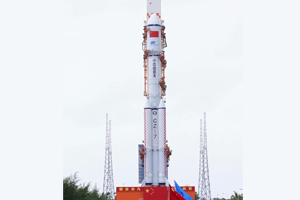
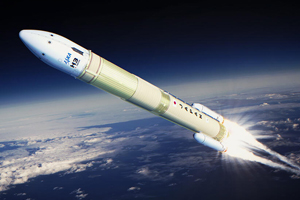
(No earlier than 10 Aug) Japan to launch the MICHIBIKI No. 7 | Quasi-Zenith Satellite System (QZS-7) navigation satellite. Launch window remains open through...
Participants will receive theoretical and hands-on training in electron imaging and X-ray spectroscopy for application to planetary samples. This training opportunity is targeted at...
"Leading Australia’s Space Future for Our Strategic Advantage". Southern Space 2026 brings together decision-makers who set the direction for Australia’s space sector. It is...
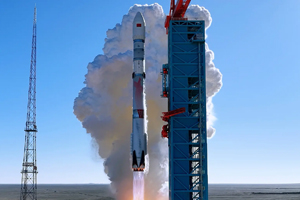
The second test launch of LandSpace's ZQ-3 rocket with undisclosed test payloads. Zhuque-3 first stage booster will attempt to land on its downrange landing...
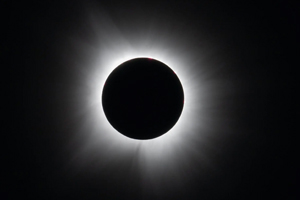
A total solar eclipse with a magnitude of 1.0386 (greatest eclipse 17:47:06 UTC) will be visible in parts of Greenland, Iceland, northern Russia, the Atlantic...
Includes presentation of the Neil Armstrong Award of Excellence, activities for the new class of Astronaut Scholars, 2-day Technical Conference where Scholars present their...
During U.S. spacewalk 97, two astronauts will replace a Space-to-Ground antenna on the orbital complex. The antenna is a critical communication system NASA uses...
Key themes include: Characterizing exoplanet-host solar-like stars; Star-planet interactions; Planet populations around solar-like stars. At University of Liège.
 The biggest interdisciplinary scientific convention on space research, the 38th COSPAR Assembly 2010, will be held on 18-25 July in Bremen Germany. At the convention, more than 2,500 representatives from science, government, industry and academia will come together to share the latest discoveries and developments in space research and technology. Topics to be covered at the conference include climate studies, the Earth-Moon system, Solar System research and astrophysics from space. Some of the notable interdisciplinary lectures include Athena Coustenis’s (R) presentation of the exploration of Titan and the Saturnian system as well as Carle Pieters’s (L) discussion of recent Lunar data. The assembly includes a space exhibition expected to attract attendees from over 50 countries. The general public will have access to the space exhibition and selected talks on Tuesday, July 20, “Public Day.” Conference goers will also have the opportunity to participate in a variety of technical visits to sites of Bremen’s space industry and research, as well as space-themed concerts and guided tours to local sites of interest. (Credit: COSPAR, brown.edu, raa.org, NASA, ISRO)
 NASA will continue to forge ahead with educational pursuits aimed to convince students and educators about the importance of Luna exploration. On July 12-16, Goddard Space Flight Center will host ‘Lunar Institute for Educators in Grades 6-12,’ in Greenbelt MD. Several hundred educators nationwide will have the opportunity to explore real data from the Lunar Reconnaissance Orbiter (LRO) mission to incorporate into classrooms. In just a year’s time, the information returned from LRO / LCROSS as well ISRO Chandrayaan-1, JAXA Kaguya and CNSA Chang’e-1 has reshaped our perspective of the Moon. From the recent findings of water to the compilation of several comprehensive maps, students now have the resources to gain a better understanding of lunar science than any generation before. The 1st Lunar Graduate Conference will be held at the Ames Research Center in Mountain View CA on Jul 18. Sponsored by NASA and the University of Colorado at Boulder, the international conference provides a venue for grad students to present research to their peers. Three key areas of focus include the Moon’s nature and history, effects of the lunar environment on terrestrial life and equipment and using the Moon as a future platform for performing scientific investigations. Pictured: Co-organizers for LunGradCon 2010 University of Colorado Boulder students Andrew Poppe (BR) and Adrienne Dove (BC). (Credit: NASA, ISRO, CNSA)
 = All times for terrestrial events in local time unless noted.
 = All times for international terrestrial events in local time unless noted.
 = All times for space events, and…
 = All times for international space / astro events in Hawaii Standard Time unless noted. Add 10 hours to obtain UT (‘Universal Time;’ Greenwich, England).
 Jul 12 — International Space Station, LEO: E-24 crew members focus attention on maintenance and science activities as well as diagnosing transmitting problems of the Russian rendezvous system, TORU.
 Jul 12 — International Space University, Strasbourg, France: ‘International Astronaut Panel,’ featuring Reinhold Ewald, Jean-Jacques Favier, Jeff Hoffman, Chiaki Mukai & Bob Thirsk.
 Jul 12-16 — NASA Goddard Space Flight Center, Greenbelt MD: ‘Lunar Institute for Educators,’ Educators for grades 6-12 to learn how much our understanding of the Moon has changed since NASA launched LRO / LCROSS.