Astrobiology Workshop to Focus on Europe Contributions, Collaboration
The European Astrobiology Network Association (EANA) will hold the 10th European Workshop on Astrobiology in Pushchino, Russia on September 6-8. The 3-day workshop will consist of 8 sessions featuring over 40 presentations by leading international astrobiologists as well as 35 poster sessions. This year’s themes include experiments in space and simulated space environments, solar system exploration and astrobiology aspects of Mars, the Jovian moons (BL) and Saturn Titan (TL), origins of early Earth, evolution of geo-biological systems as well as exoplanets, astrochemistry and planetary protection. Chaired by EANA president Gerda Horneck (T), the workshop will open with a speech from Pushchino Mayor Ivan Savintsev followed by Valery Kudeyarov, Anatoly Miroshnikov and Alexei Rozanov (B) of the Russian Academy of Sciences. A Round Table discussion, ‘Future Aspects of Astrobiology World-wide,’ will provide a platform for shared collaboration between EANA, NASA Astrobiology Institute, The International Astrobiology Society and the Astrobiology Society. There will also be 2 excursions planned to the Prioksko-Terrasny Biosphere Reserve (BC) and Polenovo Museum (BR). The Executive Council for EANA consists of national members presently representing over 17 European nations. (Credit: EANA, NASA, ESA, tula.rodgor.ru, astrobio.net)
SETI Institute Colloquium Series on NASA Flexible Path by David Korsmeyer
The mission of the SETI Institute is to explore, understand and explain the origin, nature and prevalence of life in the universe. To comprehensively achieve this mission, humanity must reach out to the stars through both astronomical observation and astronautical exploration. David Korsmeyer, Chief of the Intelligent Systems Division at NASA Ames Research Center, will be addressing the latter objective in his lecture on September 8 at the Carl Sagan Center in Mountain View CA. Dr. Korsmeyer led the Flexible Path Architecture Study for NASA in support of the ‘Review of US Human Spaceflight Plans’ Committee last summer. The flexible path architecture involves a series of missions with steadily increasing duration, distance from Earth and science capabilities that will help retire technical and operational risk, while sustaining public and political support as NASA prepares for the eventual human exploration of Mars. With more than 6,000 cataloged by mid-2009, Near-Earth Objects figure to offer a rich suite of exploration destinations for both robots and astronauts. Recent research indicates at least 9 NEOs could be reached with round-trip times anywhere from 150-180 days (assuming a 14-day stay at the asteroid). (Credit: SETI Institute, NewScientist, Digital Space)
= All times for terrestrial events in local time unless noted.
= All times for international terrestrial events in local time unless noted.
= All times for space events, and…
= All times for international space / astro events in Hawaii Standard Time unless noted. Add 10 hours to obtain UT (‘Universal Time;’ Greenwich, England).
Weekly Planet Watch – Morning Planets: Jupiter (S) / Evening Planets: Venus (WSW), Mars (WSW), Saturn (WSW), Jupiter (ESE).
MONDAY
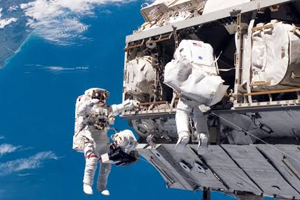
Sep 6 — International Space Station, LEO: E-24 crew prepares for arrival of Progress 39 which will deliver 2.5 tons of food, fuel and supplies.
Sep 6 — NASA Lunar Reconnaissance Orbiter (LRO), Lunar Orbit: LRO operating nominally in low polar orbit (50km) and continues to return global data of lunar surface.
Sep 6 — Mars Reconnaissance Orbiter (MRO) / ExoMars Spacecraft, Red Planet: Upgraded version of MRO Climate Sounder currently being developed for ExoMars mission NET 2016; Instrument to operate continuously from spacecraft’s orbit (400 km) above the Martian surface with flexible pivot capabilities and able to measure temperature, water vapor, dust / ices for each 5 km increment in height throughout the atmosphere from ground level to 90 km altitude.
Sep 7 — Purdue University, West Lafayette IN: NASA administrator Charles Bolden to deliver William E. Boeing Lecture ‘Our Nation’s Future in Space.‘
Sep 7-10 — University of Exeter, Exeter, United Kingdom: ‘Exoclimes Conference: Exploring the Diversity of Planetary Atmospheres,’ meeting designed to bring together Earth, Solar System and Exoplanet specialists to discuss recent scientific data and put Earth’s climate in wider context of other planetary atmospheres.
Sep 7-15 — University of Western Ontario Center for Planetary Science and Exploration, London, Ontario, Canada: ‘Planetary Science Short Course,’ a 7-day intensive modular course on planetary science.
Sep 7 — Moon: 1.7° S of Mercury, 12:00; At Perigee (Distance: 56.00 Earth-radii), 18:00.
WEDNESDAY
Sep 8 — RSA, Launch Soyuz / Progress 39P,Baikonur Cosmodrome, Kazakhstan: Russia Progress 39 cargo spacecraft delivers supplies to ISS crew. *Launch rescheduled for Friday 10 Sep.
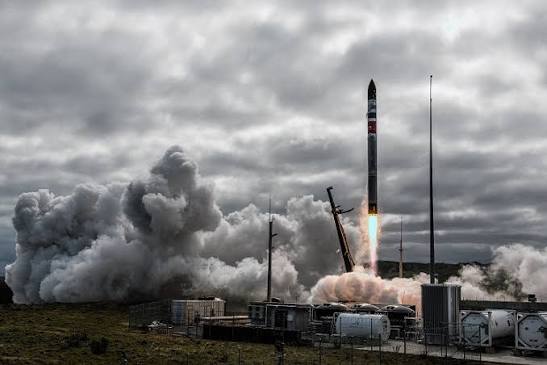
Sep 8 — RSA, Launch Rockot / Gonets,Plesetsk Cosmodrome, Russia: Russia government Rockot vehicle to launch spacecraft for Gonets satellite communications constellation.
Sep 8 — Indian Space Research Organization, Tirunelveliin Tamil Nadu, India: ISRO to conduct full duration static test (200 seconds) of the liquid core stage for GSLV Mark-III launch vehicle.
Sep 9-10 — University of Nebraska College of Law’s Space and Cyber Policy, Washington DC: ‘4th UNL Space and Cyber Law Conference,’ with 2nd day of conference focusing on USA national space policy as well as keynote address given by Deputy NASA Administrator Lori Garver.
Includes ~150 meetings covering the fields of COSPAR Scientific Commissions / Panels / Task Groups, such as SC B: The Earth-Moon System, Planets, and...
At the Palais des Nations and online. Outer space is entering a renewed phase of strategic importance, defined by rapid innovation, growing competition and deepening...
This international lunar science meeting has two objectives: to provide a platform for leading experts to review recent advances across lunar research, from the...
At CSIR International Convention Centre. Key topics are Earth Observation, Developing Space Tourism, Space Supply Manufacturing. Cultural tours are offered.
(No earlier than 10 Aug) Japan to launch the MICHIBIKI No. 7 | Quasi-Zenith Satellite System (QZS-7) navigation satellite. Launch window remains open through...
Participants will receive theoretical and hands-on training in electron imaging and X-ray spectroscopy for application to planetary samples. This training opportunity is targeted at...
"Leading Australia’s Space Future for Our Strategic Advantage". Southern Space 2026 brings together decision-makers who set the direction for Australia’s space sector. It is...
The second test launch of LandSpace's ZQ-3 rocket with undisclosed test payloads. Zhuque-3 first stage booster will attempt to land on its downrange landing...
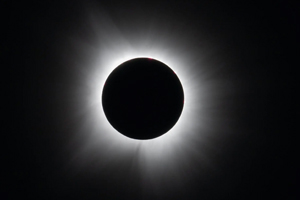
A total solar eclipse with a magnitude of 1.0386 (greatest eclipse 17:47:06 UTC) will be visible in parts of Greenland, Iceland, northern Russia, the Atlantic...
Includes presentation of the Neil Armstrong Award of Excellence, activities for the new class of Astronaut Scholars, 2-day Technical Conference where Scholars present their...
During U.S. spacewalk 97, two astronauts will replace a Space-to-Ground antenna on the orbital complex. The antenna is a critical communication system NASA uses...
Key themes include: Characterizing exoplanet-host solar-like stars; Star-planet interactions; Planet populations around solar-like stars. At University of Liège.
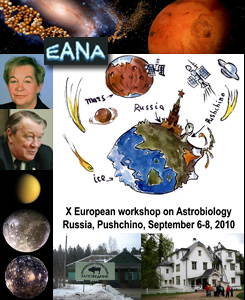 The European Astrobiology Network Association (EANA) will hold the 10th European Workshop on Astrobiology in Pushchino, Russia on September 6-8. The 3-day workshop will consist of 8 sessions featuring over 40 presentations by leading international astrobiologists as well as 35 poster sessions. This year’s themes include experiments in space and simulated space environments, solar system exploration and astrobiology aspects of Mars, the Jovian moons (BL) and Saturn Titan (TL), origins of early Earth, evolution of geo-biological systems as well as exoplanets, astrochemistry and planetary protection. Chaired by EANA president Gerda Horneck (T), the workshop will open with a speech from Pushchino Mayor Ivan Savintsev followed by Valery Kudeyarov, Anatoly Miroshnikov and Alexei Rozanov (B) of the Russian Academy of Sciences. A Round Table discussion, ‘Future Aspects of Astrobiology World-wide,’ will provide a platform for shared collaboration between EANA, NASA Astrobiology Institute, The International Astrobiology Society and the Astrobiology Society. There will also be 2 excursions planned to the Prioksko-Terrasny Biosphere Reserve (BC) and Polenovo Museum (BR). The Executive Council for EANA consists of national members presently representing over 17 European nations. (Credit: EANA, NASA, ESA, tula.rodgor.ru, astrobio.net)
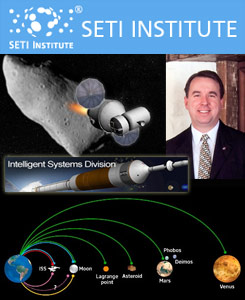 The mission of the SETI Institute is to explore, understand and explain the origin, nature and prevalence of life in the universe. To comprehensively achieve this mission, humanity must reach out to the stars through both astronomical observation and astronautical exploration. David Korsmeyer, Chief of the Intelligent Systems Division at NASA Ames Research Center, will be addressing the latter objective in his lecture on September 8 at the Carl Sagan Center in Mountain View CA. Dr. Korsmeyer led the Flexible Path Architecture Study for NASA in support of the ‘Review of US Human Spaceflight Plans’ Committee last summer. The flexible path architecture involves a series of missions with steadily increasing duration, distance from Earth and science capabilities that will help retire technical and operational risk, while sustaining public and political support as NASA prepares for the eventual human exploration of Mars. With more than 6,000 cataloged by mid-2009, Near-Earth Objects figure to offer a rich suite of exploration destinations for both robots and astronauts. Recent research indicates at least 9 NEOs could be reached with round-trip times anywhere from 150-180 days (assuming a 14-day stay at the asteroid). (Credit: SETI Institute, NewScientist, Digital Space)
 = All times for terrestrial events in local time unless noted.
 = All times for international terrestrial events in local time unless noted.
 = All times for space events, and…
 = All times for international space / astro events in Hawaii Standard Time unless noted. Add 10 hours to obtain UT (‘Universal Time;’ Greenwich, England).
 Sep 6 — International Space Station, LEO: E-24 crew prepares for arrival of Progress 39 which will deliver 2.5 tons of food, fuel and supplies.
 Sep 8 — Indian Space Research Organization, Tirunelveliin Tamil Nadu, India: ISRO to conduct full duration static test (200 seconds) of the liquid core stage for GSLV Mark-III launch vehicle.