Ansari and Garver to Discuss Importance of Exploration at TEDx Event
The premier of TEDxMidTownNY, a discussion featuring speakers dedicated to advancing space exploration and research, will be hosted at the Explorers Club HQ in New York NY on September 14. Sponsored by Space Frontier Foundation, TEDx conferences promote ‘ideas worth spreading’ and provide the perfect venue for deep discussion and connection in small groups. Speaking will be Spaceflight participant and X-Prize Co-Founder Anousheh Ansari (TR) and NASA Deputy Administrator Lori Garver (TL). Ansari, the 1st astronaut of Iranian descent is also the world’s 1st female private space explorer. She helped to advance commercialization of the space industry by providing title sponsorship for the Ansari X Prize, giving US$10million for the 1st non-governmental organization to launch a reusable manned spacecraft into space. Garver, also a commercial spaceflight proponent, began her role as deputy administrator on July 2009 and represents NASA to the Executive Office of the President, Congress, and international / external organizations and communities. The event will also feature videos by planetary scientist Carolyn Porco (BL) and UK stuntman Steve Truglia (BR) who will prepare to set a new record for extreme-high-altitude parachute jump from a balloon at 36,576m. Tickets are $20, $5 for students. (Credit: Space Frontier Foundation, TEDx, The Explorers Club, NASA, de.academic.ru, autotrade.co.uk)
2 Europe Meetings Explore Developments in Micro / Nanotechnology, Planetary Science
Over 250 experts from Europe, the Americas and Asia will gather at the ESTEC Center in Noordwijk, The Netherlands on September 13-17 for the ‘7th ESA Round-Table on MNT for Space Applications & 6th CANEUS Workshops.’ Already widely used in Earth-bound applications, Micro and Nano Technologies (MNT) present important advantages for space systems like Earth observation, navigation, communication and scientific missions. Microsatellites have a wet mass between 10-100kg and nanosatellites have a wet mass between 1-10kg. At the workshop, Z Zhao and Zheng You of Tsinghua University, China will give a presentation on ‘Micro-Nano Smart Systems for Space Application’ while A Sesis and M Saavedra of the UK National Physics Lab will discuss ‘Bio-Inspired Nanostructures for Spacecraft Materials.’ On Sep 19-24, the European Geosciences Union and the European Planetology Network will host the ‘European Planetary Science Congress 2010.’ Set at the Angelicum Centre – Pontifical University of Saint Thomas Aquinas in Rome, Italy, the meeting will feature 48 sessions and workshops covering such subjects as terrestrial planets, magnetospheres, astrobiology and amateur astronomy. Around 550 scientists are expected to attend. (Credit: ESA, EPSC, EGU, EPN, NASA)
= All times for terrestrial events in local time unless noted.
= All times for international terrestrial events in local time unless noted.
= All times for space events, and…
= All times for international space / astro events in Hawaii Standard Time unless noted. Add 10 hours to obtain UT (‘Universal Time;’ Greenwich, England).
Weekly Planet Watch – Morning Planets: Jupiter (S) / Evening Planets: Venus (WSW), Mars (WSW), Saturn (WSW), Jupiter (ESE).
MONDAY
Sep 13 — International Space Station, LEO: E-24 crew to focus on arrival / unloading of Progress 39 after rescheduled launch last week.
Sep 13 — NASA Lunar Reconnaissance Orbiter (LRO), Lunar Orbit: Scientists continue to review the most detailed geologic map of Schrodinger basin, which combines topographic data from LRO’s Laser Altimeter and data from earlier Clementine and Prospector missions.
Sep 13 — Mars Rover Opportunity, Red Planet: Opportunity continues on with long journey from Victoria to western rim of Endeavour Crater after passing halfway point last week (approximately 19km).
Sep 7 — University of Western Ontario Center for Planetary Science and Exploration, London, Ontario, Canada: ‘Planetary Science Short Course,’ a 7-day intensive modular course on planetary science; through Sep 15.
Sep 16-17 — NASA Outer Planets Assessment Group (OPAG), Boulder CO: ‘OPAG Meeting.’
Sep 16-17 — InOMN Organization, Nationwide: ‘International Observe the Moon Night,’ 1st public outreach campaign dedicated to engaging the lunar science / education community, amateur astronomers, space enthusiasts and the general public.
Includes ~150 meetings covering the fields of COSPAR Scientific Commissions / Panels / Task Groups, such as SC B: The Earth-Moon System, Planets, and...
At the Palais des Nations and online. Outer space is entering a renewed phase of strategic importance, defined by rapid innovation, growing competition and deepening...
This international lunar science meeting has two objectives: to provide a platform for leading experts to review recent advances across lunar research, from the...
At CSIR International Convention Centre. Key topics are Earth Observation, Developing Space Tourism, Space Supply Manufacturing. Cultural tours are offered.
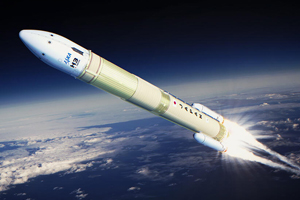
(No earlier than 10 Aug) Japan to launch the MICHIBIKI No. 7 | Quasi-Zenith Satellite System (QZS-7) navigation satellite. Launch window remains open through...
Participants will receive theoretical and hands-on training in electron imaging and X-ray spectroscopy for application to planetary samples. This training opportunity is targeted at...
"Leading Australia’s Space Future for Our Strategic Advantage". Southern Space 2026 brings together decision-makers who set the direction for Australia’s space sector. It is...
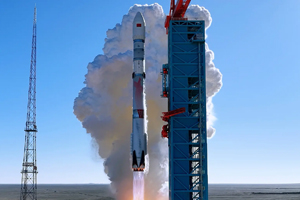
The second test launch of LandSpace's ZQ-3 rocket with undisclosed test payloads. Zhuque-3 first stage booster will attempt to land on its downrange landing...
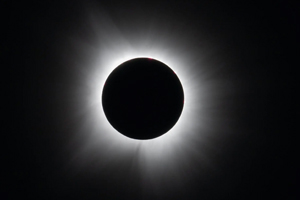
A total solar eclipse with a magnitude of 1.0386 (greatest eclipse 17:47:06 UTC) will be visible in parts of Greenland, Iceland, northern Russia, the Atlantic...
Includes presentation of the Neil Armstrong Award of Excellence, activities for the new class of Astronaut Scholars, 2-day Technical Conference where Scholars present their...
During U.S. spacewalk 97, two astronauts will replace a Space-to-Ground antenna on the orbital complex. The antenna is a critical communication system NASA uses...
Key themes include: Characterizing exoplanet-host solar-like stars; Star-planet interactions; Planet populations around solar-like stars. At University of Liège.
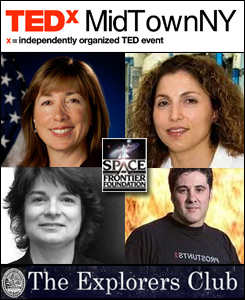 The premier of TEDxMidTownNY, a discussion featuring speakers dedicated to advancing space exploration and research, will be hosted at the Explorers Club HQ in New York NY on September 14. Sponsored by Space Frontier Foundation, TEDx conferences promote ‘ideas worth spreading’ and provide the perfect venue for deep discussion and connection in small groups. Speaking will be Spaceflight participant and X-Prize Co-Founder Anousheh Ansari (TR) and NASA Deputy Administrator Lori Garver (TL). Ansari, the 1st astronaut of Iranian descent is also the world’s 1st female private space explorer. She helped to advance commercialization of the space industry by providing title sponsorship for the Ansari X Prize, giving US$10million for the 1st non-governmental organization to launch a reusable manned spacecraft into space. Garver, also a commercial spaceflight proponent, began her role as deputy administrator on July 2009 and represents NASA to the Executive Office of the President, Congress, and international / external organizations and communities. The event will also feature videos by planetary scientist Carolyn Porco (BL) and UK stuntman Steve Truglia (BR) who will prepare to set a new record for extreme-high-altitude parachute jump from a balloon at 36,576m. Tickets are $20, $5 for students. (Credit: Space Frontier Foundation, TEDx, The Explorers Club, NASA, de.academic.ru, autotrade.co.uk)
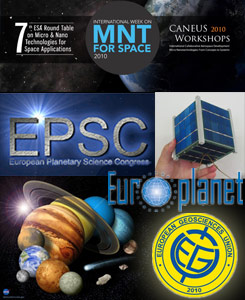 Over 250 experts from Europe, the Americas and Asia will gather at the ESTEC Center in Noordwijk, The Netherlands on September 13-17 for the ‘7th ESA Round-Table on MNT for Space Applications & 6th CANEUS Workshops.’ Already widely used in Earth-bound applications, Micro and Nano Technologies (MNT) present important advantages for space systems like Earth observation, navigation, communication and scientific missions. Microsatellites have a wet mass between 10-100kg and nanosatellites have a wet mass between 1-10kg. At the workshop, Z Zhao and Zheng You of Tsinghua University, China will give a presentation on ‘Micro-Nano Smart Systems for Space Application’ while A Sesis and M Saavedra of the UK National Physics Lab will discuss ‘Bio-Inspired Nanostructures for Spacecraft Materials.’ On Sep 19-24, the European Geosciences Union and the European Planetology Network will host the ‘European Planetary Science Congress 2010.’ Set at the Angelicum Centre – Pontifical University of Saint Thomas Aquinas in Rome, Italy, the meeting will feature 48 sessions and workshops covering such subjects as terrestrial planets, magnetospheres, astrobiology and amateur astronomy. Around 550 scientists are expected to attend. (Credit: ESA, EPSC, EGU, EPN, NASA)
 = All times for terrestrial events in local time unless noted.
 = All times for international terrestrial events in local time unless noted.
 = All times for space events, and…
 = All times for international space / astro events in Hawaii Standard Time unless noted. Add 10 hours to obtain UT (‘Universal Time;’ Greenwich, England).
 Sep 13 — International Space Station, LEO: E-24 crew to focus on arrival / unloading of Progress 39 after rescheduled launch last week.