Space Generation Council 2010 to be Held in Prague
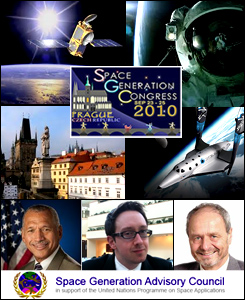
The Space Generation Advisory Council (SGAC) will hold the 9th Space Generation Congress (SGC) in Prague, Czech Republic on September 23-25. Approximately 100 selected young space professionals from over 30 countries will converge at Charles University to focus on key space issues. This year’s themes will center around industry, agency, climate, exploration and outreach. Attendees will discuss the new role of commercial space, collaborative space systems between countries, Earth observation data, human space exploration and developing science and technology education / careers for the new generation of space explorers. Invited SGC speakers include NASA Administrator Charles Bolden (BL), ESA International Relations Head Chris De Cooker, International Astronautical Federation President Berndt Feuerbacher (BR), Arianespace President Clayton Mowry, Space Frontier Foundation Executive Director Will Watson (BC) and International Space Services President Jim Zimmerman. The Czech Republic has gradually developed its own infrastructure for Space exploration, becoming the 18th member of the European Space Agency in 2008. Also held in conjunction with SGC 2010 is the 61st International Astronautical Congress on Sep 27-Oct 1. (Credit: SGAC, NASA, Virgin Galactic, inventor.com)
USGS Helping to Advance Planetary GIS Research with 2 Workshops
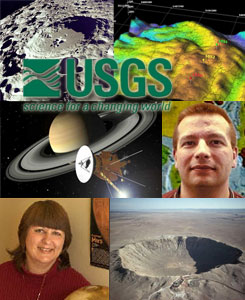
Researchers from the planetary mapping community will meet at the US Geological Survey (USGS) in Flagstaff, Arizona on September 20-21 for the ‘GIS for Planetary Mappers 2’ workshop. Participants will receive hands-on training in the uses of the innovative GIS systems such as ISIS3, ENVI and Quantum GIS. The goal of the workshop will be to demonstrate how to initiate, organize and implement ‘best practices’ for a digital planetary mapping project. Registration for the event is closed, as it is limited to 24 participants, yet interested parties can still sign up for the waiting list. The USGS will continue its planetary focus on Sep 22-24 as it hosts the ‘1st Planetary Crater Consortium (PCC) Meeting.’ Formed in 2010 from the merger of the Mars, Lunar and Outer Solar System Crater Consortiums, the PCC is open to planetary scientists interested in any aspect of impact cratering on solar system bodies, including observational, theoretical, experimental and numerical modeling studies. Experts in the field will provide updates from current missions such as MESSENGER, LRO, Mars Odyssey, MER, MRO and Cassini. In 1 of 10 featured oral presentations, Nadine Barlow (BL) of Northern Arizona University and Scott Mest (CR) of the Planetary Sciences Institute will present their research on ‘A New Database of Lunar Impact Craters.’ Participants will have the opportunity to tour USGS and the nearby Meteor Crater. (Credit: USGS)
= All times for terrestrial events in local time unless noted.
= All times for international terrestrial events in local time unless noted.
= All times for space events, and…
= All times for international space / astro events in Hawaii Standard Time unless noted. Add 10 hours to obtain UT (‘Universal Time;’ Greenwich, England).
Weekly Planet Watch – Morning Planets: Jupiter (S) / Evening Planets: Mercury (E), Venus (SW), Mars (W), Jupiter (ESE).
MONDAY
Sep 20 — International Space Station, LEO: E-24 crew members continue with scientific experiments and maintenance while capturing imagery of hurricanes churning through the Atlantic as part of ongoing Earth observation.
Sep 20 — NASA Lunar Reconnaissance Orbiter (LRO), Lunar Orbit: LRO successfully transitions to scientific phase after completing a 1-year exploration mission in polar orbit (approximately 50km above the lunar surface); Scientific phase of mission to end in March 2011.
Sep 20 — ESA Mars500, ‘Red Planet’/ Moscow, Russia: Mars500 crew continues to respond well to new phase of mission where ‘delays’ in communication will now be 2 minutes in each direction and will progress up to 20 minutes as simulation continues.
Sep 20 —United Launch Alliance, Launch Atlas 5 / NROL-41, Vandenberg AFB CA: ULA Atlas 5 rocket to launch classified spacecraft payload for US National Reconnaissance Office.
Sep 20 — Kennedy Space Center, Cape Canaveral FL: Media invited to cover space shuttle Discovery’s last move from Vehicle Assembly Building (VAB) to Launch Pad 39A for upcoming Nov 1 launch.
Sep 20 — Association of Bay Area Governments, Moffett Field CA: News media invited to attend ‘Moffett Field Bay Trail Grand Opening‘ dedication ceremony celebrating the opening of a segment of the San Francisco Bay Trail that connects Mountain View and Sunnyvale.
Sep 20-21 — US Geological Survey, Flagstaff AZ: ‘GIS for Planetary Mappers,’ workshop to teach participants how to initiate, organize, and implement best practices for digital planetary mapping.
Sep 21 — SHIFTboston, Online: New extended deadline for ‘MOON CAPITAL Competition 2010;’ winners announced Oct 21 at the Boston Center for the Arts ‘Cyclorama.’
Sep 22 — University of Southern California, Los Angeles CA / Online: Online information session about rapidly growing division of the Department of Astronautical Engineering.
Sep 22 — Fall (Autumnal) Equinox: The sun crosses celestial equator and reaches the point where it crosses the equator into the southern celestial hemisphere; 17:13.
Sep 22 — Moon: 6.5° NNW of Jupiter, 18:00; 5.7° NNW of Uranus, 19:00; Full Moon, 23:18.
Sep 22 — Asteroid 4923 Clarke: Closest Approach to Earth (0.928 AU).
Sep 23-25 — Space Generation Advisory Council, Prague, Czech Republic: ‘Space Generation Congress 2010,’ the Global Space Congress for university students and young professionals interested in today’s key space issues.
Sep 25 — Valley Medical Center Foundation, Ames Research Center, Moffett Field CA: ‘3rd Take Flight For Kids: Reach Out and Touch a Cloud,’ for youth interested in Science, Technology, Engineering and Math (STEM).
SUNDAY
NET Sep 26 —USAF, Launch Minotaur 4 / SBSS, Vandenberg AFB CA: The Air Force to launch 1st satellite for Space-Based Surveillance System aboard Minotaur 4 rocket.
Includes ~150 meetings covering the fields of COSPAR Scientific Commissions / Panels / Task Groups, such as SC B: The Earth-Moon System, Planets, and...
At the Palais des Nations and online. Outer space is entering a renewed phase of strategic importance, defined by rapid innovation, growing competition and deepening...
This international lunar science meeting has two objectives: to provide a platform for leading experts to review recent advances across lunar research, from the...
At CSIR International Convention Centre. Key topics are Earth Observation, Developing Space Tourism, Space Supply Manufacturing. Cultural tours are offered.
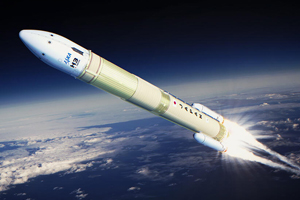
(No earlier than 10 Aug) Japan to launch the MICHIBIKI No. 7 | Quasi-Zenith Satellite System (QZS-7) navigation satellite. Launch window remains open through...
Participants will receive theoretical and hands-on training in electron imaging and X-ray spectroscopy for application to planetary samples. This training opportunity is targeted at...
"Leading Australia’s Space Future for Our Strategic Advantage". Southern Space 2026 brings together decision-makers who set the direction for Australia’s space sector. It is...
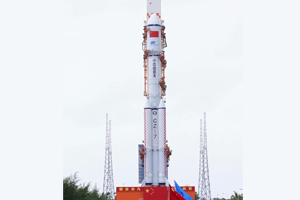
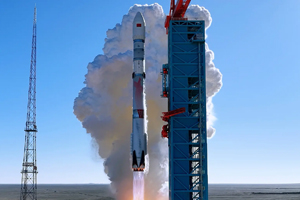
The second test launch of LandSpace's ZQ-3 rocket with undisclosed test payloads. Zhuque-3 first stage booster will attempt to land on its downrange landing...
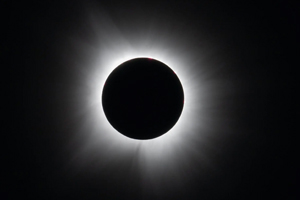
A total solar eclipse with a magnitude of 1.0386 (greatest eclipse 17:47:06 UTC) will be visible in parts of Greenland, Iceland, northern Russia, the Atlantic...
Includes presentation of the Neil Armstrong Award of Excellence, activities for the new class of Astronaut Scholars, 2-day Technical Conference where Scholars present their...
During U.S. spacewalk 97, two astronauts will replace a Space-to-Ground antenna on the orbital complex. The antenna is a critical communication system NASA uses...
Key themes include: Characterizing exoplanet-host solar-like stars; Star-planet interactions; Planet populations around solar-like stars. At University of Liège.
 The Space Generation Advisory Council (SGAC) will hold the 9th Space Generation Congress (SGC) in Prague, Czech Republic on September 23-25. Approximately 100 selected young space professionals from over 30 countries will converge at Charles University to focus on key space issues. This year’s themes will center around industry, agency, climate, exploration and outreach. Attendees will discuss the new role of commercial space, collaborative space systems between countries, Earth observation data, human space exploration and developing science and technology education / careers for the new generation of space explorers. Invited SGC speakers include NASA Administrator Charles Bolden (BL), ESA International Relations Head Chris De Cooker, International Astronautical Federation President Berndt Feuerbacher (BR), Arianespace President Clayton Mowry, Space Frontier Foundation Executive Director Will Watson (BC) and International Space Services President Jim Zimmerman. The Czech Republic has gradually developed its own infrastructure for Space exploration, becoming the 18th member of the European Space Agency in 2008. Also held in conjunction with SGC 2010 is the 61st International Astronautical Congress on Sep 27-Oct 1. (Credit: SGAC, NASA, Virgin Galactic, inventor.com)
 Researchers from the planetary mapping community will meet at the US Geological Survey (USGS) in Flagstaff, Arizona on September 20-21 for the ‘GIS for Planetary Mappers 2’ workshop. Participants will receive hands-on training in the uses of the innovative GIS systems such as ISIS3, ENVI and Quantum GIS. The goal of the workshop will be to demonstrate how to initiate, organize and implement ‘best practices’ for a digital planetary mapping project. Registration for the event is closed, as it is limited to 24 participants, yet interested parties can still sign up for the waiting list. The USGS will continue its planetary focus on Sep 22-24 as it hosts the ‘1st Planetary Crater Consortium (PCC) Meeting.’ Formed in 2010 from the merger of the Mars, Lunar and Outer Solar System Crater Consortiums, the PCC is open to planetary scientists interested in any aspect of impact cratering on solar system bodies, including observational, theoretical, experimental and numerical modeling studies. Experts in the field will provide updates from current missions such as MESSENGER, LRO, Mars Odyssey, MER, MRO and Cassini. In 1 of 10 featured oral presentations, Nadine Barlow (BL) of Northern Arizona University and Scott Mest (CR) of the Planetary Sciences Institute will present their research on ‘A New Database of Lunar Impact Craters.’ Participants will have the opportunity to tour USGS and the nearby Meteor Crater. (Credit: USGS)
 = All times for terrestrial events in local time unless noted.
 = All times for international terrestrial events in local time unless noted.
 = All times for space events, and…
 = All times for international space / astro events in Hawaii Standard Time unless noted. Add 10 hours to obtain UT (‘Universal Time;’ Greenwich, England).
 Sep 20 — International Space Station, LEO: E-24 crew members continue with scientific experiments and maintenance while capturing imagery of hurricanes churning through the Atlantic as part of ongoing Earth observation.
 Sep 24 — NASA, Air Force Research Laboratory, Moffett Field CA: Deadline for reduced conference fee ($575) for upcoming CRASTE event Oct 25-28.