Asia-Pacific Region to Address Space Technology and Climate Change at APRSAF-17
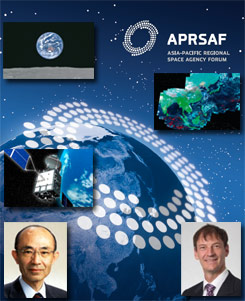
Melbourne, Australia will host the 17th session of the Asia-Pacific Regional Space Agency Forum (APRSAF-17) on November 23-26. Sponsored by the Australian Government, JAXA and MEXT, this year’s event will focus on the theme: “The role of space technology and industry in addressing climate change.” Space agencies, governmental bodies and international organizations (such as the United Nations) as well as companies, universities and research institutes from over 30 regional participants will take part in the largest space-related conference in the Asia-Pacific region. Days 1 and 2 will include parallel sessions for 4 working groups: Earth Observation, Communication Satellite Application, Space Education and Awareness and Space Environment Utilization. During the plenary session, status reports will be provided for the Sentinel Asia, Satellite Applications For Environment (SAFE) and Satellite Technology for the Asia-Pacific Region (STAR) projects. Pictured: APRSAF-17 co-chairs Michael Green (BR) of the Australia Government’s Innovation and Space Branch, Tetsuhiko Ikegami (BL) of MEXT. (Credit: APRSAF)
Dutch Seek to Advance Role in Space Based Solar Power
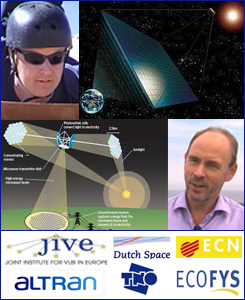
On November 23, the Dutch Space Based Solar Power (SBSP) Consortium will sponsor an SBSP workshop in Haarlem, Netherlands. The Consortium, made up of Dutch companies TNO Industry & Techniek, Dutch Space, Ecofys, Altran, JIVE and ECN, will provide a forum for participants to discuss SBSP as a potential business for the Dutch market as well as survey partnerships with the international space community to advance renewable energy sources. The event will focus on the key role of the Dutch technological market in the field of solar PV and receiver / transmitter technology. Presentations will be given by ECN Director Wim Sinke (BR) and Space Horizon President Arno Wielders (TL). With the world energy usage projected to increase 87% by 2035, the need to develop alternative energy sources will be inevitable. However, harvesting solar energy from space still poses a challenge since converting beamed energy from space into electricity in a power grid has not been successfully demonstrated. (Credit: Space Horizon, JIVE, Altran, ECN, Dutch Space, TNO, growth5, cleartechnica)
= All times for terrestrial events in local time unless noted.
= All times for international terrestrial events in local time unless noted.
= All times for space events, and…
= All times for international space / astro events in Hawaii Standard Time unless noted. Add 10 hours to obtain UT (‘Universal Time;’ Greenwich, England).
Nov 22 — International Space Station, LEO: E-25 crew members Cmdr Doug Wheelock and flight engineers Shannon Walker and Fyodor Yurchikhin continue last minute preparations for their return to Earth on board a Soyuz TMA-19 spacecraft Nov 25 at 23:46 EST.
Nov 22 — NASA Lunar Reconnaissance Orbiter (LRO), Lunar Orbit: All systems nominal in scientific phase of mission as LRO continues to return data from the Moon.
Nov 22 — Mars ‘Hopper,’ Red Planet: British Scientists from Leicester Space Research Center continue with research and design on a Mars ‘hopper’ that would move by sucking in carbon dioxide from Mars’ atmosphere and compressing it into fuel as well as be able to leap .7km at a time and travel 643km during a 6-year mission.
Nov 22 — Asteroid 1756 Giacobini: Closest Approach to Earth (1.041 AU).
Nov 23 — Space Horizon, Dutch SBSP Consortium, Haarlem, The Netherlands: ‘Space Base Solar Power Workshop,’ to address potential solution for global challenges related to increasing demand for energy.
Nov 23 — Asteroid 2008 KT: Near-Earth Flyby (0.014 AU).
WEDNESDAY
Nov 24 — Imiloa Astronomy Center, Hilo HI: ‘Science Rocks! After School Program,’ event to help students in grades 4-6 acquire a solid background in science, technology, engineering and math (STEM) skills.
Nov 25-26 —Laboratory for Space and Microgravity Research, Madrid, Spain: ‘5th Spanish Space Students – S3,’ event for professionals and students.
Nov 25 — Asteroid 2010 VP: Near-Earth Flyby (0.078 AU).
FRIDAY
NET Nov 26 — Arianespace, Launch Ariane 5 / Intelsat 17 & HYLAS 1, Kourou, French Guiana: Arianespace Flight 198 set to use Ariane 5 rocket with cryogenic upper stage to launch Intelsat 17 communications satellite and HYLAS 1 satellite for Avanti Communications UK.
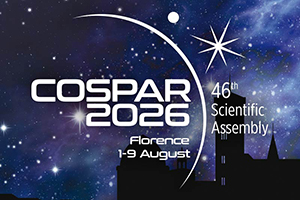
Includes ~150 meetings covering the fields of COSPAR Scientific Commissions / Panels / Task Groups, such as SC B: The Earth-Moon System, Planets, and...
At the Palais des Nations and online. Outer space is entering a renewed phase of strategic importance, defined by rapid innovation, growing competition and deepening...
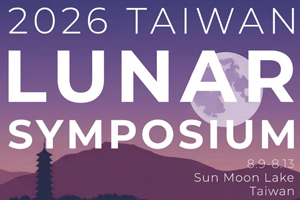
This international lunar science meeting has two objectives: to provide a platform for leading experts to review recent advances across lunar research, from the...
At CSIR International Convention Centre. Key topics are Earth Observation, Developing Space Tourism, Space Supply Manufacturing. Cultural tours are offered.
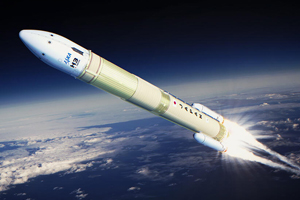
(No earlier than 10 Aug) Japan to launch the MICHIBIKI No. 7 | Quasi-Zenith Satellite System (QZS-7) navigation satellite. Launch window remains open through...
Participants will receive theoretical and hands-on training in electron imaging and X-ray spectroscopy for application to planetary samples. This training opportunity is targeted at...
"Leading Australia’s Space Future for Our Strategic Advantage". Southern Space 2026 brings together decision-makers who set the direction for Australia’s space sector. It is...
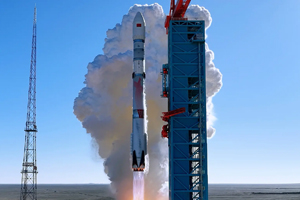
The second test launch of LandSpace's ZQ-3 rocket with undisclosed test payloads. Zhuque-3 first stage booster will attempt to land on its downrange landing...
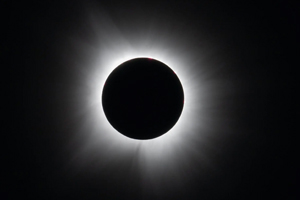
A total solar eclipse with a magnitude of 1.0386 (greatest eclipse 17:47:06 UTC) will be visible in parts of Greenland, Iceland, northern Russia, the Atlantic...
Includes presentation of the Neil Armstrong Award of Excellence, activities for the new class of Astronaut Scholars, 2-day Technical Conference where Scholars present their...
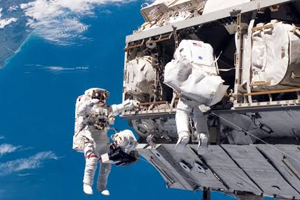
During U.S. spacewalk 97, two astronauts will replace a Space-to-Ground antenna on the orbital complex. The antenna is a critical communication system NASA uses...
Key themes include: Characterizing exoplanet-host solar-like stars; Star-planet interactions; Planet populations around solar-like stars. At University of Liège.
 Melbourne, Australia will host the 17th session of the Asia-Pacific Regional Space Agency Forum (APRSAF-17) on November 23-26. Sponsored by the Australian Government, JAXA and MEXT, this year’s event will focus on the theme: “The role of space technology and industry in addressing climate change.” Space agencies, governmental bodies and international organizations (such as the United Nations) as well as companies, universities and research institutes from over 30 regional participants will take part in the largest space-related conference in the Asia-Pacific region. Days 1 and 2 will include parallel sessions for 4 working groups: Earth Observation, Communication Satellite Application, Space Education and Awareness and Space Environment Utilization. During the plenary session, status reports will be provided for the Sentinel Asia, Satellite Applications For Environment (SAFE) and Satellite Technology for the Asia-Pacific Region (STAR) projects. Pictured: APRSAF-17 co-chairs Michael Green (BR) of the Australia Government’s Innovation and Space Branch, Tetsuhiko Ikegami (BL) of MEXT. (Credit: APRSAF)
 On November 23, the Dutch Space Based Solar Power (SBSP) Consortium will sponsor an SBSP workshop in Haarlem, Netherlands. The Consortium, made up of Dutch companies TNO Industry & Techniek, Dutch Space, Ecofys, Altran, JIVE and ECN, will provide a forum for participants to discuss SBSP as a potential business for the Dutch market as well as survey partnerships with the international space community to advance renewable energy sources. The event will focus on the key role of the Dutch technological market in the field of solar PV and receiver / transmitter technology. Presentations will be given by ECN Director Wim Sinke (BR) and Space Horizon President Arno Wielders (TL). With the world energy usage projected to increase 87% by 2035, the need to develop alternative energy sources will be inevitable. However, harvesting solar energy from space still poses a challenge since converting beamed energy from space into electricity in a power grid has not been successfully demonstrated. (Credit: Space Horizon, JIVE, Altran, ECN, Dutch Space, TNO, growth5, cleartechnica)
 = All times for terrestrial events in local time unless noted.
 = All times for international terrestrial events in local time unless noted.
 = All times for space events, and…
 = All times for international space / astro events in Hawaii Standard Time unless noted. Add 10 hours to obtain UT (‘Universal Time;’ Greenwich, England).
 Nov 22 — International Space Station, LEO: E-25 crew members Cmdr Doug Wheelock and flight engineers Shannon Walker and Fyodor Yurchikhin continue last minute preparations for their return to Earth on board a Soyuz TMA-19 spacecraft Nov 25 at 23:46 EST.