Europe Conferences Hosted in Tartu, Vienna, Berlin; Launch of Vega Set for April 28
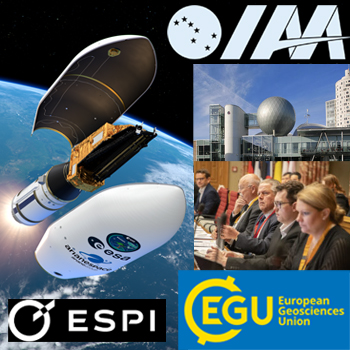
Estonia is 2025 chair of the European Interparliamentary Space Conference themed Security in Space: Europe’s Challenges and Opportunities. The Annual Workshop is April 27-29 in Tartu, which is the science and research capital, and location of an ESA Business Incubation Center. The Workshop includes a visit to Estonia’s largest astronomical observatory, Tõravere. Vienna, Austria hosts European Geosciences Union General Assembly April 27 to May 2. Programs include Bernard Foing, Executive Director of ILEWG, presenting on Payloads for Future Moon and Mars Missions. A team from China discusses Scientific discoveries of China’s Lunar and Deep Space exploration program: Chang’e missions to the Moon, Tianwen-1 to Mars, and beyond, a comprehensive look at aspects of lunar and deep space exploration missions developed by CNSA, with focus on the Chang’E series to the Moon. Posters include: Geologic Moon maps; The lunar radiation environment and its constraint for crewed missions to the Moon; and Possibility of Creating Artificial Rain on the Moon. May 4-8 in Berlin, Germany, is the International Academy of Astronautics 15th Symposium on Earth-observing satellites. The organizing committee represents 16+ countries. Presentations include Earth-Moon navigation, mapping the Moon and the SER3NE Moon mission. Arianespace will launch its 35m, 210-tonnes Vega-C rocket from French Guiana on April 28 to carry Biomass spacecraft for ESA with its 900km of gold-coated molybdenum 25µm wire. (Image credits: Arianespace, IAA, ESPI, EGU, AHHAA Science Centre Tartu)
MONDAY
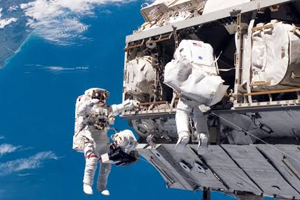
☆Apr 28 — International Space Station, ~415-km LEO: Expedition 73 seven-member crew consisting of JAXA’s Onishi Takuya as Commander, 3 Cosmonauts and 3 NASA Astronauts are working with ~3,000 kg of experiments and supplies from newly arrived Dragon cargo craft, including live microscopy images of cells for potential treatment of muscle atrophy and osteoporosis, and a project for inhibiting biofilm; 6.5-hour EVA is scheduled Thursday with Anne McClain and Nichole Ayers installing new external solar array and relocating an antenna.
☆Apr 28 — Tiangong Space Station, ~390-km LEO: Beginning 6-month stay, are Shenzhou 20 three-member crew: Commander Chen Dong on his 3rd flight to the station, and Jie Wang & Zhongrui Chen on their first; this mission marks 9th crew for Tiangong and will install external space debris shielding and hold science lectures; Shenzhou 19 Taikonaut trio Cai Xuzhe, Song Lingdong and Wang Haoze returning to Earth April 29 after 175 days in space.
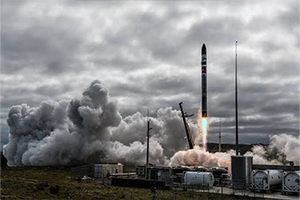
☆ Apr 28 — Arianespace, Launch Vega-C / Biomass, Ariane Launch Area 1, Guiana Space Centre, French Guiana: ESA mission, satellite built by Airbus, reflector with gold-coated molybdenum wire from L3Harris.
★ Apr 28 — United Launch Alliance, Launch Atlas V551 / Project Kuiper (KA-01), SLC41, Cape Canaveral SFS FL: First launch for operational Kuiper satellites; planned to become a constellation of 3,276, in 98 orbital planes.
☾ Apr 28 — Moon: 4.7° NNW of Uranus, 15:00; 0.62° N of Pleiades, 22:00.
☆ Apr 28 — Venus: 3.7° N of Saturn, 14:00.
TUESDAY
☆ Apr 29 —Tiangong Space Station (TSS), ~390-kmLEO: Tianhe, first component of China TSS reaches 4 full years / enters 5th year in Space today, having launched on this day in 2021.
● = Terrestrial and o = International terrestrial events in local time; ☾ = Moon, ★ = Space and ☆ = International space events in Hawai’i time unless noted.
ULA to Launch First Operational Batch of 27 Kuiper Satellites NET April 28
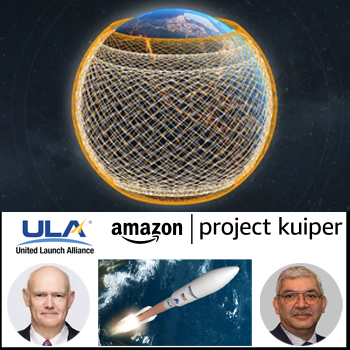
The inaugural launch of Project Kuiper operational satellites is set for April 28 from Cape Canaveral SFS Launch Complex 41, Florida aboard the United Launch Alliance Atlas V 551. This mission, designated Kuiper KA-01, will deploy 27 satellites into LEO, ~450 km altitude. Launch cost is estimated to be US$153M. The project was initially referred to by codename “Kuiper” and is inspired by the Kuiper Belt, highlighting its ambition to provide internet to ‘far away’ places that currently have no access. Owned by Kuiper Systems LLC (a subsidiary of Amazon) the project is aiming for an internet constellation of 3,276 satellites to be arranged in 98 orbital planes across three altitudes at 590 km, 610 km, and 630 km. SpaceX Starlink mega constellation has 7,135 satellites in orbit so far, and aims to deploy nearly 12,000. Two Kuiper prototype satellites were launched in October 2023 aboard an Atlas V. SpaceX Falcon 9, ULA Vulcan Centaur and ESA Ariane 6 will be utilized for future launches alongside Atlas V. The expendable Atlas V 551 has had 14 successful launches and 0 failed attempts to date. Space Launch Complex 41 has seen 114 launches. The total launches from Cape Canaveral are now over 1,000. (Pictured: ULA CEO Tory Bruno (left), Kuiper Systems President Rajeev Badyal; Image Credits: Kuiper Systems LLC, ULA, OneWeb).
☆ NET Apr — Gilmour Space, Launch Eris Block 1 / Test flight, Eris Pad, Bowen Orbital Spaceport, Queensland, Australia: First flight of 3-stage orbital rocket to deliver up to ~300 kg to LEO; first launch from Bowen Spaceport.
● Apr 29 — American Institute of Aeronautics and Astronautics Los Angeles Section, Hawthorne CA:Young (Early Career) Professionals Mixer; at Los Angeles Ale Works, 17:30-20:00 PDT.
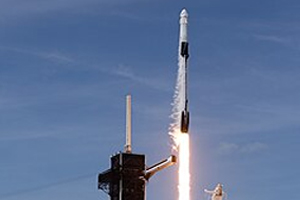
★ Apr 30 — SpaceX,Launch Falcon 9 / Starlink Group 6-75,SLC-40, Cape Canaveral SFS FL: Next batch of Starlink satellites to launch for mega-constellation.
o Apr 30 — European Space Agency, Online: Applications Due: ESA Archival Research Visitor Programme; welcomes applications from scientists interested in pursuing research projects based on ESA Space Science Archives data.
☆May 1 — International Space Station, U.S. EVA #93, ~415-km LEO: NASA Astronauts Anne McClain and Nichole Ayers to perform 6.5-hour spacewalk to install a new solar array and relocate an antenna, starts 08:00 EDT, live coverage available.
☆ May 1 — Deep Space, Jupiter orbit: NASA scientists have reestablished contact with Spacecraft Juno, bringing it out of safe mode established during 71st flyby, ahead of May 7 flyby of Jupiter and its moon Io.
★ May 1 — SpaceX, Launch Falcon 9 / Starlink Group 15-3, SLC-4E, Vandenberg SFB CA: Batch of satellites for Starlink mega-constellation space-based Internet communication system.
☾ May 1 — Moon: 4.2° N of M35 cluster, 02:00.
☆ May 1 — Asteroid 4 Vesta: At opposition in longitude, magnitude 5.6, 02:00.
☆ May 1 — Aten Asteroid 2024 BF: Near-Earth Flyby (0.024 AU)
FRIDAY
● May 2 — Maryland Space Business Roundtable,Greenbelt MD:MSBR 28th Annual Gala; celebrating talents and accomplishments to support STEM.
o May 2 — International Space Day 2025, Worldwide: First Friday in May, events and presentations to promote STEM education and inspire people to continue the work of Space explorers; originally began as ‘National Space Day’ in 1997 by Lockheed Martin Corp.
☾ May 2 — Moon: 5.4° S of Castor, 09:00; 2.14° S of Pollux, 15:00.
● May 3 — Maunakea Observatories, Maunakea Astronomy Outreach Committee, Hilo, Hawai’i Island HI:AstroDay 2025; activities and exhibits at Prince Kuhio Mall, 10:00-16:00 HST.
☾ May 3 — Moon: 1.99° NNE of Mars, 15:00; 2.60° NNE of Beehive Cluster, 17:00.
☆ May 3 — Venus: 2.03° N of Neptune, 05:00.
☆ May 3 — Aten Asteroid 2024 JM2: Near-Earth Flyby (0.018 AU)
At the Spokane Convention Center. The meeting will have a broad scope, with a wide-ranging program of science and workforce topics, and celebrating planetary...
Convene, connect, and collaborate at the 19th annual von Braun Space Exploration Symposium! This year’s event will spotlight how bold ideas, emerging technologies, and...
Themes include: Space & the Arctic; Space & AI; Space & International Collaboration. There is a Student Session, a Technical Session, a Frontier Session,...
Oslo Spaceport Norway offers monthly a knowledgeable speaker and opportunity for networking, 17:00-20:00 local time; free entry but registration required. Ground Control is for...
45 satellites to launch for Amazon Leo, formerly named Project Kuiper. This LEO mega constellation will offer broadband internet access with 3,276 satellites.
Occurring 31 October from 09:00-11:00 local time (16:00-18:00 HST, 19:00-21:00 PDT, 22:00-24:00 EDT on 30 October), this Galaxy Forum will be in hybrid format...
Originally planned around this date for Wenchang, China -- TBC (to be confirmed); As the only professional association for astronauts, ASE supports the advancement of...
Coordinating Division Division C Education, Outreach and Heritage The IAU Symposium on Innovative Research and Techniques in Astronomy Communication will take place from November...
Change clocks back 1 hour from Daylight Saving to Standard Time; does not include Hawai’i, Arizona (except the Navajo Nation), American Samoa, Guam, Northern...
ESWW is the main annual event in the European Space Weather and Space Climate calendar. It is an international meeting organised annually within the...
IAU Symposium: IAUS409 - A Journey Towards Effective Astronomy Communication; online and at National Astronomical Observatory of Japan, 2-21-2 Osawa Mitaka, Tokyo. Topics include:...
Launch Complex 1, ~39°S, Mahia Peninsula, New Zealand
iQPS Launch 9, an Earth observation satellite with Synthetic aperture radar for Japan-based imaging company iQPS, to launch on "The Sea God Surveys" mission...
Launch window 10:34am - 2:34pm local time for the 15th batch of classified satellites for a reconnaissance constellation built by SpaceX and Northrop Grumman...