The international space community will converge at several events in an effort to advance space initiatives in Europe. On March 31 – April 1, the United Kingdom Students for the Exploration and Development of Space (UKSEDS) will hold the ‘24th UKSEDS Annual 2012 Conference’ in Kent UK. SEDS, the world’s largest student space organization, currently has more than 60 branches worldwide. This year’s event will feature 2 days of talks ranging from astrobiology and space planes to space settlement and rockets. Representatives from various space industries will be on hand to offer potential graduate jobs, internships and postgraduate research. On Mar 27-30, The Royal Astronomical Society along with the German Astronomical Society will hold the ‘2012 National Astronomy Meeting’ at the University of Manchester. Over 600 participants are expected to attend the event which will feature 290 posters and 469 talks. Plenary lectures will be given by University of Colorado Professor Fran Bagenal (CR) on ‘Probing the Interior of Jupiter: NASA’s Juno Mission,’ and Max Planck Institute Scientist Michael Kramer on ‘The Square Kilometer Array.’ The British Interplanetary Society and West England Metals and Materials Association will host a talk on Mar 28 on ‘SKYLON – The Materials Challenge.’ Speaker Mark Hempsell (BR) from Reaction Engines Ltd will discuss the SKYLON (B) vision, a fully reusable spaceplane that can carry 15 tonnes of cargo to space NET 2020. (Image Credit: UKSEDS, BIS, RAS, wn.com, jimmydoolitlemuseum.org)
A Spring of Innovation Comes to California, USA
Three innovation focused events kick off in California, starting with the NASA Innovative Advanced Concepts program 1st annual Spring Symposium in Pasadena, on March 27-29. NIAC funds research on visionary ideas with potential to create radically better or entirely new aerospace concepts. Keynote speakers are: Gentry Lee, Chief Engineer for the Solar System Exploration Directorate at JPL, and renowned author David Brin who will present on “Looking Upward – The Most Human Trait.” Other topics by Phase I Fellows include: Ultra-Light “Photonic Muscle” Space Structures, Regolith Derived Heat Shield for a Planetary Body Entry and Descent System with In-Situ Fabrication, and Entanglement-assisted Communication System for Deep-Space Missions. SpaceUp San Francisco on March 31 – April 1 is the latest “unconference” where participants spontaneously decide the topics, schedule and structure of the event. Organizers hope to engage the space community with innovators among the local culture of hackers, makers, artists, entrepreneurs and internet pros. The Innovation Summit at Ames Research Center on March 28-31 represents the culmination of Conrad Foundation’s Spirit of Innovation Challenge. Leading entrepreneurs, government officials and scientists will join top student innovators in a collaborative social forum to help build progressive technologies and foster next-generation professionals. (Image Credit: NIAC, SpaceUp SF, Conrad Foundation)
= All times for terrestrial events in local time unless noted.
= All times for international terrestrial events in local time unless noted.
= All times for space events, and…
= All times for international space / astro events in Hawaii Standard Time unless noted. Add 10 hours to obtain UT (‘Universal Time;’ Greenwich, England).
Weekly Planet Watch – Morning Planets: Saturn (S) / Evening Planets: Mercury (W), Venus (W), Mars (S), Jupiter (W).
MONDAY
Mar 26 — International Space Station, LEO: E-30 crew members begin preparations for docking /unloading of 20-ton cargo freighter, ‘Edoardo Amaldi’ due to arrive Wed; Mission will be heaviest load of cargo ever delivered to the ISS by an Ariane 5 rocket.
Mar 26 — Lunar Reconnaissance Orbiter (LRO), Lunar Orbit: NASA LRO functioning nominally in its 50±15 km near-circular orbit as it makes digital elevation and surface maps that will be a fundamental reference for future human exploration.
Mar 26 — Mars Science Laboratory (MSL), Red Planet: Scientists to conduct MSL Trajectory Correction Maneuver #2 (TCM-2).
Mar 26 — Jupiter Juno Mission, In Transit to Jupiter: Juno spacecraft completes 234th day of mission as it continues long journey to Jupiter.
NET Mar 27 — ILS, Launch Proton / Intelsat 22, Baikonur Cosmodrome, Kazakhstan: An ILS Proton rocket with a Breeze M upper stage set to deploy the Intelsat 22 satellite to provide C-band and Ku-band communications services over Africa, Asia, Europe and the Middle East.
Mar 27-28 — The SMi Group, Vienna, Austria: ‘6th MilSpace 2012,’ participants to discuss interoperability, national space programs and space situational awareness.
Mar 28 — NASA Headquarters, Washington DC: ‘NASA Technology: Imagine. Innovate. Explore,’ event to feature talk by NASA Administrator Charles Bolden and NASA Deputy Administrator Lori Garver; Attendees to discuss traveling in space with Astronauts Mike Massimino and Mike Good.
Mar 28-31 — Conrad Foundation, Ames Research Center, Moffett Field CA: ‘Innovation Summit 2012.’
THURSDAY
NET Mar 29 — ULA, Launch Delta 4 – Heavy / NROL 25, Vandenberg Air Force Base CA: A ULA Delta 4 rocket set to launch a classified payload for the National Reconnaissance Office.
Mar 31 – Apr 1 — United Kingdom Students for the Exploration and Development of Space (UKSEDS), Kent, United Kingdom: ‘UKSEDS 2012 Conference.’
Mar 31 — Moon: 10.4° SSW of Pollux; 10:00.
SUNDAY
Apr 1 — NASA Kepler Mission, Exoplanets: Scientists confirm 709 exoplanets and 2,321 exoplanet candidates, bringing total number of exoplanets to 3030.
Apr 1 — Moon: 5.8° SSW of Beehive Cluster; 12:00.
Apr 1 — Asteroid 2008 CH70: Near-Earth Flyby (0.087 AU).
Includes ~150 meetings covering the fields of COSPAR Scientific Commissions / Panels / Task Groups, such as SC B: The Earth-Moon System, Planets, and...
At the Palais des Nations and online. Outer space is entering a renewed phase of strategic importance, defined by rapid innovation, growing competition and deepening...
This international lunar science meeting has two objectives: to provide a platform for leading experts to review recent advances across lunar research, from the...
At CSIR International Convention Centre. Key topics are Earth Observation, Developing Space Tourism, Space Supply Manufacturing. Cultural tours are offered.
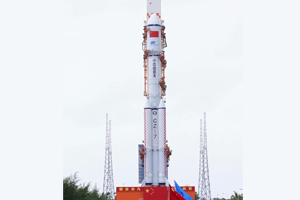
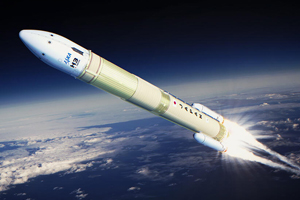
(No earlier than 10 Aug) Japan to launch the MICHIBIKI No. 7 | Quasi-Zenith Satellite System (QZS-7) navigation satellite. Launch window remains open through...
Participants will receive theoretical and hands-on training in electron imaging and X-ray spectroscopy for application to planetary samples. This training opportunity is targeted at...
"Leading Australia’s Space Future for Our Strategic Advantage". Southern Space 2026 brings together decision-makers who set the direction for Australia’s space sector. It is...
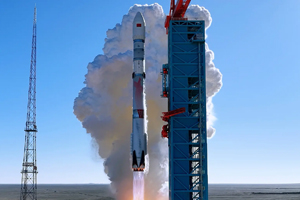
The second test launch of LandSpace's ZQ-3 rocket with undisclosed test payloads. Zhuque-3 first stage booster will attempt to land on its downrange landing...
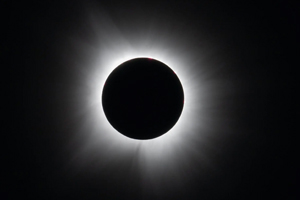
A total solar eclipse with a magnitude of 1.0386 (greatest eclipse 17:47:06 UTC) will be visible in parts of Greenland, Iceland, northern Russia, the Atlantic...
Includes presentation of the Neil Armstrong Award of Excellence, activities for the new class of Astronaut Scholars, 2-day Technical Conference where Scholars present their...
During U.S. spacewalk 97, two astronauts will replace a Space-to-Ground antenna on the orbital complex. The antenna is a critical communication system NASA uses...
Key themes include: Characterizing exoplanet-host solar-like stars; Star-planet interactions; Planet populations around solar-like stars. At University of Liège.
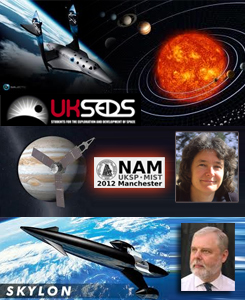 The international space community will converge at several events in an effort to advance space initiatives in Europe. On March 31 – April 1, the United Kingdom Students for the Exploration and Development of Space (UKSEDS) will hold the ‘24th UKSEDS Annual 2012 Conference’ in Kent UK. SEDS, the world’s largest student space organization, currently has more than 60 branches worldwide. This year’s event will feature 2 days of talks ranging from astrobiology and space planes to space settlement and rockets. Representatives from various space industries will be on hand to offer potential graduate jobs, internships and postgraduate research. On Mar 27-30, The Royal Astronomical Society along with the German Astronomical Society will hold the ‘2012 National Astronomy Meeting’ at the University of Manchester. Over 600 participants are expected to attend the event which will feature 290 posters and 469 talks. Plenary lectures will be given by University of Colorado Professor Fran Bagenal (CR) on ‘Probing the Interior of Jupiter: NASA’s Juno Mission,’ and Max Planck Institute Scientist Michael Kramer on ‘The Square Kilometer Array.’ The British Interplanetary Society and West England Metals and Materials Association will host a talk on Mar 28 on ‘SKYLON – The Materials Challenge.’ Speaker Mark Hempsell (BR) from Reaction Engines Ltd will discuss the SKYLON (B) vision, a fully reusable spaceplane that can carry 15 tonnes of cargo to space NET 2020. (Image Credit: UKSEDS, BIS, RAS, wn.com, jimmydoolitlemuseum.org)
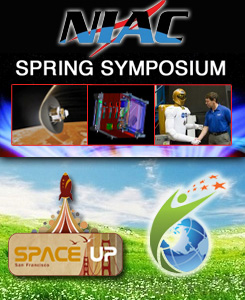 Three innovation focused events kick off in California, starting with the NASA Innovative Advanced Concepts program 1st annual Spring Symposium in Pasadena, on March 27-29. NIAC funds research on visionary ideas with potential to create radically better or entirely new aerospace concepts. Keynote speakers are: Gentry Lee, Chief Engineer for the Solar System Exploration Directorate at JPL, and renowned author David Brin who will present on “Looking Upward – The Most Human Trait.” Other topics by Phase I Fellows include: Ultra-Light “Photonic Muscle” Space Structures, Regolith Derived Heat Shield for a Planetary Body Entry and Descent System with In-Situ Fabrication, and Entanglement-assisted Communication System for Deep-Space Missions. SpaceUp San Francisco on March 31 – April 1 is the latest “unconference” where participants spontaneously decide the topics, schedule and structure of the event. Organizers hope to engage the space community with innovators among the local culture of hackers, makers, artists, entrepreneurs and internet pros. The Innovation Summit at Ames Research Center on March 28-31 represents the culmination of Conrad Foundation’s Spirit of Innovation Challenge. Leading entrepreneurs, government officials and scientists will join top student innovators in a collaborative social forum to help build progressive technologies and foster next-generation professionals. (Image Credit: NIAC, SpaceUp SF, Conrad Foundation)
 = All times for terrestrial events in local time unless noted.
 = All times for international terrestrial events in local time unless noted.
 = All times for space events, and…
 = All times for international space / astro events in Hawaii Standard Time unless noted. Add 10 hours to obtain UT (‘Universal Time;’ Greenwich, England).
 Mar 26 — International Space Station, LEO: E-30 crew members begin preparations for docking /unloading of 20-ton cargo freighter, ‘Edoardo Amaldi’ due to arrive Wed; Mission will be heaviest load of cargo ever delivered to the ISS by an Ariane 5 rocket.