The International Space Station is set for approval by USA and Russia for a 4-year extension through 2024, with potential life-span out to 2028. ISS “1.0”, a US$100-B project requiring over 100 launches, 13 years and 160 spacewalks to build, has fallen short of its original design purpose as staging platform for human exploration sorties to the Moon, Mars and beyond. Key to future evolution of space station development are commercial partners such as SpaceX with its multipurpose Dragon spacecraft, Orbital Sciences with its Cygnus cargo transport and Bigelow Aerospace with its inflatable space habitats. The Bigelow Expandable Activity Module (BEAM) launches on SpaceX CRS-8 Falcon 9 in 2015 to the ISS for 2 years of orbital testing and experimental use. ISS Program Director Sam Scimemi emphasized that “if we are going to do anything as it relates to deep space exploration… we need a healthy, viable and sustainable station.” China is conducting the independent Tiangong series of space laboratory missions working toward a permanently crewed 3-person space station in the 2020-2022 time frame. The intention is to coincide with initial operations of the proposed Orbital Piloted Assembly and Experiment Complex in development by Russia. This would re-purpose modules from the Russian Orbital Segment of the ISS into a new facility capable of on-orbit component assembly and support of crewed interplanetary spacecraft. (Image Credit: NASA, CNSA, Bigelow)
Investigating Planets, Satellites, Icy Worlds in the Solar System and Beyond
Earth, Solar System and Extrasolar Planet experts meet at various conferences around the globe this week. The ‘Workshop on the Habitability of Icy Worlds’ hosted by Lunar and Planetary Institute and USRA in Pasadena CA February 5-7 will focus on the astrobiological potential of Europa, Ganymede, Enceladus, Titan, Uranus, Neptune and the Kuiper Belt. During the ‘Continuing and Future Outer Solar System Exploration’ session David Senske (L) will discuss advancing our understanding of icy world habitability with the Europa Clipper mission, Michele Bannister (C) will present information on finding new icy worlds with CFHT Outer Solar System Origins Survey, and Kostas Konstantinidis (R) will detail DLR funded projects to develop a submersible for Europa and a melting probe for Enceladus. Scientists from LPI, MIT, JPL, JHU/APL, among others review Vesta data collected by the Dawn spacecraft (en route to Ceres arriving ~Feb 2015) during ‘Vesta in the Light of Dawn’ on Feb 3-4 in Houston TX. The ‘Exoclimes III’ conference in Davos, Switzerland Feb 9-14 covers planetary atmospheres of Venus, Mars, Earth, Jupiter, Saturn and configurations unknown in the Solar System – exo-atmospheres such as iron clouds and silicate rains. In Garching, Germany ‘Exoplanet Observations with the E-ELT’ explores the planned capabilities of the European Extremely Large Telescope on Feb 3-6. (Image Credit: LPI, USRA, ESO, UE, NASA, S. Wiessinger, Icarus Interstellar)
= All times for terrestrial events in local time unless noted.
= All times for international terrestrial events in local time unless noted.
= All times for space events, and…
= All times for international space / astro events in Hawaii Standard Time unless noted. Add 10 hours to obtain UT (‘Universal Time;’ Greenwich, England).
Feb 3 — ISS, LEO: Expedition 38 preparing for arrival of Progress 54P resupply ship; Monitor of All-sky X-ray Image (MAXI) sensors scanning entire sky 16 times per day as station orbits Earth.
Feb 3 — ISS, LEO: Progress 52P resupply vehicle undocking scheduled 16:21 UT, live coverage available; will burn up upon Earth atmosphere reentry.
Feb 3 — Tiangong-1, LEO: Laboratory performance being tested remotely; acquiring data in narrow, adjacent spectral bands with hyperspectral imager and images of Earth with 2 observation cameras.
Feb 3 — NuSTAR, LEO: Observations planned for stellar explosion / supernova SN 2014J which occurred Jan 21 in galaxy M82 about 12M light years away.
Feb 3 — Curiosity, KMS-9 Trajectory, Mars: Approaching ‘Dingo Gap’ from southeast, science team evaluating smoothest route to next drilling site ‘KMS-9’ about 800 meters away.
Feb 3 — SpaceX, Hawthorne CA: NewSpace company manufacturing rocket / spacecraft necessary to perform abort system tests of Dragon capsule in preparation for 2015 human spaceflight.
Feb 3 — Waypoint 2 Space,Houston TX:Will utilize Johnson Space Center to provide orbital & suborbital spaceflight training programs for commercial space industry this spring.
Feb 3 — zero2infinity S.L.,Cerdanyola del Vallès, Spain: Planning to begin crewed test flights of bloon near-space ship (36 km) this year to qualify pod and life support system.
Feb 1 – Dec 31 — Stratospheric Observatory for Infrared Astronomy (SOFIA),Multiple Locations: Cycle 2 of science flights to observe universe consists of 47 science flights grouped into multi-week observing campaigns totaling about 350 research flight hours.
Feb 5 — RSA, Launch Soyuz / Progress 54P, Baikonur Cosmodrome, Kazakhstan: An RSA Soyuz rocket set to launch 54th Progress cargo ship to ISS 22:23 local time; set to dock 6 hours later; live coverage available for both events.
Feb 5-7 — Lunar and Planetary Institute, USRA,Pasadena CA: Workshop on the Habitability of Icy Worlds; to discuss Jupiter & Saturn satellites, icy worlds of Uranus & Neptune, Kuiper Belt & beyond, Cassini, Europa Clipper study, JUICE, future of outer Solar System exploration.
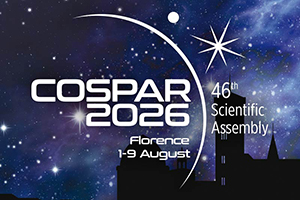
Includes ~150 meetings covering the fields of COSPAR Scientific Commissions / Panels / Task Groups, such as SC B: The Earth-Moon System, Planets, and...
From 02 to 07 August 2026, a few thousand geoscientists across diverse disciplines will gather at the 23rd annual meeting of the Asia Oceania Geosciences...
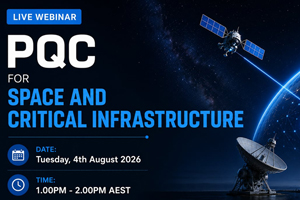
Virtual Series 2026 will offer deeper conversations on why PQC matters and the practical steps businesses should be taking; starts 1:00 pm AEST. Featuring:...
This international lunar science meeting has two objectives: to provide a platform for leading experts to review recent advances across lunar research, from the...
At CSIR International Convention Centre. Key topics are Earth Observation, Developing Space Tourism, Space Supply Manufacturing. Cultural tours are offered.
Participants will receive theoretical and hands-on training in electron imaging and X-ray spectroscopy for application to planetary samples. This training opportunity is targeted at...
"Leading Australia’s Space Future for Our Strategic Advantage". Southern Space 2026 brings together decision-makers who set the direction for Australia’s space sector. It is...
A total solar eclipse with a magnitude of 1.0386 (greatest eclipse 17:47:06 UTC) will be visible in parts of Greenland, Iceland, northern Russia, the Atlantic...
Includes presentation of the Neil Armstrong Award of Excellence, activities for the new class of Astronaut Scholars, 2-day Technical Conference where Scholars present their...
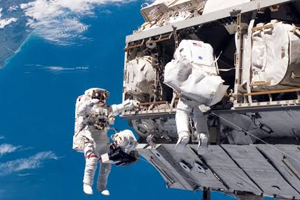
During U.S. spacewalk 97, two astronauts will replace a Space-to-Ground antenna on the orbital complex. The antenna is a critical communication system NASA uses...
Key themes include: Characterizing exoplanet-host solar-like stars; Star-planet interactions; Planet populations around solar-like stars. At University of Liège.
India orbiter surpasses another full year in lunar polar orbit since reaching the Moon in 2019; Chandrayaan-2 lander and rover were unsuccessful in lunar...
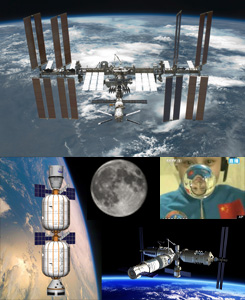 The International Space Station is set for approval by USA and Russia for a 4-year extension through 2024, with potential life-span out to 2028. ISS “1.0”, a US$100-B project requiring over 100 launches, 13 years and 160 spacewalks to build, has fallen short of its original design purpose as staging platform for human exploration sorties to the Moon, Mars and beyond. Key to future evolution of space station development are commercial partners such as SpaceX with its multipurpose Dragon spacecraft, Orbital Sciences with its Cygnus cargo transport and Bigelow Aerospace with its inflatable space habitats. The Bigelow Expandable Activity Module (BEAM) launches on SpaceX CRS-8 Falcon 9 in 2015 to the ISS for 2 years of orbital testing and experimental use. ISS Program Director Sam Scimemi emphasized that “if we are going to do anything as it relates to deep space exploration… we need a healthy, viable and sustainable station.” China is conducting the independent Tiangong series of space laboratory missions working toward a permanently crewed 3-person space station in the 2020-2022 time frame. The intention is to coincide with initial operations of the proposed Orbital Piloted Assembly and Experiment Complex in development by Russia. This would re-purpose modules from the Russian Orbital Segment of the ISS into a new facility capable of on-orbit component assembly and support of crewed interplanetary spacecraft. (Image Credit: NASA, CNSA, Bigelow)
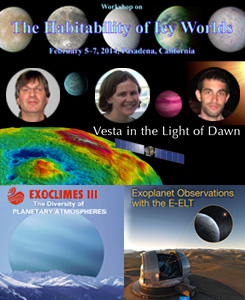 Earth, Solar System and Extrasolar Planet experts meet at various conferences around the globe this week. The ‘Workshop on the Habitability of Icy Worlds’ hosted by Lunar and Planetary Institute and USRA in Pasadena CA February 5-7 will focus on the astrobiological potential of Europa, Ganymede, Enceladus, Titan, Uranus, Neptune and the Kuiper Belt. During the ‘Continuing and Future Outer Solar System Exploration’ session David Senske (L) will discuss advancing our understanding of icy world habitability with the Europa Clipper mission, Michele Bannister (C) will present information on finding new icy worlds with CFHT Outer Solar System Origins Survey, and Kostas Konstantinidis (R) will detail DLR funded projects to develop a submersible for Europa and a melting probe for Enceladus. Scientists from LPI, MIT, JPL, JHU/APL, among others review Vesta data collected by the Dawn spacecraft (en route to Ceres arriving ~Feb 2015) during ‘Vesta in the Light of Dawn’ on Feb 3-4 in Houston TX. The ‘Exoclimes III’ conference in Davos, Switzerland Feb 9-14 covers planetary atmospheres of Venus, Mars, Earth, Jupiter, Saturn and configurations unknown in the Solar System – exo-atmospheres such as iron clouds and silicate rains. In Garching, Germany ‘Exoplanet Observations with the E-ELT’ explores the planned capabilities of the European Extremely Large Telescope on Feb 3-6. (Image Credit: LPI, USRA, ESO, UE, NASA, S. Wiessinger, Icarus Interstellar)
 = All times for terrestrial events in local time unless noted.
 = All times for international terrestrial events in local time unless noted.
 = All times for space events, and…
 = All times for international space / astro events in Hawaii Standard Time unless noted. Add 10 hours to obtain UT (‘Universal Time;’ Greenwich, England).