United Nations Hosting Multiple Space Related Events in Vienna
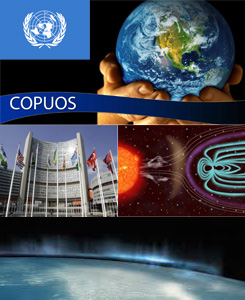
The Scientific and Technical Subcommittee of the Committee on the Peaceful Uses of Outer Space holds its 51st session February 10-21 at the UN Office in Vienna, Austria. The provisional program includes sections on space debris, space-system-based disaster management, global navigation satellite systems, space weather, near-Earth objects, use of nuclear power sources in outer space and long-term sustainability of outer space activities. Elöd Both of Hungary has been nominated to Chair the Subcommittee which comprises representatives from 76 Member States. A number of related events are being held in conjunction with the 51st UN COPUOS session including an Expert Meeting on Improving Space Weather Forecasting in the Next Decade co-hosted by the International Space Weather Initiative on Feb 10-11. ISWI is actively promoting installation of new ground-based instrumentation in non-traditional locations and making substantial progress in observations of equatorial ionosphere, solar transients and energetic particles. International Living with a Star program works to coordinate plans of World space agencies for missions related to space weather – an inherently international enterprise with global implications. There is also a UN Expert Meeting on International Space Station Benefits for Health on Feb 19-20. The focus is to identify space-proven health applications for the benefit of underserved populations on Earth. (Image Credit: UN, COPUOS, SOHO ESA/NASA)
25th Space Radiation Workshop Focuses on Human Space Flight
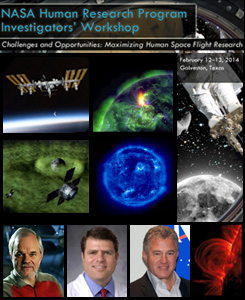
The 25th Annual NASA Space Radiation Investigators’ Workshop with the theme ‘Challenges and Opportunities: Maximizing Human Space Flight Research’ is set for February 11-13 in Galveston, Texas. Active researchers in the Space Radiation Program interact and share their results with scientists in the Human Research Program and discuss future program directions. Principal Investigators will give presentations under Human Research Program categories of Behavioral Health and Performance, Exploration Medical Capability, Human Health Countermeasures, Space Human Factors and Habitability, and Space Radiation. John Norbury (L) of Langley Research Center will chair 2 sessions on ‘Physics and Space Technology’ and David Kirsch (C) of Duke University will chair ‘New Investigations – Space Radiation.’ According to Dr. Cary Zeitlin, PI for the Martian Radiation Environment Experiment, the average yearly dose of galactic cosmic radiation (GCR) on Earth is 0.3 millisieverts (radiation from all sources equals 3.6 millisieverts). The average yearly GCR dose during cruise to / from Mars equals 657 millisieverts. Dr. James Logan (R) stresses “the standard approach just won’t cut it for extended missions beyond earth orbit… considerable strategic vision, innovation and resources [are required]… once these new realities are taken into account, where we should go, how we should get there and why do it at all will become more and more obvious.” (Image Credit: NASA, WPI, Duke Univ., Virtualastro, J. Logan)
= All times for terrestrial events in local time unless noted.
= All times for international terrestrial events in local time unless noted.
= All times for space events, and…
= All times for international space / astro events in Hawaii Standard Time unless noted. Add 10 hours to obtain UT (‘Universal Time;’ Greenwich, England).
Feb 10 — ISS, LEO: Expedition 38 transferring cargo from Cygnus (scheduled for demate / release Feb 18) & newly arrived Progress 54P with 2,584 kg of cargo; configuring hardware, positioning camera in Combustion Integrated Rack.
Feb 10 — LADEE, Moon Orbit: Will continue to monitor Moon dust / atmosphere until scheduled impact (likely Apr 21); science team analyzing data from Chang’e-3 landing, meteoroid showers, other variations.
Feb 10 — Mars Orbiter Mission (Mangalyaan), Mars Trajectory: India spacecraft operating nominally, will undergo 3 Trajectory Control Maneuvers heading toward Sep 22 orbital insertion.
Feb 10 — Blue Origin LLC, Kent WA: NewSpace company planning to review sub-scale propellant tank assembly and space vehicle subsystems designs for Orbital Launch Vehicle being developed for NASA CCiCAP.
Feb 10 — Astrobotic Technology Inc., Mojave CA: Testing Griffin lunar lander sensor package and software system on Masten Xombie suborbital rocket.
Feb 10 — Spacefleet Ltd, Wiltshire, United Kingdom: Developing prototype of EARL suborbital reusable launch vehicle, will have 3m-long hull, be powered by bi-liquid engines, able to reach 30-km altitude.
Feb 11 — Moon: At apogee (distance 405,768 km), 19:00; 11.7° S of Pollux, 20:00.
Feb 11 — Asteroid 2013 BS45: Near-Earth flyby (0.016 AU).
Feb 11 — Asteroid 2014 BT43: Near-Earth flyby (0.025 AU).
WEDNESDAY
Feb 12 — Oregon L5 Society, AIAA Pacific Northwest Section, Portland OR: Commercial Mining with a Lunar Elevator; presented by Liftport Group adviser Charles Radley at Midland Library, 18:00 PST.
Feb 12-14 — South California Center for Galaxy Evolution, University of California High-Performance AstroComputing Center, Irvine CA: The Near-Field Deep-Field Connection.
Feb 14 — NASA HQ, Solar System Exploration Research Virtual Institute, Online / Washington DC:Asteroid Grand Challenge: Virtual Seminar Series; David Morrison speaks on History of impacts research and planetary defense, 11:00 EST.
Feb 14 — Space Center Houston, Houston TX:Lunch with an Astronaut, Brian Duffy; US$49.95 adult.
Feb 14 — Moon: Full (Snow Moon), 13:54; 4.8° SSW of Regulus, 22:00.
SATURDAY
Feb 15 — International Launch Services, Launch Proton / Turksat 4A, Baikonur Cosmodrome, Kazakhstan: Proton rocket to deploy Turksat 4A communications satellite, at 03:09:03 local time.
Feb 15-16 — Auckland University of Technology, SpaceUp, KiwiSpace Foundation, Auckland,New Zealand:SpaceUp New Zealand; featuring Astronaut Akihiko Hoshide, Prof. Takashi Kubota (JAXA Hayabusa mission).
Feb 15 — Asteroid 2014 BQ43: Near-Earth flyby (0.055 AU).
Includes ~150 meetings covering the fields of COSPAR Scientific Commissions / Panels / Task Groups, such as SC B: The Earth-Moon System, Planets, and...
From 02 to 07 August 2026, a few thousand geoscientists across diverse disciplines will gather at the 23rd annual meeting of the Asia Oceania Geosciences...
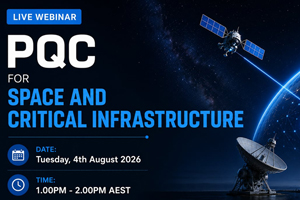
Virtual Series 2026 will offer deeper conversations on why PQC matters and the practical steps businesses should be taking; starts 1:00 pm AEST. Featuring:...
This international lunar science meeting has two objectives: to provide a platform for leading experts to review recent advances across lunar research, from the...
At CSIR International Convention Centre. Key topics are Earth Observation, Developing Space Tourism, Space Supply Manufacturing. Cultural tours are offered.
Participants will receive theoretical and hands-on training in electron imaging and X-ray spectroscopy for application to planetary samples. This training opportunity is targeted at...
"Leading Australia’s Space Future for Our Strategic Advantage". Southern Space 2026 brings together decision-makers who set the direction for Australia’s space sector. It is...
A total solar eclipse with a magnitude of 1.0386 (greatest eclipse 17:47:06 UTC) will be visible in parts of Greenland, Iceland, northern Russia, the Atlantic...
Includes presentation of the Neil Armstrong Award of Excellence, activities for the new class of Astronaut Scholars, 2-day Technical Conference where Scholars present their...
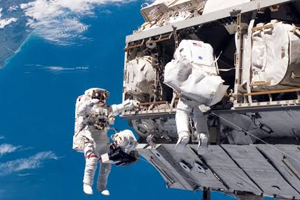
During U.S. spacewalk 97, two astronauts will replace a Space-to-Ground antenna on the orbital complex. The antenna is a critical communication system NASA uses...
Key themes include: Characterizing exoplanet-host solar-like stars; Star-planet interactions; Planet populations around solar-like stars. At University of Liège.
India orbiter surpasses another full year in lunar polar orbit since reaching the Moon in 2019; Chandrayaan-2 lander and rover were unsuccessful in lunar...
 The Scientific and Technical Subcommittee of the Committee on the Peaceful Uses of Outer Space holds its 51st session February 10-21 at the UN Office in Vienna, Austria. The provisional program includes sections on space debris, space-system-based disaster management, global navigation satellite systems, space weather, near-Earth objects, use of nuclear power sources in outer space and long-term sustainability of outer space activities. Elöd Both of Hungary has been nominated to Chair the Subcommittee which comprises representatives from 76 Member States. A number of related events are being held in conjunction with the 51st UN COPUOS session including an Expert Meeting on Improving Space Weather Forecasting in the Next Decade co-hosted by the International Space Weather Initiative on Feb 10-11. ISWI is actively promoting installation of new ground-based instrumentation in non-traditional locations and making substantial progress in observations of equatorial ionosphere, solar transients and energetic particles. International Living with a Star program works to coordinate plans of World space agencies for missions related to space weather – an inherently international enterprise with global implications. There is also a UN Expert Meeting on International Space Station Benefits for Health on Feb 19-20. The focus is to identify space-proven health applications for the benefit of underserved populations on Earth. (Image Credit: UN, COPUOS, SOHO ESA/NASA)
 The 25th Annual NASA Space Radiation Investigators’ Workshop with the theme ‘Challenges and Opportunities: Maximizing Human Space Flight Research’ is set for February 11-13 in Galveston, Texas. Active researchers in the Space Radiation Program interact and share their results with scientists in the Human Research Program and discuss future program directions. Principal Investigators will give presentations under Human Research Program categories of Behavioral Health and Performance, Exploration Medical Capability, Human Health Countermeasures, Space Human Factors and Habitability, and Space Radiation. John Norbury (L) of Langley Research Center will chair 2 sessions on ‘Physics and Space Technology’ and David Kirsch (C) of Duke University will chair ‘New Investigations – Space Radiation.’ According to Dr. Cary Zeitlin, PI for the Martian Radiation Environment Experiment, the average yearly dose of galactic cosmic radiation (GCR) on Earth is 0.3 millisieverts (radiation from all sources equals 3.6 millisieverts). The average yearly GCR dose during cruise to / from Mars equals 657 millisieverts. Dr. James Logan (R) stresses “the standard approach just won’t cut it for extended missions beyond earth orbit… considerable strategic vision, innovation and resources [are required]… once these new realities are taken into account, where we should go, how we should get there and why do it at all will become more and more obvious.” (Image Credit: NASA, WPI, Duke Univ., Virtualastro, J. Logan)
 = All times for terrestrial events in local time unless noted.
 = All times for international terrestrial events in local time unless noted.
 = All times for space events, and…
 = All times for international space / astro events in Hawaii Standard Time unless noted. Add 10 hours to obtain UT (‘Universal Time;’ Greenwich, England).