Commercial Crew Program, Sierra Nevada Corporation Progress
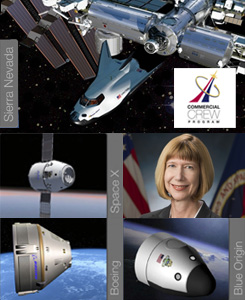
The Commercial Crew Program, with Kathy Lueders as newly appointed program manager, is aiming to transport humans to LEO in 2017. Four commercial partners (Blue Origin, Boeing Company, Sierra Nevada Corporation, SpaceX) continue to advance technologies and face challenging evaluations / tests in 2014 during the 3rd phase of the program named Commercial Crew integrated Capability (CCiCap). According to the current schedule, Sierra Nevada intends to soon meet a US$17M milestone to significantly mature all Dream Chaser systems to or beyond a Critical Design Review (CDR) level and an $8M milestone to mature the main propulsion system and reaction control system to or beyond a CDR level. Each CCiCap company is behind schedule however, so NASA has extended May-June deadlines until August when it hopes to award the next round of contracts. Sierra Nevada is planning to launch the first uncrewed Dream Chaser orbital test flight on an Atlas V rocket from Cape Canaveral AFS November 1, 2016. Sierra Nevada also has a ‘cooperative understanding’ with European Space Agency and German Aerospace Center (DLR) for potential application of European technologies to Dream Chaser and future versions of the vehicle. (Image Credit: NSC, NASA)
Habitable Worlds Explored by Space Telescopes
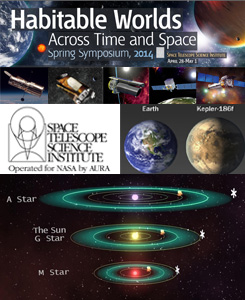
The Space Telescope Science Institute (STScI) hosts its Spring Symposium 2014 on April 28 – May 1 in Baltimore MD with the theme ‘Habitable Worlds Across Time and Space.’ The four-day symposium anticipates that within ~10 years humanity will have thoroughly verified the frequency of terrestrial-like planets in orbit around other stars and this will allow us to understand more deeply planet Earth’s history and future. It will also be important in the process of predicting where and when different bodies throughout the Cosmos might be suitable for simple and complex life forms. Confirmed speakers include Natalie Batalha of NASA Ames on ‘Progress Toward Reliable Planet Occurrence Rates with Kepler,’ and B. Scott Gaudi from Ohio State University on ‘Exoplanet Demographics with Microlensing Surveys.’ A special Workshop for Science Writers will be held on May 1 and includes speakers Dr. Shawn Domagal-Goldman (NASA GSFC) ‘Early Earth as an Alien World,’ Dr. Massimo Marengo (Iowa State University) ‘Forming Planets During Post-Main Sequence Evolution’ and Dr. Alison Murray (Desert Research Institute) ‘Lake Vida and Subsurface Life.’ STScI enables excellence in astronomical research by optimizing the science from state-of-the-art observational instruments in space and includes a total staff of 500 scientists, post-docs, engineers, administrators. STScI was founded in 1981 and its software engineers now maintain about 7,900,000 source lines of code. (Image Credit: STScI, NASA)
= All times for terrestrial events in local time unless noted.
= All times for international terrestrial events in local time unless noted.
= All times for space events, and…
= All times for international space / astro events in Hawaii Standard Time unless noted. Add 10 hours to obtain UT (‘Universal Time;’ Greenwich, England).
Apr 28 — ISS, LEO: Exp 39 will begin setting up new computers, wiring, mechanical assembly, leg interface for Robonaut 2; participating in public in-flight events Apr 29 & May 2, live coverage available.
Apr 28 — MESSENGER, Mercury Orbit: Working at 199-km altitude (closest any craft has ever orbited Mercury) to make high resolution optical, neutron, X-ray, gamma-ray observations.
Apr 28 — Juno, Jupiter Trajectory: Spacecraft is in excellent health, operating nominally, now beyond Ceres orbital path having traveled more than 2B km; 798 days to Jupiter insertion.
Apr 28 — Dunvegan Space Systems Inc., Atlanta GA: Partnering with Deep Space Industries to build ‘BitSat’ satellites as part of Bitcoin orbital system to provide transaction information / distribute block chain data.
Apr 28 — Clyde Space Ltd., Glasgow, Scotland: Planning to launch Scotland’s first satellite into space June 19, open office in USA; announced record annual orders of about £3M (~US$5M).
Apr 28 — Arianespace, Launch Vega / DZZ-HR, Kourou, French Guiana: Vega rocket, designated flight VV03, set to launch Astrium-built DZZ-HR Earth observation satellite for the Republic of Kazakhstan.
Apr 25 – May 3 — Philadelphia Science Festival Steering Committee, Philadelphia PA: 2014 Philadelphia Science Festival; Astronaut Terry Hart to speak / participate in Astronomy Night.
Apr 29 – May 2 — Applied Technology Institute, Littleton CO: Space Mission Structures course; with insturctors Tom Sarafin and Poti Doukas.
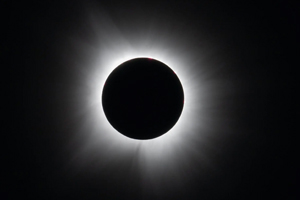
Apr 29 — Annular Solar Eclipse: Moon’s apparent disk is just smaller than Sun’s, making Sun appears as a brilliant ring; visible in parts of Antarctica & Australia; greatest eclipse to occur at 06:04:33 UT.
Apr 29 — Moon: 1.6° S of Mercury, 04:00.
Apr 29 — Asteroid 2014 HV2: Near-Earth flyby (0.003 AU).
Apr 29 — Asteroid 2013 JX28: Near-Earth flyby (0.084 AU).
Apr 30 — Johnson Space Center, NASA, National Space Grant Foundation, Online / Houston TX:Proposals Due: 2015 eXploration Habitat (X-Hab); university-level students design, develop, manufacture functional subsystem prototypes for space habitats & deep space exploration missions.
Apr 30 — Moon: 6.8° S of Pleiades, 10:00.
Apr 30 — Asteroid 2014 FR52: Near-Earth flyby (0.043 AU).
THURSDAY
NET May — Gaia,Sun-Earth L2 Lagrange Point: Spacecraft instrument checks and calibration to be completed this month, will begin 5-year operational mission phase to map 1 billion stars.
NET May — Rosetta, Comet 67P / Churyumov-Gerasimenko Orbit: European Space Agency spacecraft arrives at Comet 67P / Churyumov-Gerasimenko after 10-year journey.
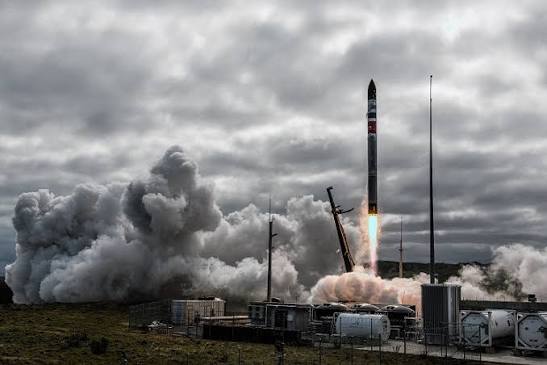
NET May — SpaceX, Launch Falcon 9 / Orbcomm OG2,Cape Canaveral AFS FL: SpaceX Falcon 9 v1.1 rocket to launch 8 second-generation Orbcomm communications satellites.
NET May — Sierra Nevada Corp., Louisville CO: Developing 7-person Dream Chaser spaceplane for NASA CCiCap, Risk Reduction, Technology Readiness Level Advancement Testing, Main Propulsion and Reaction Control System Risk Reduction Testing to occur this month.
May 1 — Deep Space, Ceres Trajectory: Dawn spacecraft cruising at about 69,000 kph, has traveled 4.5B km, expected to begin imaging dwarf planet and its potential water vapor plumes Feb 2015.
May 1 — American Astronautical Society, the National Academies, Washington DC: ISS Utilization Event; to discuss recent research on the ISS, as well as future plans and opportunities; at National Academy of Sciences building, free.
Includes ~150 meetings covering the fields of COSPAR Scientific Commissions / Panels / Task Groups, such as SC B: The Earth-Moon System, Planets, and...
From 02 to 07 August 2026, a few thousand geoscientists across diverse disciplines will gather at the 23rd annual meeting of the Asia Oceania Geosciences...
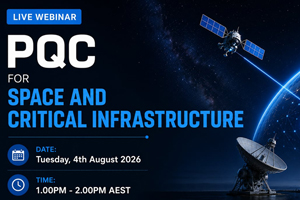
Virtual Series 2026 will offer deeper conversations on why PQC matters and the practical steps businesses should be taking; starts 1:00 pm AEST. Featuring:...
This international lunar science meeting has two objectives: to provide a platform for leading experts to review recent advances across lunar research, from the...
At CSIR International Convention Centre. Key topics are Earth Observation, Developing Space Tourism, Space Supply Manufacturing. Cultural tours are offered.
Participants will receive theoretical and hands-on training in electron imaging and X-ray spectroscopy for application to planetary samples. This training opportunity is targeted at...
"Leading Australia’s Space Future for Our Strategic Advantage". Southern Space 2026 brings together decision-makers who set the direction for Australia’s space sector. It is...
A total solar eclipse with a magnitude of 1.0386 (greatest eclipse 17:47:06 UTC) will be visible in parts of Greenland, Iceland, northern Russia, the Atlantic...
Includes presentation of the Neil Armstrong Award of Excellence, activities for the new class of Astronaut Scholars, 2-day Technical Conference where Scholars present their...
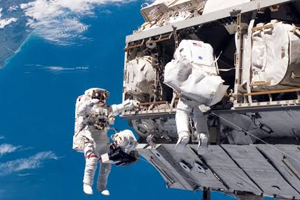
During U.S. spacewalk 97, two astronauts will replace a Space-to-Ground antenna on the orbital complex. The antenna is a critical communication system NASA uses...
Key themes include: Characterizing exoplanet-host solar-like stars; Star-planet interactions; Planet populations around solar-like stars. At University of Liège.
India orbiter surpasses another full year in lunar polar orbit since reaching the Moon in 2019; Chandrayaan-2 lander and rover were unsuccessful in lunar...
 The Commercial Crew Program, with Kathy Lueders as newly appointed program manager, is aiming to transport humans to LEO in 2017. Four commercial partners (Blue Origin, Boeing Company, Sierra Nevada Corporation, SpaceX) continue to advance technologies and face challenging evaluations / tests in 2014 during the 3rd phase of the program named Commercial Crew integrated Capability (CCiCap). According to the current schedule, Sierra Nevada intends to soon meet a US$17M milestone to significantly mature all Dream Chaser systems to or beyond a Critical Design Review (CDR) level and an $8M milestone to mature the main propulsion system and reaction control system to or beyond a CDR level. Each CCiCap company is behind schedule however, so NASA has extended May-June deadlines until August when it hopes to award the next round of contracts. Sierra Nevada is planning to launch the first uncrewed Dream Chaser orbital test flight on an Atlas V rocket from Cape Canaveral AFS November 1, 2016. Sierra Nevada also has a ‘cooperative understanding’ with European Space Agency and German Aerospace Center (DLR) for potential application of European technologies to Dream Chaser and future versions of the vehicle. (Image Credit: NSC, NASA)
 The Space Telescope Science Institute (STScI) hosts its Spring Symposium 2014 on April 28 – May 1 in Baltimore MD with the theme ‘Habitable Worlds Across Time and Space.’ The four-day symposium anticipates that within ~10 years humanity will have thoroughly verified the frequency of terrestrial-like planets in orbit around other stars and this will allow us to understand more deeply planet Earth’s history and future. It will also be important in the process of predicting where and when different bodies throughout the Cosmos might be suitable for simple and complex life forms. Confirmed speakers include Natalie Batalha of NASA Ames on ‘Progress Toward Reliable Planet Occurrence Rates with Kepler,’ and B. Scott Gaudi from Ohio State University on ‘Exoplanet Demographics with Microlensing Surveys.’ A special Workshop for Science Writers will be held on May 1 and includes speakers Dr. Shawn Domagal-Goldman (NASA GSFC) ‘Early Earth as an Alien World,’ Dr. Massimo Marengo (Iowa State University) ‘Forming Planets During Post-Main Sequence Evolution’ and Dr. Alison Murray (Desert Research Institute) ‘Lake Vida and Subsurface Life.’ STScI enables excellence in astronomical research by optimizing the science from state-of-the-art observational instruments in space and includes a total staff of 500 scientists, post-docs, engineers, administrators. STScI was founded in 1981 and its software engineers now maintain about 7,900,000 source lines of code. (Image Credit: STScI, NASA)
 = All times for terrestrial events in local time unless noted.
 = All times for international terrestrial events in local time unless noted.
 = All times for space events, and…
 = All times for international space / astro events in Hawaii Standard Time unless noted. Add 10 hours to obtain UT (‘Universal Time;’ Greenwich, England).