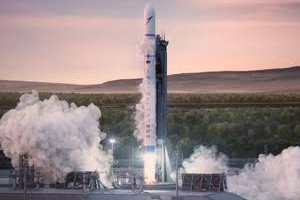
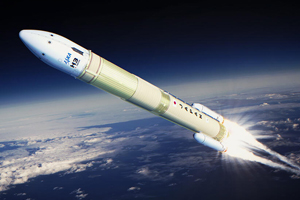
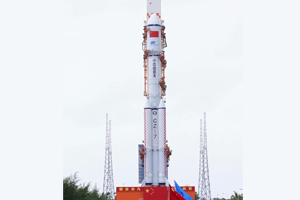
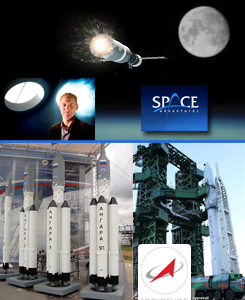
The Angara series of Russia rocket boosters, named after a Siberian river, is scheduled to attempt its maiden flight on June 27 from the Plesetsk Cosmodrome in Mirny, Arkhangelsk Oblast, about 800 km north of Moscow. The Angara 1.2PP is set to launch on a suborbital demonstration flight to prove that this new generation of modular carrier rockets with economical and environmentally-friendly oxygen-kerosene engines is suitable for operational flights. The rocket family includes light, medium and heavy configurations capable of lifting payloads of 3.8 to 35 metric tons to low Earth orbit. The lead developer and manufacturer is Khrunichev State Research and Production Space Center. The tried-and-true Soyuz rocket is set to launch the Meteor M2 satellite and several secondary payloads, including SkySat 2 for Skybox Imaging, from Baikonur Cosmodrome on July 8. Russia is currently working on plans with space tourism firm Space Adventures, to modify a Soyuz capsule for trips around the far side of the Moon and back to Earth. Tom Shelley, president of Space Adventures, says two independent customers have already paid deposits on the ~US$150M tickets for the 2 available passenger seats on the first mission NET 2017. (Image Credit: RSA, Space Adventures, Krasnaya Zvezda / RussianSpaceWeb.com)
Wallops Flight Facility and MARS Advancing Commercial, Educational Spaceflight
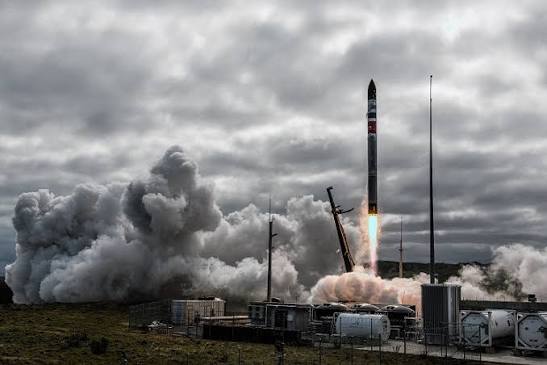
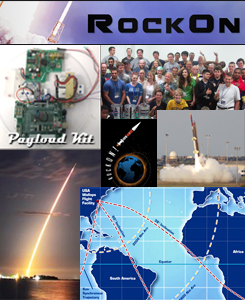
Launching June 26, two-stage Terrier-Orion sounding rockets built by three-person teams will attempt to reach Space from the NASA Wallops Flight Facility (WFF) in Virginia. Supported by the Virginia and Colorado Space Grant Consortia, the 2014 RockOn! Workshop is joined by more than 65 students and educators from around the country. The experiment payload is built from a hardware kit which may be used on future RocketSats and possibly CubeSat missions. It will measure acceleration, spin rate, radiation, humidity, pressure and temperature during its suborbital flight to ~117 km. WFF and the commercial Mid-Atlantic Regional Spaceport (MARS), launch site for the LADEE Moon Mission and Orbital Sciences Corp’s ISS Cygnus cargo freighters, offer ideal access to LEO including polar and sun-synchronous orbits. Located on the Eastern Shore of the USA at 37.94°N latitude, WFF has relatively population-free flight trajectories, but cannot compare to the safer and more cost-effective flights which could be offered by an off-shore Hawai`i Sea Launching enterprise operating at an equatorial site in the Pacific Ocean. WFF mobile range instrumentation (telemetry, radar, command and power systems) have been used to support rocket launches from locations in the Antarctic, Arctic, South America, Africa, Europe, Australia and at sea. (Image Credit: NASA, WFF, VSGC, CSGC, J. Houck)
= All times for terrestrial events in local time unless noted.
= All times for international terrestrial events in local time unless noted.
= All times for space events, and…
= All times for international space / astro events in Hawaii Standard Time unless noted. Add 10 hours to obtain UT (‘Universal Time;’ Greenwich, England).
Jun 23 — ISS, LEO: Expedition 40 six-member crew continuing to transfer waste to Progress 55P, working with SPHERES-Slosh experiment & FASES (Fundamental and Applied Studies of Emulsion Stability) hardware.
Jun 23 — Hubble Space Telescope, LEO: Will scan sky in direction of constellation Sagittarius (toward Center of Milky Way) to try to identify Kuiper Belt Object for New Horizons to visit after its Pluto flyby July 2015.
Jun 23 — MESSENGER, Mercury Orbit: First observation of hot flow anomaly (HFA) at Mercury revealed by spacecraft data, adds to knowledge of HFA size & space weather events.
Jun 23 — Astrobotic Technology Inc., Pittsburgh PA: NewSpace company proposing to carry at least 4 other GLXP teams to Moon surface with its Griffin Lander & Red Rover mission to simultaneously start 500-meter race.
Jun 23 — Copenhagen Suborbitals,Copenhagen, Denmark: Changing location for the LOX pressure sensor on HEAT 2X rocket engine & adding more; examining burst disk from latest test.
Jun 23 — World View Enterprises Inc., Tucson AZ: Partnered with Paragon Space Development Corp., developing capsule & balloon technology to carry humans to ~30-km altitude starting 2016; landing may be as far as 482 km from launch site.
Jun 23-26 — Royal Astronomical Society, University of Portsmouth Institute of Cosmology and Gravitation,London, United Kingdom:RAS National Astronomy Meeting.
Jun 18 – Jul 11 — Venus Express, Venus Orbit: ESA spacecraft to perform “experimental aerobraking” maneuvers to reach ~130-km altitude; if survives this phase, will raise orbit for few months before making final plunge into atmosphere.
Jun 21-26 — Virginia Space Grant Consortium, Wallops Flight Facility, NASA, Colorado Space Grant Consortium,Wallops Island VA: RockOn! 2014: The Next How-To Workshop.
Jun 25 — Asteroid 2007 WU3: Near-Earth flyby (0.095 AU).
THURSDAY
Jun 26 — ISRO, Launch PSLV / Spot 7,Satish Dhawan Space Center, Sriharikota, India: India Polar Satellite Launch Vehicle flying on PSLV-C23 mission to launch Spot 7 remote sensing satellite for Astrium Services and other payloads.
Jun 26 — Moon: 0.27° N of Mercury, 02:00; New Moon, 22:09.
Jun 26 — Asteroid 2010 NY65: Near-Earth flyby (0.067 AU).
FRIDAY
Jun 27 — RSA, Launch Angara-1.2PP, Plesetsk Cosmodrome, Russia: Angara rocket developed by Khrunichev State Research and Production Space Center to launch on a suborbital test flight; will be maiden flight of Angara.
Jun 28 — Space Tourism Society, Los Angeles CA:Seminar: Space Experience Economy (SEE); presented by STS founder / president John Spencer and other guests; US$175.
Jun 28 — Moon: 5.4° S of Jupiter, 15:00.
Jun 28 — Asteroid 1994 CJ1: Near-Earth flyby (0.091 AU).
SUNDAY
Jun 29 — Moon: 6.2° SSW of Beehive, 14:00.
Jun 29 — Asteroid 2011 UZ255: Near-Earth flyby (0.079 AU).
Includes ~150 meetings covering the fields of COSPAR Scientific Commissions / Panels / Task Groups, such as SC B: The Earth-Moon System, Planets, and...
From 02 to 07 August 2026, a few thousand geoscientists across diverse disciplines will gather at the 23rd annual meeting of the Asia Oceania Geosciences...
Virtual Series 2026 will offer deeper conversations on why PQC matters and the practical steps businesses should be taking; starts 1:00 pm AEST. Featuring:...
This international lunar science meeting has two objectives: to provide a platform for leading experts to review recent advances across lunar research, from the...
At CSIR International Convention Centre. Key topics are Earth Observation, Developing Space Tourism, Space Supply Manufacturing. Cultural tours are offered.
Participants will receive theoretical and hands-on training in electron imaging and X-ray spectroscopy for application to planetary samples. This training opportunity is targeted at...
"Leading Australia’s Space Future for Our Strategic Advantage". Southern Space 2026 brings together decision-makers who set the direction for Australia’s space sector. It is...
A total solar eclipse with a magnitude of 1.0386 (greatest eclipse 17:47:06 UTC) will be visible in parts of Greenland, Iceland, northern Russia, the Atlantic...
Includes presentation of the Neil Armstrong Award of Excellence, activities for the new class of Astronaut Scholars, 2-day Technical Conference where Scholars present their...
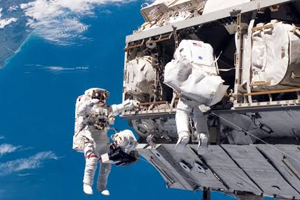
During U.S. spacewalk 97, two astronauts will replace a Space-to-Ground antenna on the orbital complex. The antenna is a critical communication system NASA uses...
Key themes include: Characterizing exoplanet-host solar-like stars; Star-planet interactions; Planet populations around solar-like stars. At University of Liège.
India orbiter surpasses another full year in lunar polar orbit since reaching the Moon in 2019; Chandrayaan-2 lander and rover were unsuccessful in lunar...
 The Angara series of Russia rocket boosters, named after a Siberian river, is scheduled to attempt its maiden flight on June 27 from the Plesetsk Cosmodrome in Mirny, Arkhangelsk Oblast, about 800 km north of Moscow. The Angara 1.2PP is set to launch on a suborbital demonstration flight to prove that this new generation of modular carrier rockets with economical and environmentally-friendly oxygen-kerosene engines is suitable for operational flights. The rocket family includes light, medium and heavy configurations capable of lifting payloads of 3.8 to 35 metric tons to low Earth orbit. The lead developer and manufacturer is Khrunichev State Research and Production Space Center. The tried-and-true Soyuz rocket is set to launch the Meteor M2 satellite and several secondary payloads, including SkySat 2 for Skybox Imaging, from Baikonur Cosmodrome on July 8. Russia is currently working on plans with space tourism firm Space Adventures, to modify a Soyuz capsule for trips around the far side of the Moon and back to Earth. Tom Shelley, president of Space Adventures, says two independent customers have already paid deposits on the ~US$150M tickets for the 2 available passenger seats on the first mission NET 2017. (Image Credit: RSA, Space Adventures, Krasnaya Zvezda / RussianSpaceWeb.com)
 Launching June 26, two-stage Terrier-Orion sounding rockets built by three-person teams will attempt to reach Space from the NASA Wallops Flight Facility (WFF) in Virginia. Supported by the Virginia and Colorado Space Grant Consortia, the 2014 RockOn! Workshop is joined by more than 65 students and educators from around the country. The experiment payload is built from a hardware kit which may be used on future RocketSats and possibly CubeSat missions. It will measure acceleration, spin rate, radiation, humidity, pressure and temperature during its suborbital flight to ~117 km. WFF and the commercial Mid-Atlantic Regional Spaceport (MARS), launch site for the LADEE Moon Mission and Orbital Sciences Corp’s ISS Cygnus cargo freighters, offer ideal access to LEO including polar and sun-synchronous orbits. Located on the Eastern Shore of the USA at 37.94°N latitude, WFF has relatively population-free flight trajectories, but cannot compare to the safer and more cost-effective flights which could be offered by an off-shore Hawai`i Sea Launching enterprise operating at an equatorial site in the Pacific Ocean. WFF mobile range instrumentation (telemetry, radar, command and power systems) have been used to support rocket launches from locations in the Antarctic, Arctic, South America, Africa, Europe, Australia and at sea. (Image Credit: NASA, WFF, VSGC, CSGC, J. Houck)
 = All times for terrestrial events in local time unless noted.
 = All times for international terrestrial events in local time unless noted.
 = All times for space events, and…
 = All times for international space / astro events in Hawaii Standard Time unless noted. Add 10 hours to obtain UT (‘Universal Time;’ Greenwich, England).