July 4th, USA Independence Day Marks Progression of Space Age, 1969-2019
In observation of USA Independence Day, explorers, innovators and out-of-this-world people think toward the future of human independence and expansion. As Earth reaches aphelion July 4th (~152M km, 1.017 AU from the Sun) it highlights the fact that very few people get to travel the ~400 km distance to the ISS in LEO. Even fewer have traveled to the Moon, and while the NASA Voyagers cruise in the Heliosheath (~19B & 15B km from Earth), almost all humans are Earthbound looking to the Stars. On July 4, 2016 the NASA Juno spacecraft is scheduled to arrive at Jupiter to begin pioneering science and advance the possibility of human missions to the system with 67 known moons. On July 4, 1969 Americans anticipated the Apollo 11 Moon landing – arguably the most significant event in the 20th Century, and in 1982 President Reagan and more than half a million spectators celebrated the landing of Space Shuttle Columbia on its 4th orbital test flight (STS-4). Hopefully by July 4, 2017 USA companies participating in NASA CCiCap will be launching humans to space and in 2019 tourists will be gearing up to visit the Moon via Golden Spike Co. to reclaim our status as a Multi World Species, 50 years after the first Moon landing. The Mars Pathfinder landed on Mars July 4, 1997 and perhaps by the same date in 2016 Mars One will have launched its first round of technologies to the planet as a prelude for permanent human settlement and in 2018 Inspiration Mars Foundation Astronauts might be on their 501-day Mars flyby mission. (Image Credit: NASA)
Europe Hosts Space Show and Science Meetings
The Toulouse Space Show takes place during the International Week on Space Applications, June 30 – July 2 at the Pierre Baudis Congress Center in Toulouse, France. More than 1,300 participants from 48 countries are expected to attend. There will be 7 roundtables, over 45 speakers, 100 exhibitors and numerous associated events. The Show will be launched by Geneviève Fioraso (pictured), French Secretary of State for Higher Education and Research, who notes that “For France and for Europe, space is a job-creating strategic objective of the highest order.” Keynote speeches will be given by CNES President Jean-Yves Le Gall, Director General of the European Space Agency Jean-Jacques Dordain and Airbus Group CEO Thomas Enders. The European Week of Astronomy and Space Science is being hosted June 30 – July 4 at the International Conference Centre, Geneva, Switzerland. EWASS, formerly known as JENAM, represents the annual meeting of the European Astronomical Society and has become over 20 years the largest European astronomy conference. Lord Martin Rees, Emeritus Professor at the University of Cambridge will hold a conference at EWASS called From Mars to the Multiverse. There is also a CoRoT Symposium / KASC Meeting titled ‘The Space Photometry Revolution” in Toulouse on July 6-11. (Image Credit: TSS, EWASS, ESA)
= All times for terrestrial events in local time unless noted.
= All times for international terrestrial events in local time unless noted.
= All times for space events, and…
= All times for international space / astro events in Hawaii Standard Time unless noted. Add 10 hours to obtain UT (‘Universal Time;’ Greenwich, England).
Jun 30 — ISS, LEO: Expedition 40 training for robotic capture of Cygnus 2 resupply craft, working with Ice Crystal 2 experiment, continuing power diagnostics of Zvezda, participating in In-Flight Interviews with NBC Today Show.
Jun 30 — Convection, Rotation and Planetary Transits (CoRoT), LEO: ESA 6-year-old spacecraft to perform technology experiments before lowering orbit to burn up in Earth atmosphere; stopped transmitting data Nov 2012.
Jun 30 — ISEE-3, Heliocentric Orbit: Three-day window opens for privately-funded International Sun-Earth Explorer to perform ~17 hours of pulsed orbit change maneuvers in order to fly by Moon at 50-km altitude Aug 10 & enter Earth Orbit.
Jun 30 — Rosetta, Comet 67P/Churyumov-Gerasimenko Trajectory: In Main Asteroid Belt ~500,000 km from Comet, relaying science data of initial observations.
Jun 30 — Cassini,Saturn Orbit: Spacecraft achieves 10 years at Saturn today.
Jun 30 — Bigelow Aerospace, Las Vegas NV: NewSpace company continuing to develop BA-330 inflatable space habitat to house 6 people at a time; US$25M for 1 person, 2-month stay.
Jun 30 — SpaceX, Hawthorne CA: Awaiting FAA decision on potential permit to conduct launches near Brownsville TX; Falcon 9 / Orbcomm OG2 launch postponed until mid-Jul; Falcon Heavy demo launch expected in 2015.
Jun 30 — Space Frontier Foundation, Nyack NY: Will present awards to various individuals, NewSpace companies at upcoming 2014 NewSpace Awards Jul 26 including OSC, SpaceX, NewSpace Global, Patti Grace Smith.
Jun 30 — ISRO, Launch PSLV / Spot 7,Satish Dhawan Space Center, Sriharikota, India: India Polar Satellite Launch Vehicle flying on PSLV-C23 mission to launch Spot 7 remote sensing satellite for Astrium Services and other payloads.
Jun 30 – Jul 3 — Jet Propulsion Laboratory, Caltech/NASA, USN Pacific Missile Range Facility, Barking Sands, Kauai HI: Back-up dates for testing Low-Density Supersonic Decelerator (LDSD) for Mars entry vehicles; planned tests will boost vehicle up to 54.8 km using balloon and rocket stages.
Jun 4 – Aug 10 — Johns Hopkins University Applied Physics Laboratory, NASA, Laurel MD:2014 Internship Program; summer projects for students interested in working on NASA missions or space-related research opportunities at APL.
Jun 18 – Jul 11 — Venus Express, Venus Orbit: ESA spacecraft to perform “experimental aerobraking” maneuvers to reach ~130-km altitude; if survives this phase, will raise orbit for few months before making final plunge into atmosphere.
TUESDAY
NET Jul — Chang’e-2, Deep Space: Spacecraft expected to reach 100M km from Earth this month.
Jul 1 — Deep Space, Pluto Trajectory: New Horizons spacecraft very near Uranus orbital path, traveling at ~52,994 kph, now 378 days from Pluto closest approach; undergoing various check outs, homing activities until Sep 6.
Jul 1 — United Launch Alliance, Launch Delta 2 / Orbiting Carbon Observatory-2, Vandenberg AFB CA: Launch of NASA Orbiting Carbon Observatory-2 (OCO-2) spacecraft aboard Delta 2 rockets from Complex 2.
Jul 4 — U.S. Space & Rocket Center, Huntsville AL:4th of July Celebration; featuring rocket building, Moon bounce, Kids Cosmos, fireworks; US$20 per vehicle.
Jul 4 — University of Arizona,Houston TX:Premiere of ‘Desert Moon’ documentary exploring how University of Arizona helped land a human on the Moon; at Flandrau Science Center
Jul 4 — Space Center Houston, Houston TX:Lunch with an Astronaut, Jerry Ross; US$49.95 adult.
Jul 5-6 — SpaceUp, Pocket Spacecraft Co., Satellite Applications, London, United Kingdom: SpaceUp UK; the “unconference” where participants decide space issues / topics to discuss, schedule and structure of event.
Jul 5 — Moon: First quarter Moon, 01:59; 0.24° NNW of Mars, 15:00; 2.2° N of Spica, 20:00.
Includes ~150 meetings covering the fields of COSPAR Scientific Commissions / Panels / Task Groups, such as SC B: The Earth-Moon System, Planets, and...
From 02 to 07 August 2026, a few thousand geoscientists across diverse disciplines will gather at the 23rd annual meeting of the Asia Oceania Geosciences...
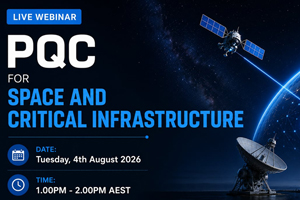
Virtual Series 2026 will offer deeper conversations on why PQC matters and the practical steps businesses should be taking; starts 1:00 pm AEST. Featuring:...
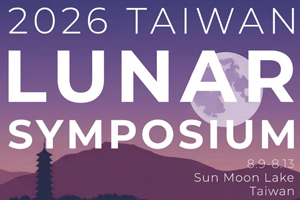
This international lunar science meeting has two objectives: to provide a platform for leading experts to review recent advances across lunar research, from the...
At CSIR International Convention Centre. Key topics are Earth Observation, Developing Space Tourism, Space Supply Manufacturing. Cultural tours are offered.
Participants will receive theoretical and hands-on training in electron imaging and X-ray spectroscopy for application to planetary samples. This training opportunity is targeted at...
"Leading Australia’s Space Future for Our Strategic Advantage". Southern Space 2026 brings together decision-makers who set the direction for Australia’s space sector. It is...
A total solar eclipse with a magnitude of 1.0386 (greatest eclipse 17:47:06 UTC) will be visible in parts of Greenland, Iceland, northern Russia, the Atlantic...
Includes presentation of the Neil Armstrong Award of Excellence, activities for the new class of Astronaut Scholars, 2-day Technical Conference where Scholars present their...
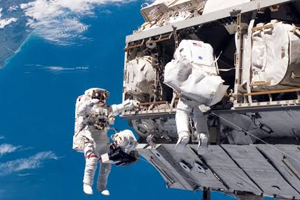
During U.S. spacewalk 97, two astronauts will replace a Space-to-Ground antenna on the orbital complex. The antenna is a critical communication system NASA uses...
Key themes include: Characterizing exoplanet-host solar-like stars; Star-planet interactions; Planet populations around solar-like stars. At University of Liège.
India orbiter surpasses another full year in lunar polar orbit since reaching the Moon in 2019; Chandrayaan-2 lander and rover were unsuccessful in lunar...
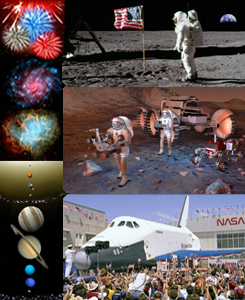 In observation of USA Independence Day, explorers, innovators and out-of-this-world people think toward the future of human independence and expansion. As Earth reaches aphelion July 4th (~152M km, 1.017 AU from the Sun) it highlights the fact that very few people get to travel the ~400 km distance to the ISS in LEO. Even fewer have traveled to the Moon, and while the NASA Voyagers cruise in the Heliosheath (~19B & 15B km from Earth), almost all humans are Earthbound looking to the Stars. On July 4, 2016 the NASA Juno spacecraft is scheduled to arrive at Jupiter to begin pioneering science and advance the possibility of human missions to the system with 67 known moons. On July 4, 1969 Americans anticipated the Apollo 11 Moon landing – arguably the most significant event in the 20th Century, and in 1982 President Reagan and more than half a million spectators celebrated the landing of Space Shuttle Columbia on its 4th orbital test flight (STS-4). Hopefully by July 4, 2017 USA companies participating in NASA CCiCap will be launching humans to space and in 2019 tourists will be gearing up to visit the Moon via Golden Spike Co. to reclaim our status as a Multi World Species, 50 years after the first Moon landing. The Mars Pathfinder landed on Mars July 4, 1997 and perhaps by the same date in 2016 Mars One will have launched its first round of technologies to the planet as a prelude for permanent human settlement and in 2018 Inspiration Mars Foundation Astronauts might be on their 501-day Mars flyby mission. (Image Credit: NASA)
 The Toulouse Space Show takes place during the International Week on Space Applications, June 30 – July 2 at the Pierre Baudis Congress Center in Toulouse, France. More than 1,300 participants from 48 countries are expected to attend. There will be 7 roundtables, over 45 speakers, 100 exhibitors and numerous associated events. The Show will be launched by Geneviève Fioraso (pictured), French Secretary of State for Higher Education and Research, who notes that “For France and for Europe, space is a job-creating strategic objective of the highest order.” Keynote speeches will be given by CNES President Jean-Yves Le Gall, Director General of the European Space Agency Jean-Jacques Dordain and Airbus Group CEO Thomas Enders. The European Week of Astronomy and Space Science is being hosted June 30 – July 4 at the International Conference Centre, Geneva, Switzerland. EWASS, formerly known as JENAM, represents the annual meeting of the European Astronomical Society and has become over 20 years the largest European astronomy conference. Lord Martin Rees, Emeritus Professor at the University of Cambridge will hold a conference at EWASS called From Mars to the Multiverse. There is also a CoRoT Symposium / KASC Meeting titled ‘The Space Photometry Revolution” in Toulouse on July 6-11. (Image Credit: TSS, EWASS, ESA)
 = All times for terrestrial events in local time unless noted.
 = All times for international terrestrial events in local time unless noted.
 = All times for space events, and…
 = All times for international space / astro events in Hawaii Standard Time unless noted. Add 10 hours to obtain UT (‘Universal Time;’ Greenwich, England).