Mars Gaining 2 New Orbiters in Time for Comet ‘Siding Spring’ Flyby
Mars is in full focus as USA NASA Mars Atmosphere and Volatile EvolutioN (MAVEN) and India ISRO Mars Orbiter Mission (MOM or Mangalyaan) spacecraft prepare to enter Mars orbit. Author Anthony Fucilla (R) will be speaking about terraforming Mars September 17 at the British Interplanetary Society in London. He will cover proposed methods, strategies and challenges. The U.S. Library of Congress in Washington DC is hosting a lecture Sep 18 by Dr. Jared Espley (L), planetary scientist with NASA MAVEN mission, titled ‘Climate Change on Mars: The Case of the Missing Martian Atmosphere.’ On Sep 21 MAVEN spacecraft is expected to fire its 6 thrusters, then its 6 engines for 33-minutes to enter elliptical Mars orbit 380 km above the north pole. It will study Mars atmosphere with 8 instruments over the next 12 months. India’s first interplanetary mission, the indigenous MOM spacecraft, will test fire its 440N Liquid Apogee Motor Sep 22 for ~4 seconds. On Sep 24 it will then fire its motor for ~24 minutes to reduce velocity by ~1.1 km per second, enter 365-km x 80,000-km Mars orbit and spend 6-10 months observing surface features, morphology, mineralogy and atmosphere using 5 instruments. The new orbiters along with NASA MRO & Mars Odyssey, and ESA Mars Express will be taking safety precautions and preparing to make scientific observations of Comet C/2013 A1 Siding Spring during its 132,000-km altitude flyby October 19 at 18:28 UT. (Image Credit: ISRO, NASA, Stefan Morrell, Anthony Fucilla, Orbiter.ch Aerospace)
100 Year Starship: Prescient Vision for the Future
The 100YSS 2014 Public Symposium takes place September 18-21 at the George R. Brown Convention Center in Houston TX, USA. The theme is Pathway to the Stars, Footprints on Earth, and the focus has shifted from fundamentals that facilitate ready access to our inner solar system to more in-depth access to emerging and leading edge topics. The immediate goal is to expand our view of design and creativity in education, psychology and transportation. The conference tracks include: Propulsion and Energy; Data, Communications and IT; ‘Uncharted’ Space and Destinations; Interstellar Innovation Enhancing Life on Earth; and Becoming an Interstellar Civilization. Dr. Mason Peck, Director of Cornell’s Space Systems Design Studio and former NASA Chief Technologist, is featured in the State of the Universe Panel. Dr. Peter Swan will be a Radical Leaps panelist and lead a Deep Dive Workshop on Space Elevators. There are a variety of other technical, panel, and keynote sessions, as well as social and interactive events. Through a collaborative and Transdisciplinary approach to Starship capability and capacity building 100YSS also aims to contribute to enhancing life here on Earth… today. (Graphic Credit: 100YSS, Anderson Institute, Dr. Cameron Smith / PSU)
= All times for terrestrial events in local time unless noted.
= All times for international terrestrial events in local time unless noted.
= All times for space events, and…
= All times for international space / astro events in Hawaii Standard Time unless noted. Add 10 hours to obtain UT (‘Universal Time;’ Greenwich, England).
Sep 15 — ISS, LEO: Expedition 41 three-member crew with Max Suraev as Cmdr preparing for Dragon CRS-4 resupply ship arrival, setting up Cell Mechanosensing-2 experiment, working with Matryoshka radiation study & Combustion Integrated Rack.
Sep 15 — Tiangong-1, LEO: Various sensors detecting and analyzing Sun energy particles, atmosphere properties, ionosphere disturbances.
Sep 15 — Chang’e-3 Lander & Yutu Rover, Sinus Iridum / Mare Imbrium, 44.12°N 19.51°W, Moon Surface: Spacecraft continue observations, science during Lunar Day 10; set to go into hibernation Sep 16, wake for Lunar Day 11 Oct 4 or 5.
Sep 15 — New Horizons, Pluto Trajectory: Traveling at 52,843 kph in hibernation mode until Dec 7; now 301 days from Pluto & Charon closest approach.
Sep 15 —Golden Spike Co., Boulder CO: NewSpace company working toward providing Human Moon missions by end of this decade; conducting multiple studies, advancing business planning & engineering.
Sep 15 —Virgin Galactic, Las Cruces NM: Planning for commercial suborbital flights to begin Feb or Mar 2015; will carry experiment / research payloads for NASA under Space Tech Mission Directorate contract.
Sep 15 — Spaceflight Inc., Tukwila WA: Offering customers SmallSat rideshare opportunities for deep space missions to launch Q3 2016: 5 kg for US$750K, up to 300 kg for $19,900K.
Sep 12-14 — HawaiiCon Organization, Waimea HI: HawaiiCon; with panels featuring Space Tourism in Hawaii, Solar System Exploration, Astronomy, Asteroids, Exoplanets, Deep Space Voyaging.
Sep 12-20 — University of Utah, Institute ofTheoretical PhysicsUAM/CSIC, Corfu, Greece:Workshop on Dark Energy.
TUESDAY
Sep 16 — United Launch Alliance, Launch Atlas V / CLIO,Cape Canaveral AFS FL: United Launch Alliance to launch CLIO satellite mission on a commercial flight for a U.S. government customer.
Sep 19 — Space Center Houston, Houston TX:Lunch with an Astronaut, Ken Cameron; US$49.95 adult.
Sep 19 — Moon: 6.3° SSW of Beehive Cluster, 09:00; 5.3° SSW of Jupiter, 22:00.
Sep 19 — Asteroid 2014 RH12: Near-Earth flyby (0.058 AU).
SATURDAY
Sep 20 — SpaceX, Launch Falcon 9 / CRS 4,Cape Canaveral AFS FL: SpaceX Falcon 9 rocket set to launch 6th Dragon spacecraft on 4th operational cargo delivery mission to ISS; to deliver Made in Space 3D printer, ISS-RapidScat & CATS; launch set for 02:16 EDT, live coverage available; back up launch window Sep 21, 01:53.
Sep 20 — ISS,Grapple & Berthing of CRS-4,LEO: Dragon CRS-4 spacecraft to be grappled and berthed to ISS; activities begin 09:30 UT, live coverage available.
Sep 20-21 — SpaceUp, Cité de l’espace (City of Space), Toulouse, France: SpaceUp France; the “unconference” where participants decide space issues / topics to discuss, schedule and structure of event.
Sep 20-23 — Nicolaus Copernicus University, Polish Academy of Sciences, Aleksander Jablonski Foundation, Astronomy Students’ Scientific Association, Torun, Poland: International Conference of Young Astronomers (ICYA).
Sep 20 — Asteroid 2014 QJ33: Near-Earth flyby (0.040 AU).
SUNDAY
Sep 21 — MAVEN, Mars Orbit: Potential Mars orbit insertion date for Mars Atmosphere and Volatile EvolutioN (MAVEN); will study Martian upper atmosphere, role of atmospheric gas loss in changing Martian climate over time from altitudes ranging between 150 – 6,215 km; nominal mission to last 1 year.
Sep 21 — The Space Show, Tiburon CA / Online: Dr. David Livingston talks with Michael Belfiore, Space author / journalist.
Sep 21 — Moon: 4.4° SSW of Regulus, 07:00.
Sep 21 — Asteroid 2011 UT: Near-Earth flyby (0.057 AU).
Includes ~150 meetings covering the fields of COSPAR Scientific Commissions / Panels / Task Groups, such as SC B: The Earth-Moon System, Planets, and...
From 02 to 07 August 2026, a few thousand geoscientists across diverse disciplines will gather at the 23rd annual meeting of the Asia Oceania Geosciences...
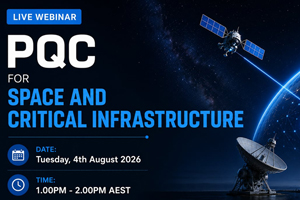
Virtual Series 2026 will offer deeper conversations on why PQC matters and the practical steps businesses should be taking; starts 1:00 pm AEST. Featuring:...
This international lunar science meeting has two objectives: to provide a platform for leading experts to review recent advances across lunar research, from the...
At CSIR International Convention Centre. Key topics are Earth Observation, Developing Space Tourism, Space Supply Manufacturing. Cultural tours are offered.
Participants will receive theoretical and hands-on training in electron imaging and X-ray spectroscopy for application to planetary samples. This training opportunity is targeted at...
"Leading Australia’s Space Future for Our Strategic Advantage". Southern Space 2026 brings together decision-makers who set the direction for Australia’s space sector. It is...
A total solar eclipse with a magnitude of 1.0386 (greatest eclipse 17:47:06 UTC) will be visible in parts of Greenland, Iceland, northern Russia, the Atlantic...
Includes presentation of the Neil Armstrong Award of Excellence, activities for the new class of Astronaut Scholars, 2-day Technical Conference where Scholars present their...
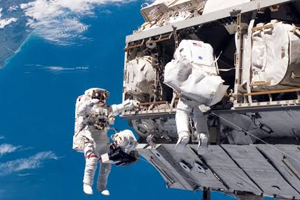
During U.S. spacewalk 97, two astronauts will replace a Space-to-Ground antenna on the orbital complex. The antenna is a critical communication system NASA uses...
Key themes include: Characterizing exoplanet-host solar-like stars; Star-planet interactions; Planet populations around solar-like stars. At University of Liège.
India orbiter surpasses another full year in lunar polar orbit since reaching the Moon in 2019; Chandrayaan-2 lander and rover were unsuccessful in lunar...
 Mars is in full focus as USA NASA Mars Atmosphere and Volatile EvolutioN (MAVEN) and India ISRO Mars Orbiter Mission (MOM or Mangalyaan) spacecraft prepare to enter Mars orbit. Author Anthony Fucilla (R) will be speaking about terraforming Mars September 17 at the British Interplanetary Society in London. He will cover proposed methods, strategies and challenges. The U.S. Library of Congress in Washington DC is hosting a lecture Sep 18 by Dr. Jared Espley (L), planetary scientist with NASA MAVEN mission, titled ‘Climate Change on Mars: The Case of the Missing Martian Atmosphere.’ On Sep 21 MAVEN spacecraft is expected to fire its 6 thrusters, then its 6 engines for 33-minutes to enter elliptical Mars orbit 380 km above the north pole. It will study Mars atmosphere with 8 instruments over the next 12 months. India’s first interplanetary mission, the indigenous MOM spacecraft, will test fire its 440N Liquid Apogee Motor Sep 22 for ~4 seconds. On Sep 24 it will then fire its motor for ~24 minutes to reduce velocity by ~1.1 km per second, enter 365-km x 80,000-km Mars orbit and spend 6-10 months observing surface features, morphology, mineralogy and atmosphere using 5 instruments. The new orbiters along with NASA MRO & Mars Odyssey, and ESA Mars Express will be taking safety precautions and preparing to make scientific observations of Comet C/2013 A1 Siding Spring during its 132,000-km altitude flyby October 19 at 18:28 UT. (Image Credit: ISRO, NASA, Stefan Morrell, Anthony Fucilla, Orbiter.ch Aerospace)
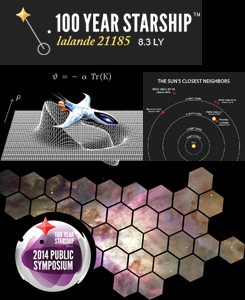 The 100YSS 2014 Public Symposium takes place September 18-21 at the George R. Brown Convention Center in Houston TX, USA. The theme is Pathway to the Stars, Footprints on Earth, and the focus has shifted from fundamentals that facilitate ready access to our inner solar system to more in-depth access to emerging and leading edge topics. The immediate goal is to expand our view of design and creativity in education, psychology and transportation. The conference tracks include: Propulsion and Energy; Data, Communications and IT; ‘Uncharted’ Space and Destinations; Interstellar Innovation Enhancing Life on Earth; and Becoming an Interstellar Civilization. Dr. Mason Peck, Director of Cornell’s Space Systems Design Studio and former NASA Chief Technologist, is featured in the State of the Universe Panel. Dr. Peter Swan will be a Radical Leaps panelist and lead a Deep Dive Workshop on Space Elevators. There are a variety of other technical, panel, and keynote sessions, as well as social and interactive events. Through a collaborative and Transdisciplinary approach to Starship capability and capacity building 100YSS also aims to contribute to enhancing life here on Earth… today. (Graphic Credit: 100YSS, Anderson Institute, Dr. Cameron Smith / PSU)
 = All times for terrestrial events in local time unless noted.
 = All times for international terrestrial events in local time unless noted.
 = All times for space events, and…
 = All times for international space / astro events in Hawaii Standard Time unless noted. Add 10 hours to obtain UT (‘Universal Time;’ Greenwich, England).