International Space Station: Looking toward Moon, Mars, Stars and Future Transport Systems
Expedition 41 crew Alexander Samokutyaev (RSA), Yelena Serova (RSA) and Barry Wilmore (NASA) are set for a 6-hour journey from Baikonur Cosmodrome in Kazakhstan to ISS aboard Soyuz TMA-14 on September 26 at 02:25. Serova will become the fourth Russian woman to fly in space. The trio will join Commander Max Suraev (RSA), Flight Engineers Reid Wiseman (NASA) and Alexander Gerst (ESA), and stay aboard the station until March 12, 2015. There are two USA and one Russia EVAs planned for Exp 41. Some of their science investigations involve observation of meteors entering Earth atmosphere, seedling growth, Zebrafish muscle mass and mice osteocytes / bone health. The mission patch, designed by the crew, represents the path of Human space exploration from LEO to the Moon, Mars and Stars beyond. Russia with its Soyuz rocket remains the only provider for Human launches into space, costing USA US$70M a seat. NASA recently selected Boeing Co. and SpaceX to provide between 2-6 flights of 4 Astronauts to LEO beginning 2017, with contracts up to $4.2B & $2.6B respectively. The agency is also working on the deep space Orion capsule and Space Launch System. (Image Credit: NASA, Boeing, SpaceX)
Europe, China Advancing Joint Scientific Space Mission With 2nd Planning Workshop
Scientists from Europe and China will present their ideas about a possible joint scientific space mission at the 2nd ESA-CAS workshop in Copenhagen, Denmark on September 23-24. Presentations by joint Europe / China teams will outline specific scientific objectives and early mission concepts for potential missions. More details concerning the technical and programmatic requirements for mission proposals will be provided and discussed at the workshop in preparation for the release of a formal call for missions later this year. Proposals must be co-signed by two Co-PIs, one affiliated with an ESA Member State institution, the other with a China institution. All stages of the mission will be carried out by joint teams and data rights will be shared. Twenty-one pairs will present their mission proposals at the workshop through oral or poster presentations. Possible science objectives include astronomy, solar science and fundamental physics, yet no Moon or Mars mission proposals will be accepted, as they are – in both agencies – covered under different programs. Spacecraft launch mass must be under 300 kg with a science payload under 60 kg, requiring under 65W of power. Both ESA and China are expected to contribute up to US$64M towards the selected mission. (Image Credit: ESA, CAS, Allan Philiba)
= All times for terrestrial events in local time unless noted.
= All times for international terrestrial events in local time unless noted.
= All times for space events, and…
= All times for international space / astro events in Hawaii Standard Time unless noted. Add 10 hours to obtain UT (‘Universal Time;’ Greenwich, England).
Sep 22 — ISS, LEO: Expedition 41 crew measuring loads on station during dynamic events (reboosts, craft berthing), transferring cargo / equipment from ATV-5 Georges Lemaitre, will work to restore NanoRacks CubeSat deployer.
Sep 22 — ISS, Dragon CRS 4 Grapple & Berthing, LEO: Dragon CRS-4 resupply craft to be grappled 11:30 UT by Gerst & Wiseman using 17-m Canadarm2, live coverage available.
Sep 22 — Mars Orbiter Mission (Mangalyaan), Mars Orbit: Spacecraft to test fire 440N liquid apogee motor in preparation for Mars Insertion Orbit Sep 24.
Sep 22 — Cassini, Saturn Orbit: Flyby of Titan at 1,400-km altitude; science teams studying data of clumps in F ring, lakes / seas & weather patterns on Titan, ~0.8-km wide object which may be new Moon forming.
Sep 22 — Juno, Jupiter Trajectory: On target for Jul 4, 2016 Jupiter arrival; about 670M km from Earth with one-way radio signal travel time ~37 minutes, traveling at 52,535 kph relative to Sun; traveled 2.3B km (15.28 AU) since Aug 2011 launch.
Sep 22 — Blue Origin LLC, Kent WA: NewSpace company partnering with ULA to develop 4,893,043-netwon BE-4 rocket; planning full scale testing 2016, first flight 2019.
Sep 22 — Flexure Engineering,Multiple Locations USA: Designing Midnight Rambler – Lunar and Icy Moon Rover to operate in -120 kelvin or below conditions.
Sep 22 — Midland International Airport, Midland TX: With FAA Commercial Space Launch Site License, will become Midland International Air & Space Port; XCOR Aerospace & Orbital Outfitters planning to become first tenants.
Sep 22-25 — Max Planck Institute for Astronomy,Heidelberg, Germany:Workshop: Exoplanets with JWST – MIRI; to discuss future capabilities of James Webb Space Telescope and its MIRI instrument.
Sep 22 — Fall / Autumn Equinox: The Sun, appearing to travel along the ecliptic, reaches the point where it crosses the equator into the southern hemisphere, 16:29.
Sep 20-23 — Nicolaus Copernicus University, Polish Academy of Sciences, Aleksander Jablonski Foundation, Astronomy Students’ Scientific Association, Torun, Poland: International Conference of Young Astronomers (ICYA).
Sep 23 — Moon: 3.8° SSW of Venus, 03:00; New Moon, 20:12.
Sep 23 — Asteroid 2007 RY19: Near-Earth flyby (0.072 AU).
WEDNESDAY
NET Sep 24 — ISRO, Launch GSLV Mk 3 / Atmospheric Test Flight, Satish Dhawan Space Center, Sriharikota, India: Geosynchronous Satellite Launch Vehicle Mk 3 to launch on suborbital test flight, will carry mock-up human crew module.
Sep 24 — Mars Orbiter Mission (Mangalyaan), Mars Orbit: Spacecraft to enter 365-km x 80,000-km altitude orbit around Mars today; spend 6-10 months studying surface features, morphology, mineralogy, atmosphere using 5 indigenous instruments.
Sep 24 – Oct 2 — Nordic Network of Astrobiology, EU COST (Cooperation in Space and Technology), La Palma, Canary Islands, Spain:Summer Course on Exoplanets.
Sep 25-27 — Space Generation Advisory Council, Toronto, Ontario, Canada:Space Generation Congress 2014; 13th annual event.
Sep 25 — Moon: 2.5° NNE of Spica, 17:00.
FRIDAY
Sep 26 — RSA, Launch Soyuz TMA-14 / ISS 40S, Baikonur Cosmodrome, Kazakhstan: An RSA Soyuz rocket set to launch members of Expedition 41/42: Yelena Serova of RSA, Barry Wilmore of NASA, Alexander Samoukutyaev of RSA; 02:25 local time, live coverage available.
Sep 27 — Asteroid 2007 DL41: Near-Earth flyby (0.047 AU).
SUNDAY
Sep 28 — RSA, Launch Proton / Olymp, Baikonur Cosmodrome, Kazakhstan: Russia Proton rocket with Breeze M upper stage to launch classified payload known as Olymp (Olympus) or Luch (Beam).
Includes ~150 meetings covering the fields of COSPAR Scientific Commissions / Panels / Task Groups, such as SC B: The Earth-Moon System, Planets, and...
From 02 to 07 August 2026, a few thousand geoscientists across diverse disciplines will gather at the 23rd annual meeting of the Asia Oceania Geosciences...
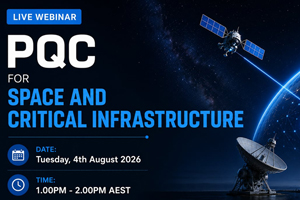
Virtual Series 2026 will offer deeper conversations on why PQC matters and the practical steps businesses should be taking; starts 1:00 pm AEST. Featuring:...
This international lunar science meeting has two objectives: to provide a platform for leading experts to review recent advances across lunar research, from the...
At CSIR International Convention Centre. Key topics are Earth Observation, Developing Space Tourism, Space Supply Manufacturing. Cultural tours are offered.
Participants will receive theoretical and hands-on training in electron imaging and X-ray spectroscopy for application to planetary samples. This training opportunity is targeted at...
"Leading Australia’s Space Future for Our Strategic Advantage". Southern Space 2026 brings together decision-makers who set the direction for Australia’s space sector. It is...
A total solar eclipse with a magnitude of 1.0386 (greatest eclipse 17:47:06 UTC) will be visible in parts of Greenland, Iceland, northern Russia, the Atlantic...
Includes presentation of the Neil Armstrong Award of Excellence, activities for the new class of Astronaut Scholars, 2-day Technical Conference where Scholars present their...
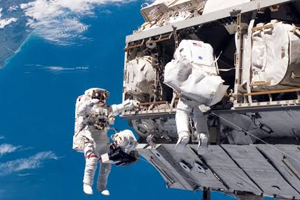
During U.S. spacewalk 97, two astronauts will replace a Space-to-Ground antenna on the orbital complex. The antenna is a critical communication system NASA uses...
Key themes include: Characterizing exoplanet-host solar-like stars; Star-planet interactions; Planet populations around solar-like stars. At University of Liège.
India orbiter surpasses another full year in lunar polar orbit since reaching the Moon in 2019; Chandrayaan-2 lander and rover were unsuccessful in lunar...
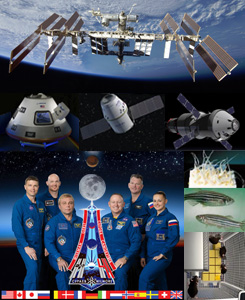 Expedition 41 crew Alexander Samokutyaev (RSA), Yelena Serova (RSA) and Barry Wilmore (NASA) are set for a 6-hour journey from Baikonur Cosmodrome in Kazakhstan to ISS aboard Soyuz TMA-14 on September 26 at 02:25. Serova will become the fourth Russian woman to fly in space. The trio will join Commander Max Suraev (RSA), Flight Engineers Reid Wiseman (NASA) and Alexander Gerst (ESA), and stay aboard the station until March 12, 2015. There are two USA and one Russia EVAs planned for Exp 41. Some of their science investigations involve observation of meteors entering Earth atmosphere, seedling growth, Zebrafish muscle mass and mice osteocytes / bone health. The mission patch, designed by the crew, represents the path of Human space exploration from LEO to the Moon, Mars and Stars beyond. Russia with its Soyuz rocket remains the only provider for Human launches into space, costing USA US$70M a seat. NASA recently selected Boeing Co. and SpaceX to provide between 2-6 flights of 4 Astronauts to LEO beginning 2017, with contracts up to $4.2B & $2.6B respectively. The agency is also working on the deep space Orion capsule and Space Launch System. (Image Credit: NASA, Boeing, SpaceX)
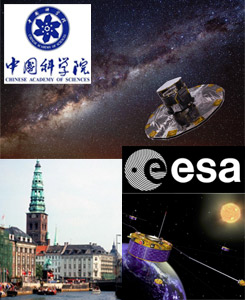 Scientists from Europe and China will present their ideas about a possible joint scientific space mission at the 2nd ESA-CAS workshop in Copenhagen, Denmark on September 23-24. Presentations by joint Europe / China teams will outline specific scientific objectives and early mission concepts for potential missions. More details concerning the technical and programmatic requirements for mission proposals will be provided and discussed at the workshop in preparation for the release of a formal call for missions later this year. Proposals must be co-signed by two Co-PIs, one affiliated with an ESA Member State institution, the other with a China institution. All stages of the mission will be carried out by joint teams and data rights will be shared. Twenty-one pairs will present their mission proposals at the workshop through oral or poster presentations. Possible science objectives include astronomy, solar science and fundamental physics, yet no Moon or Mars mission proposals will be accepted, as they are – in both agencies – covered under different programs. Spacecraft launch mass must be under 300 kg with a science payload under 60 kg, requiring under 65W of power. Both ESA and China are expected to contribute up to US$64M towards the selected mission. (Image Credit: ESA, CAS, Allan Philiba)
 = All times for terrestrial events in local time unless noted.
 = All times for international terrestrial events in local time unless noted.
 = All times for space events, and…
 = All times for international space / astro events in Hawaii Standard Time unless noted. Add 10 hours to obtain UT (‘Universal Time;’ Greenwich, England).