Mars Spacecraft Positioned for Oort Cloud Comet ‘Siding Spring’ Flyby
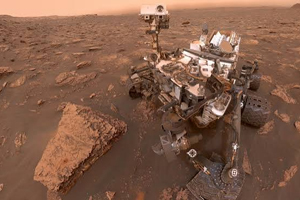
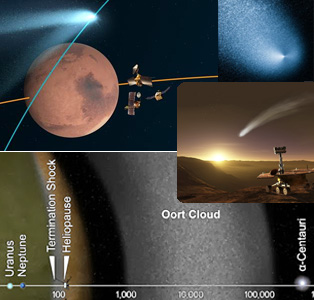
Mars with its 2 functioning rovers (Opportunity, Curiosity) and 5 orbiters (Mars Odyssey, Mars Express, Mars Reconnaissance Orbiter, Mars Orbiter Mission, MAVEN) will experience comet ‘Siding Spring C/2013 A1′ flying by with closest approach October 19 at 18:27 UT. It is expected to pass at ~55 km/sec within 139,500 km of the surface (about 1/3 of the distance between the Moon and Earth). All 7 spacecraft will observe and analyze the comet, as will Hubble, Kepler, Swift, Spitzer, SOHO, Chandra, Hawai’i-based Infrared Telescope Facility, and others. Siding Spring originates from the Oort Cloud, estimated to span from beyond the orbit of Pluto to about 1/4 of the distance to Proxima Centauri, the closest Star. The exact size, shape and composition of the comet’s nucleus is unknown and no Oort Cloud comet has been observed up close before. All 5 orbiters have been positioned behind the planet for protection from potential dust particle impacts. There is also a chance Siding Spring may break apart due to Mars’ gravitational pull. For ~2.5 days as it approaches and flies by, the spacecraft will image the comet and collect data to characterize materials and distributions, meteor trails, interactions with the atmosphere, and effects on air temperature and clouds. (Image Credit: NASA, JPL, Caltech)
MONDAY
Oct 20 — ISS, LEO: Expedition 41 preparing for Russia EVA set for Oct 22, conducting in-flight events Oct 23, filling Progress 56 with waste for undocking Oct 27.
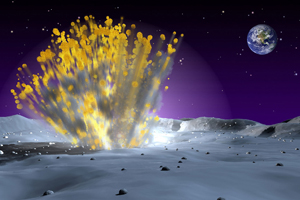
Oct 20 — Lunar Reconnaissance Orbiter,Moon Orbit: Imaging Chang’e-3 landing site, observing Moon for radiation; 20th data set release upcoming; recent data suggests Moon volcanic activity gradually slowed.
Oct 20 — New Horizons, Pluto Trajectory: Traveling at 52,777 kph, now 265 days from Pluto / Charon closest approach; set to wake from hibernation Dec 7; three KBOs ~1.5B km from Pluto have been identified for potential exploration.
Oct 20 —Innovative Solutions In Space, Delft, The Netherlands: NewSpace company being contracted to launch 5 CubeSats for Korea Aerospace Research Institute in 2015 aboard its US partner Spaceflight Inc. Sherpa vehicle.
Oct 20 — Alba Orbital Ltd. (PocketQube Shop), Glasgow, United Kingdom: Offering commercial off-the-shelf components for 5-cm cubed, 150-gram spacecraft including new DHV Technology PocketQube Solar Panel.
Oct 20 — zero2infinity S.L., Cerdanyola del Vallès, Spain: Designing Bloostar nanosat launch system to ascend from seaship using balloon, then 3-stage rocket will put satellite into orbit; next high-altitude balloon launch campaign set for November in Cordoba, Spain.
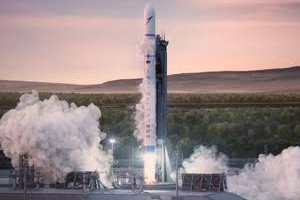
Oct 20 — Up Aerospace, Launch SpaceLoft XL / Conestoga 1 (Earth Rise 6),Las Cruces NM: Up Aerospace to launch 6th Earth Rise mission (13th memorial spaceflight) for Celestis Inc; launch window 08:00 – 10:30 MDT.
= All times for terrestrial events in local time unless noted.
= All times for international terrestrial events in local time unless noted.
= All times for space events, and…
= All times for international space / astro events in Hawaii Standard Time unless noted. Add 10 hours to obtain UT (‘Universal Time;’ Greenwich, England).
China Chang’e Moon Program Advancing with Major Step Toward 2017 Sample Return
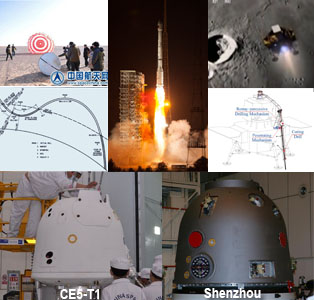
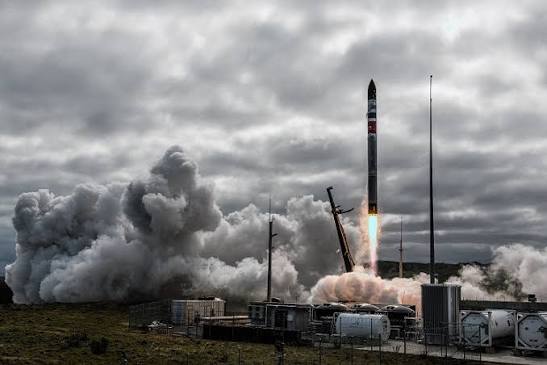
Chang’e-5 Sample Return Test Orbiter (CE5-T1), the fourth flight to the Moon of the ambitious and successful China Lunar Exploration Program, will launch on a Long March 3C/E rocket from the Xichang Satellite Launch Center in southwest China on October 23. The spacecraft consists of the return vehicle, strikingly similar in appearance to the Shenzhou crew capsule, and a Service Module based on the CE2 orbiter design. This stack will be boosted into a parking orbit at about 200km altitude before re-ignition of the cryogenic upper stage for a 3-minute trans-lunar insertion burn. CE5-T1 will enter lunar orbit about 100 hours later. Various tests will be carried out before the craft fires engines to return toward Earth at 11.2km/s. The high speed Skip Re-entry demonstration is a complex procedure designed to reduce heat load and involves the capsule conducting an initial reentry to slow, then steering up to lift out of the atmosphere for a ballistic exospheric segment, followed by a gliding entry that slows the craft down enough to open parachutes and land accurately near Huofutan in Inner Mongolia. The full CE5 mission is set for 2017 and is intended to return up to 2kg of lunar material, including core samples collected via drilling mechanisms, to Earth. It is also widely seen as the final step before China attempts to meld its Human Space Flight program with the Lunar Exploration Program to initiate Human Moon missions. (Image Credit: CNSA, CAST, CASC, NASA, Harbin Institute of Technology, Xinhua)
Oct 21 — Asteroid 2010 VQ: Near-Earth flyby (0.027 AU).
Oct 21 — Asteroid 2340 Hathor: Near-Earth flyby (0.048 AU).
WEDNESDAY
Oct 22 — ISS, Russia EVA 40, LEO: Commander Max Suraev & Alexander Samokutyaev to jettison obsolete gear, photograph Russia side of ISS, starting 13:00 UT, live coverage available.
Oct 22-24 — Lunar Exploration Analysis Group, Johns Hopkins University Applied Physics Laboratory, Laurel MD: Annual Meeting of the LEAG.
Oct 22-24 — MIT, Cambridge MA: MIT Aeronautics and Astronautics Centennial Symposium; featuring Buzz Aldrin, Karol Bobko, Michael Collins, Vance Brand, Philip Chapman, Walter Cunningham, Charlie Duke, Rusty Schweickart & James Lovell.
Oct 23-24 — Application Center GmbH Oberpfaffenhofen (AZO), ESA, et al, Berlin, Germany:Satellite Masters Conference.
Oct 23 — Partial Eclipse of Sun: Visible in East Asia, N America, over Pacific & Atlantic; partial eclipse begins 09:38, greatest eclipse at 11:45, partial eclipse ends 13:53.
Oct 23 — Moon: 0.12° SE of Venus, 11:00; New Moon 11:55.
Oct 23 — Asteroid 2014 SC324: Near-Earth flyby (0.003 AU).
Oct 24 — Cassini, Saturn Orbit: Titan flyby scheduled at 1,013-km altitude.
Oct 24 — Stanford on the Moon (SOM), Stanford CA: SOM 2014 Homecoming Reunion Conference: SOM in the 21st Century, Sustaining and Realizing the Vision: the Next 50 – 75 Years; at Stanford University, Room 200-034, 15:00-17:00 PDT.
Oct 24 — Space Center Houston, Houston TX:Lunch with an Astronaut, John-David Bartoe; US$49.95 adult.
Oct 24 — Venus: At superior conjunction with Sun, 21:00, 1.717 AU from Earth.
SATURDAY
Oct 25 — Muslim New Year 1435 AH, Worldwide: Islamic New Year 1 Muharram (1st day) to begin at sunset; if young New Moon is not visible the beginning of the month and year may be delayed.
Oct 25 — Mercury: At perihelion (distance 46,001,345 km from Sun), 11:00.
SUNDAY
Oct 26 — The Space Show, Tiburon CA / Online: Dr. David Livingston talks with Michael Listner about NASA drone air traffic control system being developed for UAVs.
Oct 26 — Standard Time (Europe): Change clocks back 1 hour, from Summer Time to Standard Time.
Includes ~150 meetings covering the fields of COSPAR Scientific Commissions / Panels / Task Groups, such as SC B: The Earth-Moon System, Planets, and...
From 02 to 07 August 2026, a few thousand geoscientists across diverse disciplines will gather at the 23rd annual meeting of the Asia Oceania Geosciences...
NASA Curiosity (Mars Science Laboratory) rover surpasses another full year of operations on Mars surface today; launched Nov 26, 2011 – landed Aug 5,...
Virtual Series 2026 will offer deeper conversations on why PQC matters and the practical steps businesses should be taking; starts 1:00 pm AEST. Featuring:...
This international lunar science meeting has two objectives: to provide a platform for leading experts to review recent advances across lunar research, from the...
At CSIR International Convention Centre. Key topics are Earth Observation, Developing Space Tourism, Space Supply Manufacturing. Cultural tours are offered.
Participants will receive theoretical and hands-on training in electron imaging and X-ray spectroscopy for application to planetary samples. This training opportunity is targeted at...
"Leading Australia’s Space Future for Our Strategic Advantage". Southern Space 2026 brings together decision-makers who set the direction for Australia’s space sector. It is...
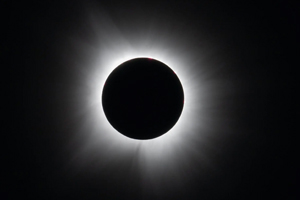
A total solar eclipse with a magnitude of 1.0386 (greatest eclipse 17:47:06 UTC) will be visible in parts of Greenland, Iceland, northern Russia, the Atlantic...
Includes presentation of the Neil Armstrong Award of Excellence, activities for the new class of Astronaut Scholars, 2-day Technical Conference where Scholars present their...
During U.S. spacewalk 97, two astronauts will replace a Space-to-Ground antenna on the orbital complex. The antenna is a critical communication system NASA uses...

 = All times for terrestrial events in local time unless noted.
 = All times for international terrestrial events in local time unless noted.
 = All times for space events, and…
 = All times for international space / astro events in Hawaii Standard Time unless noted. Add 10 hours to obtain UT (‘Universal Time;’ Greenwich, England).