Orion Capsule First Test Flight Crucial for Human Deep Space Missions
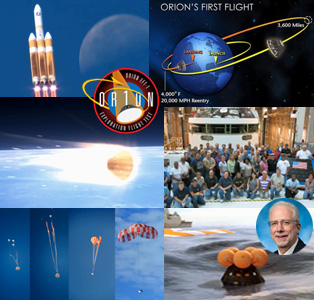
The Orion Multi-Purpose Crew Vehicle is set to launch to ~5,800 km altitude atop a United Launch Alliance Delta IV Heavy rocket on December 4, 2014 at 07:05 EST from Cape Canaveral Air Force Station Space Launch Complex 37B in Florida. It will travel farther from Earth than any crew vehicle has since the Apollo 17 mission in 1972. The 4-hr 23-min 29-sec Exploration Flight Test-1 will test the 5-meter diameter heat shield, parachute systems, avionics, launch abort system and attitude control. After 2 orbits of Earth, the 8,600-kg crew module is expected to separate from the mock-up service module / Delta 4 upper stage and reenter Earth atmosphere at ~32,000 kph, reaching temperatures of ~2,200°C (4,000°F) – about 80% as hot as Orion would experience returning from lunar orbit. Its parachute system should deploy about 4 minutes before splashdown in the Pacific Ocean ~1,000 km west of Baja CA to slow the spacecraft to ~32 kph. This test must be successful to reach the target date of September 30, 2018 for uncrewed circumlunar trajectory 7-day Exploration Mission-1 (EM-1) launching aboard the Space Launch System rocket. The first crewed spaceflight EM-2, planned for 2021, will consist of a 10-14 day mission in Moon orbit. Pictured: NASA Orion Program Manager Mark Geyer and part of the NASA/Lockheed Martin Orion team. (Image Credit: NASA, Lockheed Martin Corp.)
MONDAY
Dec 1 — ISS, LEO: Expedition 42 six-member crew including Cristoforetti (1st woman astronaut from Italy) and Serova (1st woman from Russia to visit ISS) to install small satellite deployer in Kibo module, work on European Physiology Module in Columbus Laboratory, transfer cargo from Soyuz TMA-15M & Progress 57P.
Dec 1 — Tiangong-1, LEO: Orbiting Earth ~16 times a day, collecting data to detect & analyze Sun energy particles, atmosphere properties & ionosphere disturbances; data from hyperspectral imaging to be sold commercially to fund China R&D space efforts.
Dec 1 — Chang’e-3 Lander & Yutu Rover, Sinus Iridum / Mare Imbrium, 44.12°N 19.51°W, Moon Surface: Spacecraft to wake for Lunar Day 13 starting Dec 2; sending radio signals & data back to Earth; Lunar-based Ultraviolet Telescope & Extreme UV Camera on lander, and 4 instruments on rover operating nominally.
Dec 1 — Rosetta, Comet 67P/Churyumov–Gerasimenko Orbit: Studying comet body as it becomes more active / travels toward Sun closet approach Aug 13; planned to reach 20-km altitude orbit Dec 6, over next few months will fly in distant ‘unbound’ orbits, make series of close flybys some within 8 km of comet center.
Dec 1 — Deep Space, Ceres Trajectory: Traveling at 63,543 kph with one-way radio signal travel time of ~1 hour, Dawn spacecraft to begin imaging dwarf planet Ceres Jan 13 and arrive at Ceres NET Mar 2015.
Dec 1 — XCOR Aerospace Inc., Mojave CA: NewSpace company working on new R&D center in Midland TX; testing liquid oxygen / liquid hydrogen engine, working toward running engine in fully closed cycle mode.
Dec 1 — SpaceX, Multiple Locations: Preparing for Dec 16 launch of Dragon CRS-5 ISS resupply mission aboard Falcon 9 v1.1, will attempt to land first stage on floating 90 x 35 meter platform on Atlantic Ocean.
Dec 1 — Explore Mars Inc., Beverly MA: Working to design, build, launch first privately-funded, student-led CubeSat carrying digital data to land on Mars surface by 2019; aiming to raise US$25M.
= All times for terrestrial events in local time unless noted.
= All times for international terrestrial events in local time unless noted.
= All times for space events, and…
= All times for international space / astro events in Hawaii Standard Time unless noted. Add 10 hours to obtain UT (‘Universal Time;’ Greenwich, England).
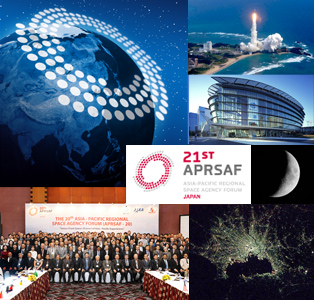
Asia-Pacific Regional Space Agency Forum Session 21 is set for December 2-5 at Miraikan National Museum of Emerging Science And Innovation and Plaza Heisei – Tokyo International Exchange Center. Hosted by the Ministry of Education, Culture, Sports, Science and Technology MEXT and the Japan Aerospace Exploration Agency JAXA the theme is Leap to the Next Stage: Delivering Innovative Ideas and Solutions. Four days of extensive programming includes a special session on Space Exploration moderated by Astronaut Soichi Noguchi who is also President of the Association of Space Explorers; country reports from 14 ASPRAF national partners; as well as technical tours of the Tsukuba and Tanegashima Space Centers. Four working groups cover Space Applications, Space Technology, Space Environment Utilization and Space Education. There will also be presentations by Kiyoshi Higuchi, President of the International Astronautical Federation and David Turner Deputy Director at the Office of Space and Advanced Technology, US Department of State. As of 2014, ASPRAF membership consisted of 472 organizations from 42 countries and regions, supplemented by 27 truly international organizations like the Asian Development Bank, ASEAN Secretariat, UN Economic and Social Commission for Asia and the Pacific, and International Space University. Activities and related projects include a Water Rocket Event at Nihon University, an Asia-Pacific Regional Space Generation Workshop, a Poster Contest and a Kibo-ABC workshop. (Image Credit: APRSAF, JAXA, NASA)
NET Dec 1 — ISRO, Launch GSLV Mk 3 / Atmospheric Test Flight, Satish Dhawan Space Center, Sriharikota, India: Geosynchronous Satellite Launch Vehicle Mk 3 to launch on suborbital test flight, will carry mock-up human crew module.
Dec 2 — ISS, ATV-5 Undocking, LEO: 5th (and final) ESA Automated Transfer Vehicle, named Georges Lemaitre, to undock from Zvezda module, live coverage available, burn up upon Earth atmosphere reentry.
Dec 2-5 — University of Colorado, Boulder CO: L5 Consortium Meeting 2014; to discuss current efforts, pathways toward Sun-Earth L5 mission to study heliophysics.
Dec 2 — Asteroid 2014 WC201: Near-Earth flyby (0.004 AU).
Dec 2 — Asteroid 2014 SF145: Near-Earth flyby (0.061 AU).
Dec 3 — Asteroid 2014 WZ120: Near-Earth flyby (0.047 AU).
THURSDAY
Dec 4 — Kennedy Space Center, NASA, Launch Delta IV Heavy / Orion EFT-1, Cape Canaveral AFS FL: Exploration Flight Test-1 of Orion Multi-Purpose Crew Vehicle to launch craft into highly elliptical orbital trajectory, launch window 07:05 – 09:44 EST; will return to Earth at nearly 80% of the velocity of a return from Moon.
Dec 4 — Arianespace, Launch Ariane 5 / GSAT 16 & DirecTV 14,Kourou, French Guiana: Arianespace to launch Ariane 5 ECA rocket, designated VA221, to deploy GSAT 16 (communications satellite for ISRO) & DirecTV 14 (broadcast satellite for USA).
Includes ~150 meetings covering the fields of COSPAR Scientific Commissions / Panels / Task Groups, such as SC B: The Earth-Moon System, Planets, and...
From 02 to 07 August 2026, a few thousand geoscientists across diverse disciplines will gather at the 23rd annual meeting of the Asia Oceania Geosciences...
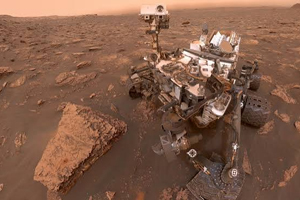
NASA Curiosity (Mars Science Laboratory) rover surpasses another full year of operations on Mars surface today; launched Nov 26, 2011 – landed Aug 5,...
Virtual Series 2026 will offer deeper conversations on why PQC matters and the practical steps businesses should be taking; starts 1:00 pm AEST. Featuring:...
This international lunar science meeting has two objectives: to provide a platform for leading experts to review recent advances across lunar research, from the...
At CSIR International Convention Centre. Key topics are Earth Observation, Developing Space Tourism, Space Supply Manufacturing. Cultural tours are offered.
Participants will receive theoretical and hands-on training in electron imaging and X-ray spectroscopy for application to planetary samples. This training opportunity is targeted at...
"Leading Australia’s Space Future for Our Strategic Advantage". Southern Space 2026 brings together decision-makers who set the direction for Australia’s space sector. It is...
A total solar eclipse with a magnitude of 1.0386 (greatest eclipse 17:47:06 UTC) will be visible in parts of Greenland, Iceland, northern Russia, the Atlantic...
Includes presentation of the Neil Armstrong Award of Excellence, activities for the new class of Astronaut Scholars, 2-day Technical Conference where Scholars present their...
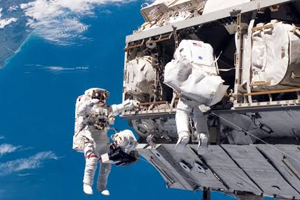
During U.S. spacewalk 97, two astronauts will replace a Space-to-Ground antenna on the orbital complex. The antenna is a critical communication system NASA uses...

 = All times for terrestrial events in local time unless noted.
 = All times for international terrestrial events in local time unless noted.
 = All times for space events, and…
 = All times for international space / astro events in Hawaii Standard Time unless noted. Add 10 hours to obtain UT (‘Universal Time;’ Greenwich, England).