Indonesia Hosts 1st APRSAF Space Exploration Workshop for Asia
The 1st Space Exploration and Kibo Utilization Workshop for Asia is being organized by the Space Environment Utilization Working Group (SEUWG) of the Asia-Pacific Regional Space Agency Forum (APRSAF) for May 28, hosted by the Indonesia National Institute of Aeronautics and Space (LAPAN). A major objective of the Working Group since its inception has been to promote utilization of the Kibo Japanese Experiment Module on the International Space Station among Asian countries in cooperation with Japan, specifically in the fields of life science, space medicine, physics / materials science, space observation, Earth observation and advanced technology demonstration. A broader goal of this workshop is to advance progress on recommendations set at APRSAF-21 in Tokyo last December, including improving our knowledge about the Earth, the Solar System and the Universe by crewed and uncrewed space exploration. The program opens with remarks by Dr. Thomas Djamaluddin of LAPAN and an overview by SEUWG Co-Chair Mr. Yoshiya Fukuda of JAXA. There will be presentations from the Korea Aerospace Research Institute, the National Science and Technology Development Agency of Thailand, the Department of Science and Technology of Philippines and the Vietnam Academy of Science and Technology. The 22nd Session of the APRSAF Annual Meeting will be hosted in Bali, Indonesia December 1-4. (Image Credit: JAXA/NASDA, APRSAF/SEUWG)
MONDAY
May 25 — ISS, LEO: Expedition 43 crew to relocate Permanent Multipurpose Module from Unity to Tranquility Module this week, working with Muscle Atrophy Research & Exercise System and Fluid Shifts study; 3 members scheduled to return to Earth June 11; ISS now 6,030 days in orbit.
May 25 — Tiangong-1, LEO: Currently uncrewed, China space station in 330-370 km orbit with inclination of 42° continuing to collect data for future, larger space station to establish permanent China human presence in LEO by 2020.
May 25 — Venus Climate Orbiter (Akatsuki), Heliocentric Orbit: JAXA spacecraft being monitored for instrument health & thermal conditions, will attempt to achieve Venus orbit in Dec.
May 25 — Juno, Jupiter Trajectory: Traveling at 10 km per second relative to Sun, craft is 681M km from Earth with one-way radio signal travel time of ~38 minutes, in excellent health & operating nominally, has 283M km (~1.89 AU) to go before entering Jupiter orbit.
May 25 — Pioneer Astronautics, Lakewood CO: NewSpace company receiving 2 small business awards to develop nitrous ethane-ethylene rocket engine for small spacecraft & Carbonaceous Asteroid Volatile Recovery (CAVoR) system to extract water & volatiles for propellant, life support, ISRU manufacturing.
May 25 — Moon Express, KSC FL: To transport ‘MoonLIGHT’ laser range finding arrays to Moon for US$24M (half funded by ME) through 4-mission agreement with Italy National Laboratories of Frascati & University of Maryland.
May 25 — Flexure Engineering, Seattle WA: Promoting Lunar Initiatives, preparing for next LunarCubes workshop Oct 6-9 in San Jose, providing cryogenic engineering, optical performance testing, extreme environment testing expertise.
May 25-26 — Terrapinn Holdings Ltd., Russian Satellite Communications Co., SatADSL, et al, Johannesburg, South Africa:Conference: SatCom Africa; at Sandton Convention Centre.
= All times
for terrestrial events in local time unless noted.
= All times for international terrestrial events in local time unless noted.
= All times for space events, and…
= All times for international space / astro events in Hawaii Standard Time unless noted. Add 10 hours to obtain UT (‘Universal Time;’ Greenwich, England).
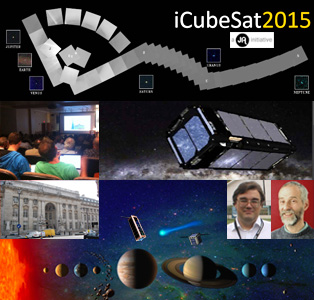
The 4th Interplanetary Workshop (iCubeSat 2015) will be held May 26-27 in South Kensington, London, United Kingdom at Imperial College. The Workshop is organized by JA Initiative, which supports a number of projects for private and peaceful robotic exploration of Space. This year will feature a record 45 presentations and attendees from companies, space agencies and universities from more than 20 countries. Talks, round tables and unconference sessions will focus on technology, science and collaboration. Opening remarks will be given by Michael Johnson of JA Initiative / Pocket Spacecraft and Steven Schwartz, Director of Imperial Space Lab. Notable talks include Onur Celik from Cranfield University UK on ‘CubeSat Landing Opportunities for Binary Asteroid Exploration,’ Frank Crary from University of Colorado USA on ‘Enhanced electromagnetic sounding of Europa’s ocean using CubeSats,’ Andres Dono from NASA Ames USA on ‘Lunar orbit stability for small satellite mission design’ and Xingzhi Hu from National University of Defense Technology China on ‘Uncertainty-based Multidisciplinary Design Optimization of Lunar CubeSat Missions.’ Other topics for CubeSat applications include UV astrophysics, monitoring space weather, technology testbeds, imaging exoplanets and interplanetary CubeSats to study particle acceleration and radiation. (Image Credit: JA Initiative, Pocket Spacecraft, Imperial College, NASA, JPL)
May 1 – Jun 30 — Johnson Space Center, NASA, National Space Grant Foundation, Houston TX:2015 eXploration Habitat (X-Hab); university-level students’ designs for functional space habitat subsystems prototypes to be submitted & evaluated.
May 26-28 — Emirates Institution for Advanced Science and Technology (EIAST), UAE Space Agency, Dubai, United Arab Emirates:Global Space & Satellite Forum 2015.
May 28 — National Institute of Aeronautics and Space (LAPAN), Space Environment Utilization Working Group of Asia-Pacific Regional Space Agency Forum (APRSAF), Jakarta, Indonesia:First Space Exploration Workshop.
May 30 — Asteroid 2015 JZ1: Near-Earth flyby (0.044 AU).
May 30 — Mercury: At inferior conjunction with Sun, 2.08° S of Sun and 0.549 AU from Earth, 07:00.
SUNDAY
NET May 31 — International Launch Services, Launch Soyuz / Inmarsat 5 F3, Baikonur Cosmodrome, Kazakhstan: ILS Proton rocket with Breeze M upper stage to deploy Inmarsat 5 F3 communications satellite for Inmarsat of London.
Includes ~150 meetings covering the fields of COSPAR Scientific Commissions / Panels / Task Groups, such as SC B: The Earth-Moon System, Planets, and...
From 02 to 07 August 2026, a few thousand geoscientists across diverse disciplines will gather at the 23rd annual meeting of the Asia Oceania Geosciences...
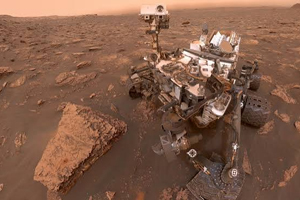
NASA Curiosity (Mars Science Laboratory) rover surpasses another full year of operations on Mars surface today; launched Nov 26, 2011 – landed Aug 5,...
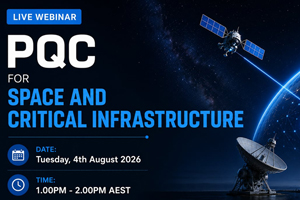
Virtual Series 2026 will offer deeper conversations on why PQC matters and the practical steps businesses should be taking; starts 1:00 pm AEST. Featuring:...
This international lunar science meeting has two objectives: to provide a platform for leading experts to review recent advances across lunar research, from the...
At CSIR International Convention Centre. Key topics are Earth Observation, Developing Space Tourism, Space Supply Manufacturing. Cultural tours are offered.
Participants will receive theoretical and hands-on training in electron imaging and X-ray spectroscopy for application to planetary samples. This training opportunity is targeted at...
"Leading Australia’s Space Future for Our Strategic Advantage". Southern Space 2026 brings together decision-makers who set the direction for Australia’s space sector. It is...
A total solar eclipse with a magnitude of 1.0386 (greatest eclipse 17:47:06 UTC) will be visible in parts of Greenland, Iceland, northern Russia, the Atlantic...
Includes presentation of the Neil Armstrong Award of Excellence, activities for the new class of Astronaut Scholars, 2-day Technical Conference where Scholars present their...
During U.S. spacewalk 97, two astronauts will replace a Space-to-Ground antenna on the orbital complex. The antenna is a critical communication system NASA uses...
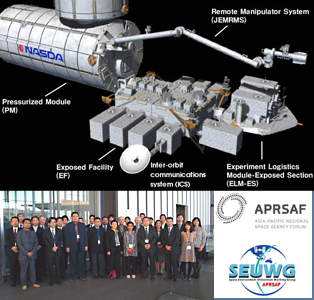 The 1st Space Exploration and Kibo Utilization Workshop for Asia is being organized by the Space Environment Utilization Working Group (SEUWG) of the Asia-Pacific Regional Space Agency Forum (APRSAF) for May 28, hosted by the Indonesia National Institute of Aeronautics and Space (LAPAN). A major objective of the Working Group since its inception has been to promote utilization of the Kibo Japanese Experiment Module on the International Space Station among Asian countries in cooperation with Japan, specifically in the fields of life science, space medicine, physics / materials science, space observation, Earth observation and advanced technology demonstration. A broader goal of this workshop is to advance progress on recommendations set at APRSAF-21 in Tokyo last December, including improving our knowledge about the Earth, the Solar System and the Universe by crewed and uncrewed space exploration. The program opens with remarks by Dr. Thomas Djamaluddin of LAPAN and an overview by SEUWG Co-Chair Mr. Yoshiya Fukuda of JAXA. There will be presentations from the Korea Aerospace Research Institute, the National Science and Technology Development Agency of Thailand, the Department of Science and Technology of Philippines and the Vietnam Academy of Science and Technology. The 22nd Session of the APRSAF Annual Meeting will be hosted in Bali, Indonesia December 1-4. (Image Credit: JAXA/NASDA, APRSAF/SEUWG)
 = All times
 = All times for international terrestrial events in local time unless noted.
 = All times for space events, and…
 = All times for international space / astro events in Hawaii Standard Time unless noted. Add 10 hours to obtain UT (‘Universal Time;’ Greenwich, England).