Hawai`i Hosts LDSD Mars Technology and HI-SEAS Human Analog Testing
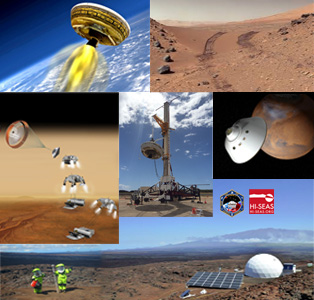
The second Low-Density Supersonic Decelerator (LDSD) test will be conducted off the coast of Kauai, Hawaii from the U.S. Navy Pacific Missile Range Facility with a launch window beginning 07:30 HST on June 2. The JPL / NASA project will boost a saucer-shaped vehicle up to 55,000-meter altitude using an Orbital ATK Star-48 solid rocket motor and helium-filled balloon (consisting of 22 acres of plastic) to test a supersonic inflatable aerodynamic decelerator (SIAD) and an advanced parachute. All elements will then be recovered from the Pacific Ocean by Oahu-owned and operated commercial freight vessels. These technologies have the potential to help increase the surface payload delivery capacity up to 1,500 kg, increase accessible surface area for exploration and improve landing accuracy from 10.5 km to ~1.6 km for human and robotic Mars missions, as well as large payloads returning to Earth. On Hawaii Island the 3rd Hawaii Space Exploration Analog and Simulation (HI-SEAS) Mission run by University of Hawaii is nearing an end on Mauna Loa at 2,438-meter altitude. The 6-member crew (Commander Martha Lenio, Allen Mirkadyrov, Sophie Milam, Neil Scheibelhut, Jocelyn Dunn, Zak Wilson) living in a 2-story, 384-cubic meter volume habitat from October 16, 2014 to June 12, is exploring indoor gardening techniques, water recycling, energy systems, 3D printers, crew dynamics and performance for long-duration Mars missions. (Image Credit: NASA, JPL, Caltech, University of Hawaii, HI-SEAS, Zac Wilson)
MONDAY
Jun 1 — ISS, LEO: Expedition 43 six-member crew conducting studies on fluid physics, earthquake effects on Earth ionosphere & sound waves helping to pinpoint micrometeoroid impacts; work will continue later this year to enable ISS to accommodate 2 commercial cargo & 2 commercial crew vehicles at any given time.
Jun 1 — X-37B Space Plane, 312 x 325 km Earth Orbit: Fourth undisclosed mission of U.S. Air Force to conduct two experiments: electric propulsion thruster test & materials exposure in space environment.
Jun 1 — Lunar Reconnaissance Orbiter, Moon Orbit: Release 22 of LRO Data upcoming this month; craft circling Moon at 20-km altitude above unexplored South Pole to make precise measurements & 165 km at North Pole; meteor impact sites, spacecraft landing & impact sites being mapped.
Jun 1 — Cassini, Saturn Orbit: Orbiting Saturn with 18.9-day period close to planet equatorial plane, studying Enceladus plumes, Titan atmosphere & lakes / rivers, Saturn atmosphere, icy satellites, rings, magnetosphere, dust particles, charged atomic particles, radio & plasma waves.
Jun 1 — Deep Space, Interstellar Space & Heliosheath: Voyager 1 & 2, farthest spacecraft from Earth, continue to transmit signals & communications, detect environmental changes.
Jun 1 — XCOR Aerospace, Mojave CA: NewSpace company receiving additional US$5M investment from Haiyin Capital of China, developing Lynx suborbital craft (set to conduct test flights later this year), advancing wing design with 3D printed titanium parts & composite materials.
Jun 1 — Clyde Space Ltd., Glasgow, Scotland: Working on various projects for ESA, Outernet Inc. of New York & National University of Singapore; Marshall Space Flight Center to continue procuring company’s various CubeSat components.
Jun 1 — Deep Space Industries, McLean VA & Moffett Field CA: Receiving 2 NASA contracts to develop asteroid simulants & to explore methods for manufacturing propellant from asteroids; also developing 24 nanosatellite “BitSat” constellation for Dunvegan Space Systems of Georgia, USA.
= All times
for terrestrial events in local time unless noted.
= All times for international terrestrial events in local time unless noted.
= All times for space events, and…
= All times for international space / astro events in Hawaii Standard Time unless noted. Add 10 hours to obtain UT (‘Universal Time;’ Greenwich, England).
IAPS International Association of Planetary Sciences Forum Set for Kazan, Russia
The Kazan Federal University (KFU), the Ministry of Education and Science of the Russian Federation, the Russian Academy of Sciences and IAPS are organizing a variety of meetings and workshops June 1-7 under the banner SpaceKazan-IAPS-2015. The Forum is taking place at the historic campus of KFU in Kazan, capital of the Republic of Tatarstan, near the confluence of the Volga and Kazanka Rivers about 800 km east of Moscow. As a transportation hub, Kazan serves a region encompassing over 80 million people. The preliminary list of keynote and invited speakers includes Jean-Marie Torrie of OCA, Mikhail Marov of GEOKHI RAS, Jose Manuel Ferrandiz Leal of Alikante University, Ji Wu of NSSC CAS, Shuanggen Jin of SHAO CAS, Kosuke Heki of Hokkaido University, Nadir Haghighipour of University of Hawaii and many others from around the world. There will also be discussion and activities related to a wide array of upcoming, future and proposed missions like Chang’e-4/5/6, Luna Glob, Luna Resource, SELENE-2, Chandrayaan-2, European Lunar Lander, BepiColombo, Juno and JUICE. (Image Credit: IAPS, KFU, NASA, ESA, JAXA, CNSA, ROSCOSMOS)
May 1 – Jun 30 — Johnson Space Center, NASA, National Space Grant Foundation, Houston TX:2015 eXploration Habitat (X-Hab); university-level students’ designs for functional space habitat subsystems prototypes to be submitted & evaluated.
Jun 2 — International Space University US Alumni Association, The Science Club, AIAA National Capital Section,Washington DC: Space Cafe; featuring Doug Messier of Parabolic Arc, 19:00.
Jun 2-12 — Jet Propulsion Laboratory, Caltech/NASA, USN Pacific Missile Range Facility, Barking Sands, Kauai HI: Launch window for NASA to test Low-Density Supersonic Decelerator (LDSD) for Mars entry vehicles; planned tests will boost vehicle up to 55,000 meters using balloon & rocket stages.
Jun 2 — Moon: 9.0° N of Antares, 02:00; Full (Strawberry / Flower Moon), 06:19.
Jun 2 — Mercury: At aphelion (distance 0.4667 AU from Sun), 09:00.
WEDNESDAY
Jun 3 — British Interplanetary Society, London, United Kingdom: Lecture: The Beagle 2 Story; presented by Phil Molloy.
Jun 3 — Asteroid 2015 KM57: Near-Earth flyby (0.017 AU).
Jun 3 — Asteroid 2015 KV120: Near-Earth flyby (0.071 AU).
Jun 3 — Asteroid 2015 KN18: Near-Earth flyby (0.089 AU).
Jun 5 — Asteroid 2015 KA122: Near-Earth flyby (0.008 AU).
SATURDAY
Jun 6-7 — Cosmic Con, Manchester, United Kingdom: Cosmic-Con; featuringApollo 15 Astronaut Al Worden, Skylab 3 Astronaut Jack Lousma, 4 time Shuttle Astronaut Kathy Thornton, 4 time Shuttle Astronaut Don Thomas.
Jun 6 — Asteroid 2005 YK: Near-Earth flyby (0.061 AU).
SUNDAY
Jun 7 — The Space Show, Online / Tiburon CA: Dr. David Livingston talks with Dan Adamo, Co-founder of Space Enterprise Institute.
Includes ~150 meetings covering the fields of COSPAR Scientific Commissions / Panels / Task Groups, such as SC B: The Earth-Moon System, Planets, and...
From 02 to 07 August 2026, a few thousand geoscientists across diverse disciplines will gather at the 23rd annual meeting of the Asia Oceania Geosciences...
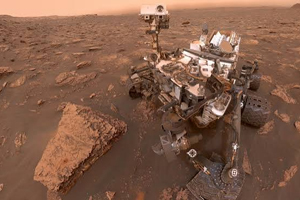
NASA Curiosity (Mars Science Laboratory) rover surpasses another full year of operations on Mars surface today; launched Nov 26, 2011 – landed Aug 5,...
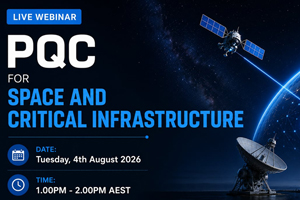
Virtual Series 2026 will offer deeper conversations on why PQC matters and the practical steps businesses should be taking; starts 1:00 pm AEST. Featuring:...
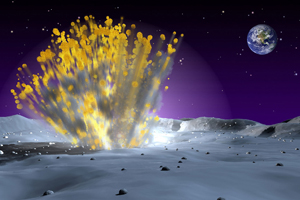
This international lunar science meeting has two objectives: to provide a platform for leading experts to review recent advances across lunar research, from the...
At CSIR International Convention Centre. Key topics are Earth Observation, Developing Space Tourism, Space Supply Manufacturing. Cultural tours are offered.
Participants will receive theoretical and hands-on training in electron imaging and X-ray spectroscopy for application to planetary samples. This training opportunity is targeted at...
"Leading Australia’s Space Future for Our Strategic Advantage". Southern Space 2026 brings together decision-makers who set the direction for Australia’s space sector. It is...
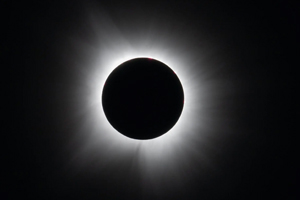
A total solar eclipse with a magnitude of 1.0386 (greatest eclipse 17:47:06 UTC) will be visible in parts of Greenland, Iceland, northern Russia, the Atlantic...
Includes presentation of the Neil Armstrong Award of Excellence, activities for the new class of Astronaut Scholars, 2-day Technical Conference where Scholars present their...
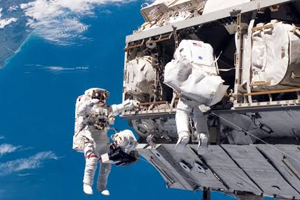
During U.S. spacewalk 97, two astronauts will replace a Space-to-Ground antenna on the orbital complex. The antenna is a critical communication system NASA uses...
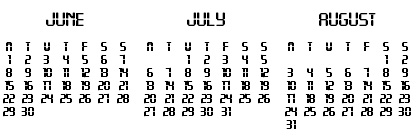
 = All times
 = All times for international terrestrial events in local time unless noted.
 = All times for space events, and…
 = All times for international space / astro events in Hawaii Standard Time unless noted. Add 10 hours to obtain UT (‘Universal Time;’ Greenwich, England).
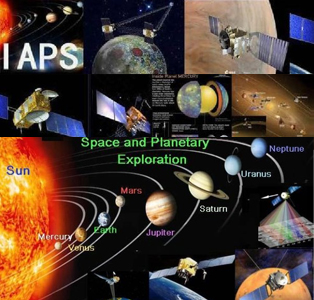 The Kazan Federal University (KFU), the Ministry of Education and Science of the Russian Federation, the Russian Academy of Sciences and IAPS are organizing a variety of meetings and workshops June 1-7 under the banner SpaceKazan-IAPS-2015. The Forum is taking place at the historic campus of KFU in Kazan, capital of the Republic of Tatarstan, near the confluence of the Volga and Kazanka Rivers about 800 km east of Moscow. As a transportation hub, Kazan serves a region encompassing over 80 million people. The preliminary list of keynote and invited speakers includes Jean-Marie Torrie of OCA, Mikhail Marov of GEOKHI RAS, Jose Manuel Ferrandiz Leal of Alikante University, Ji Wu of NSSC CAS, Shuanggen Jin of SHAO CAS, Kosuke Heki of Hokkaido University, Nadir Haghighipour of University of Hawaii and many others from around the world. There will also be discussion and activities related to a wide array of upcoming, future and proposed missions like Chang’e-4/5/6, Luna Glob, Luna Resource, SELENE-2, Chandrayaan-2, European Lunar Lander, BepiColombo, Juno and JUICE. (Image Credit: IAPS, KFU, NASA, ESA, JAXA, CNSA, ROSCOSMOS)