Cassini Spacecraft Nears 11 Years of Saturn Exploration, 18 Years in Space
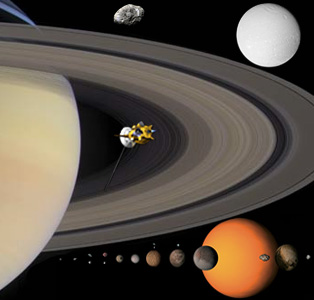
The multinational Cassini orbiter will reach 11 full years of science operations in Saturn orbit on June 30 and 18 years in space October 15. A joint mission of NASA, ESA and ASI, the craft is the 4th to visit Saturn and the 1st to enter orbit. It is currently circling Saturn with a period of 18.9-days, 0.3° from the gas giant’s equatorial plane. Between June 15-16 Cassini is planned to make flybys of 8 of 62 known Saturn moons: Dione (516 km), Polydeuces (35,000 km), Telesto (44,000 km), Janus (101,000 km), Methone (110,000 km), Atlas (111,000 km), Pan (118,000 km) and Titan (958,000 km). A particular goal of the Dione (upper right) flyby will be to map the quarter of the hemisphere that faces Saturn including the tectonically deformed terrain named “Eurotas Chasmata” first observed by the Voyager mission 35 years ago. Cassini made its final close approach of Hyperion (upper left) at 34,000 km on May 31. Investigation teams continue to convene at science meetings on Juno-Cassini, Jupiter-Saturn magnetosphere, one of which will be held June 22-26 at JPL in Pasadena. Cassini is expected to collect data on Saturn, its rings and moons until its planned fall into Saturn atmosphere on September 15, 2017. (Image Credit: NASA, JPL, Caltech, SSI, ESA, ASI)
MONDAY
Jun 15 — ISS, LEO: Expedition 44 crew with Gennady Padalka as Commander performing station, computer & spacesuit maintenance, working with Fine Motor Skills experiment to test Astronaut interactions with touch-based technologies & spacecraft instrumentation; Scott Kelly & Mikhail Kornienko now 80 days into their 1-year mission.
Jun 15 — Rosetta, Comet 67P/Churyumov–Gerasimenko Orbit: Studying comet with 11 science instruments from distances varying between hundreds of km to 8 km; mission engineers proposing to land craft next to Philae on comet surface to extend mission life / gather further data.
Jun 15 — Juno, Jupiter Trajectory: Craft in nominal health has 265M km before reaching Jupiter, traveling at 36 km/sec relative to Earth with a one-way radio signal time of 41 mins, has traveled 2.56B km.
Jun 15 — Cassini,Saturn Orbit: Polydeuces flyby scheduled at 35,000-km altitude; craft continuing to collect data on “invisible” Phoebe ring believed to be twice the thickness originally measured.
Jun 15 — Astrobotic Technology Inc., Pittsburgh PA: NewSpace company working on agreement with Mexican Space Agency (Agencia Espacial Mexicana – AEM) to develop & deliver 1st Latin American payload to Moon on Astrobotic Griffin Lander; payload to be decided Fall 2015.
Jun 15 — Generation Orbit Launch Services LLC, Atlanta GA: Developing GOLauncher 2 two-stage rocket system capable of carrying 40 kg to LEO for US$2.5M; GOLauncher 1 first flight planned for 2017; continuing fundraising efforts, has MoU with Jacksonville Cecil Spaceport & 11 Letters of Intent from future customers.
Jun 15 — Spire, Singapore, USA & Scotland: Opening third office in Glasgow, Scotland, working to build & launch ~50 Earth observation CubeSats.
Jun 15 — Tennessee Valley Interstellar Workshop, Online / Chattanooga TN:Proposals for Working Tracks Due: 2016 Tennessee Valley Interstellar Workshop: From Iron Horse to Worldship: Becoming an Interstellar Civilization; to be held Feb 28 – Mar 2, 2016.
= All times
for terrestrial events in local time unless noted.
= All times for international terrestrial events in local time unless noted.
= All times for space events, and…
= All times for international space / astro events in Hawaii Standard Time unless noted. Add 10 hours to obtain UT (‘Universal Time;’ Greenwich, England).
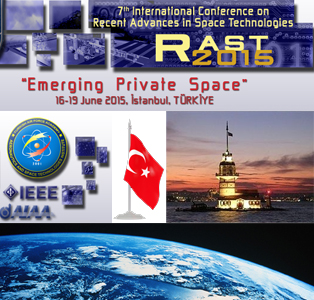
Turkey hosts IEEE and AIAA International Space Conference
The 7th International Conference on Recent Advances in Space Technologies “RAST 2015” is being organized by the Aeronautics and Space Technologies Institute of the Turkish Air Force Academy in cooperation with the Institute of Electrical and Electronics Engineers (IEEE) and the American Institute of Aeronautics and Astronautics (AIAA) on 16-19 June in Istanbul, Turkey. The theme of the event is Emerging Private Space and there will be contributions from Algeria, Azerbaijan, Egypt, Iran, Lebanon, Malaysia, Norway, Pakistan, Romania Singapore, South Africa, Switzerland, Taiwan, and Tunisia, among others. The Opening Ceremony includes Maj.Gen. Fethi Alpay of Turkish Air Force Academy, Garrett Smith of Spacelines and Dr. Charles Elachi of NASA-JPL. There will be three plenary sessions with multiple presentations on diverse topics, including Space Strategies for Developing Countries by Herman Steyn, Low-Cost Nano-Launch Vehicle via Delethalizing Rocket Propulsion by Toru Shimada, and The Need For Sustainable Use of Outer Space by Kai-Uwe Schrogl. The conference is prefaced on Tuesday by a Tutorial on Design and Testing of Nanosatellites at the Istanbul Technical University Maslak and Gumussuyu Campus. (Image Credit: TAFA, IEEE, AIAA, NASA)
May 1 – Jun 30 — Johnson Space Center, NASA, National Space Grant Foundation, Houston TX:2015 eXploration Habitat (X-Hab); university-level students’ designs for functional space habitat subsystems prototypes to be submitted & evaluated.
Jun 18, 19 — Jet Propulsion Laboratory, Caltech/NASA, Pasadena CA: von Kármán Lecture Series: On Sea Ice; presented by Ron Kwok, Senior Research Scientist at JPL.
Jun 18 — Moon: 15.0° S of Castor, 03:00; 11.5° S of Pollux, 09:00.
Jun 18 — Mars: Spring equinox, 03:00.
Jun 18 — Asteroid 2015 LG: Near-Earth flyby (0.023 AU).
Jun 19 — AIAA San Francisco Section, Mountain View CA: 2015 AIAA Annual Banquet; featuring CEO of Space Puerto Rico, and Sean Casey, Managing Director of SVSC.
Jun 21 — Summer Solstice: Longest day of the year (opposite in Southern Hemisphere) as Sun, traveling along ecliptic, reaches a point farthest north of celestial equator; 06:38.
Jun 21 — Moon: 3.5° S of Regulus, 09:00.
Jun 21 — Asteroid 2010 LN14: Near-Earth flyby (0.048 AU).
Includes ~150 meetings covering the fields of COSPAR Scientific Commissions / Panels / Task Groups, such as SC B: The Earth-Moon System, Planets, and...
From 02 to 07 August 2026, a few thousand geoscientists across diverse disciplines will gather at the 23rd annual meeting of the Asia Oceania Geosciences...
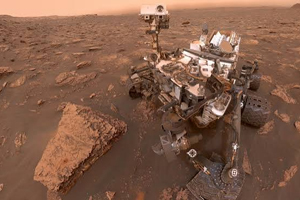
NASA Curiosity (Mars Science Laboratory) rover surpasses another full year of operations on Mars surface today; launched Nov 26, 2011 – landed Aug 5,...
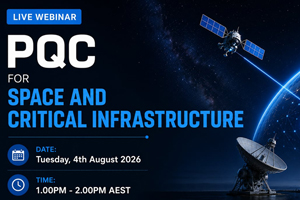
Virtual Series 2026 will offer deeper conversations on why PQC matters and the practical steps businesses should be taking; starts 1:00 pm AEST. Featuring:...
This international lunar science meeting has two objectives: to provide a platform for leading experts to review recent advances across lunar research, from the...
At CSIR International Convention Centre. Key topics are Earth Observation, Developing Space Tourism, Space Supply Manufacturing. Cultural tours are offered.
Participants will receive theoretical and hands-on training in electron imaging and X-ray spectroscopy for application to planetary samples. This training opportunity is targeted at...
"Leading Australia’s Space Future for Our Strategic Advantage". Southern Space 2026 brings together decision-makers who set the direction for Australia’s space sector. It is...
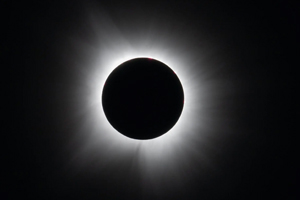
A total solar eclipse with a magnitude of 1.0386 (greatest eclipse 17:47:06 UTC) will be visible in parts of Greenland, Iceland, northern Russia, the Atlantic...
Includes presentation of the Neil Armstrong Award of Excellence, activities for the new class of Astronaut Scholars, 2-day Technical Conference where Scholars present their...
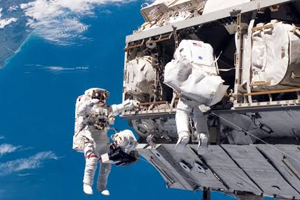
During U.S. spacewalk 97, two astronauts will replace a Space-to-Ground antenna on the orbital complex. The antenna is a critical communication system NASA uses...
 = All times
 = All times for international terrestrial events in local time unless noted.
 = All times for space events, and…
 = All times for international space / astro events in Hawaii Standard Time unless noted. Add 10 hours to obtain UT (‘Universal Time;’ Greenwich, England).