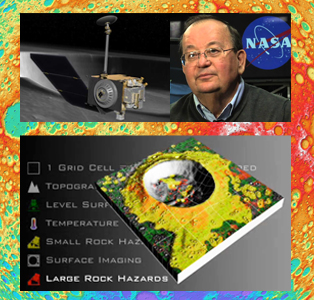
Lunar Reconnaissance Orbiter, the flagship NASA lunar mission of the 21st Century so far, is one of the most sophisticated robotic craft to study the Moon. The 1,900-kg, US$504M mission is entering year 7 in progressively lower orbits over the South Pole of our nearest celestial neighbor. Flying within 20 km of the surface, it is carrying 7 power instruments that generate data of increasingly higher spatial resolution. Release 22, the latest data set from LRO, is being poured over by scientists around the world after its publication June 15 via the Planetary Data System at the Geosciences Node. One of the primary LRO objectives is to scout safe landing sites for future human and robotic missions. Scientists can highlight areas suitable for landing from an engineering standpoint by layering topographical data from LOLA (Lunar Orbiter Laser Altimeter), temperature data from Diviner showing prevalence of small boulders and detailed stereographic data from LROC to refine the characterization and pick out larger obstacles. Then of course, many other variables will be taken into consideration in choosing the most interesting and viable location to achieve various government and independent mission priorities in terms of science, longevity, resource utilization, communications, etc. With the volume and quality of data being produced, the $12.4M ongoing annual operating costs seem a reasonable contribution to make toward Human civilization being better prepared to reclaim its status as a multi world species. As LRO Project Scientist Rich Vondrak put it, “LRO is the next step in learning to live and work off of our planet and it’s a wonderful investment in our future.” (Image Credit: NASA / GSFC)
MONDAY
Jun 22 — ISS, LEO: Three-member Expedition 44 crew investigating effects of weightlessness in carotid artery & upper half of body, preparing for arrival of Dragon CRS-7 supply ship containing 1st International Docking Adapter (IDA-1) which will facilitate future docking of human transport vehicles; ISS now 6,059 days in space.
Jun 22 — Hayabusa 2, Asteroid 1999 JU3 Trajectory: JAXA explorer preparing for Earth flyby in December, ion engine & craft remain operational & in good health; expected to reach asteroid in June / July 2018.
Jun 22 — New Horizons, Pluto Trajectory: NASA craft performing approach science operations & hazard-search observations, 22 days & ~280,000,000 km from Pluto system flyby.
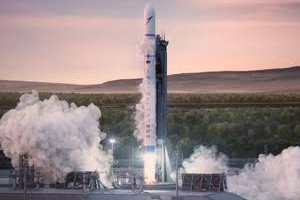
Jun 22 — ESA, Launch Vega / Sentinel 2A, Kourou, French Guiana: Europe Vega rocket, designated VV05, to launch Sentinel 2A Earth observation satellite for European Space Agency and European Commission, 21:51.
Jun 22 — Shackleton Energy Company, Del Valle TX: NewSpace company planning to use plasma-drilling technology to mine Moon for fuel & consumables for lunar / Space / Earth-return missions; will begin with 2-3 years of robotic prospecting at South & North pole.
Jun 22 — Escape Dynamics, Broomfield CO: Working to engineer single-stage-to-orbit reusable electromagnetically powered spaceplanes for orbital launches by 2020.
Jun 22 — BlackSky Global, Seattle WA: Developing fleet of 1-meter long satellites to provide Earth images & video (at 1 frame per second) in near-real time, planning to launch 6 before 2017 & have total of 60 in orbit by 2019 to observe major cities & economic zones between 40-70 times a day.
for terrestrial events in local time unless noted.
= All times for international terrestrial events in local time unless noted.
= All times for space events, and…
= All times for international space / astro events in Hawaii Standard Time unless noted. Add 10 hours to obtain UT (‘Universal Time;’ Greenwich, England).
Europe to Launch Vega Rocket and Host Astronomy, Space Technology and Industry Conferences
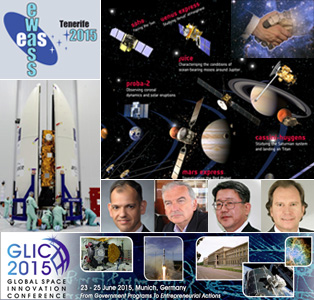
The summer season begins in Europe with the 2015 European Week of Astronomy and Space Sciences (EWASS) in Tenerife, Canary Islands on June 22-26. The European and Spanish Astronomical Societies, Astrophysics Institute of Canarias and La Laguna University conference will feature lectures, social events and excursions focused on stars, galaxies, exoplanets, cosmology, instrumentation and outreach. More than 400 people from 50 countries are expected to attend. On June 23 ESA is planning to launch the 30-meter long, three-stage Vega rocket, designated VV05, at 21:51 EDT to send the Sentinel 2A Earth observation satellite into polar, Sun-synchronous orbit at 786-km altitude. The Global Space Innovation Conference (GLiC 2015) will run from June 23-25 in Munich, Germany, supported by IAF, DLR and ESA. With the theme “From Government Programs to Entrepreneurial Actions” GLiC will address key factors to advance commercial space industry and technologies in 6 plenary panel sessions, an exhibition, keynote speeches and a young professionals ‘SpaceUp’ unconference. The Global Chief Technologies Officer Conversation will be moderated by (L-R) Robie Roy of Lockheed Martin and include panelists Piero Messidoro of Thales Alenia Space, Yasunori Mochizuki of NEC Central Research Laboratories Japan and Andreas Rittweger of DLR. ESA is also hosting an Industry Day at European Space Operations Centre in Darmstadt, Germany on June 25-26 to further advance Europe industry collaboration in space sectors and with ESA. (Image Credit: EWASS, ESA, NASA, IAF, DLR, Arianespace)
Jun 22-26 — European Astronomical Society, Spanish Astronomical Society, Canaries Institute of Astrophysics, University of San Fernando, Tenerife, Canary Islands, Spain: 2015 European Week of Astronomy and Space Science (EWASS).
May 1 – Jun 30 — Johnson Space Center, NASA, National Space Grant Foundation, Houston TX:2015 eXploration Habitat (X-Hab); university-level students’ designs for functional space habitat subsystems prototypes to be submitted & evaluated.
Jun 23 — Lunar Reconnaissance Orbiter, Moon Orbit: NASA spacecraft enters 7th year of operations in Moon orbit today; launched Jun 18, 2009.
Jun 23 — International Space University, Glenn Research Center, NASA, Ohio University, Athens OH:ISU 28th Space Studies Program Public Event: Entrepreneurial Space Panel; featuring Chris Stott (ManSat), Jeffrey Manber (NanoRacks), Adil Jafry (Chandah Space Tech), Will Marsahll (Planet Labs).
Jun 23 — XPrize Foundation, Online: Last Day to Register: 2015 Moonbots Challenge; international on-line competition for 8 to 17 year olds to form a team to design, create, program their own robots.
Jun 27 — Asteroid 2013 VY9: Near-Earth flyby (0.087 AU).
SUNDAY
Jun 28 — SpaceX, Launch Falcon 9 / CRS 7,Cape Canaveral AFS FL: SpaceX Falcon 9 rocket set to launch 9th Dragon spacecraft on 7th operational cargo delivery mission to ISS at 10:21, live coverage available; SpaceX will attempt to land first-stage of rocket on Autonomous Spaceport Drone Ship floating platform in Atlantic Ocean.
Includes ~150 meetings covering the fields of COSPAR Scientific Commissions / Panels / Task Groups, such as SC B: The Earth-Moon System, Planets, and...
From 02 to 07 August 2026, a few thousand geoscientists across diverse disciplines will gather at the 23rd annual meeting of the Asia Oceania Geosciences...
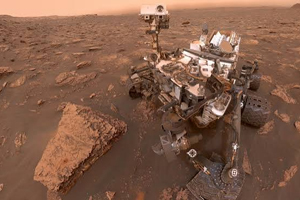
NASA Curiosity (Mars Science Laboratory) rover surpasses another full year of operations on Mars surface today; launched Nov 26, 2011 – landed Aug 5,...
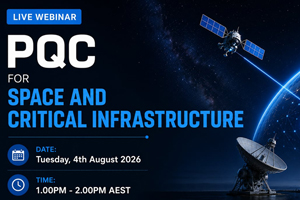
Virtual Series 2026 will offer deeper conversations on why PQC matters and the practical steps businesses should be taking; starts 1:00 pm AEST. Featuring:...
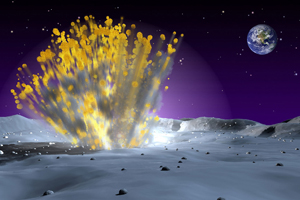
This international lunar science meeting has two objectives: to provide a platform for leading experts to review recent advances across lunar research, from the...
At CSIR International Convention Centre. Key topics are Earth Observation, Developing Space Tourism, Space Supply Manufacturing. Cultural tours are offered.
Participants will receive theoretical and hands-on training in electron imaging and X-ray spectroscopy for application to planetary samples. This training opportunity is targeted at...
"Leading Australia’s Space Future for Our Strategic Advantage". Southern Space 2026 brings together decision-makers who set the direction for Australia’s space sector. It is...
A total solar eclipse with a magnitude of 1.0386 (greatest eclipse 17:47:06 UTC) will be visible in parts of Greenland, Iceland, northern Russia, the Atlantic...
Includes presentation of the Neil Armstrong Award of Excellence, activities for the new class of Astronaut Scholars, 2-day Technical Conference where Scholars present their...
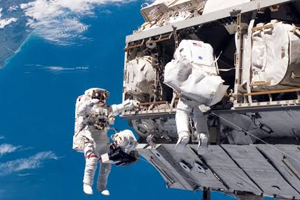
During U.S. spacewalk 97, two astronauts will replace a Space-to-Ground antenna on the orbital complex. The antenna is a critical communication system NASA uses...

 = All times
 = All times for international terrestrial events in local time unless noted.
 = All times for space events, and…
 = All times for international space / astro events in Hawaii Standard Time unless noted. Add 10 hours to obtain UT (‘Universal Time;’ Greenwich, England).
 The summer season begins in Europe with the 2015 European Week of Astronomy and Space Sciences (EWASS) in Tenerife, Canary Islands on June 22-26. The European and Spanish Astronomical Societies, Astrophysics Institute of Canarias and La Laguna University conference will feature lectures, social events and excursions focused on stars, galaxies, exoplanets, cosmology, instrumentation and outreach. More than 400 people from 50 countries are expected to attend. On June 23 ESA is planning to launch the 30-meter long, three-stage Vega rocket, designated VV05, at 21:51 EDT to send the Sentinel 2A Earth observation satellite into polar, Sun-synchronous orbit at 786-km altitude. The Global Space Innovation Conference (GLiC 2015) will run from June 23-25 in Munich, Germany, supported by IAF, DLR and ESA. With the theme “From Government Programs to Entrepreneurial Actions” GLiC will address key factors to advance commercial space industry and technologies in 6 plenary panel sessions, an exhibition, keynote speeches and a young professionals ‘SpaceUp’ unconference. The Global Chief Technologies Officer Conversation will be moderated by (L-R) Robie Roy of Lockheed Martin and include panelists Piero Messidoro of Thales Alenia Space, Yasunori Mochizuki of NEC Central Research Laboratories Japan and Andreas Rittweger of DLR. ESA is also hosting an Industry Day at European Space Operations Centre in Darmstadt, Germany on June 25-26 to further advance Europe industry collaboration in space sectors and with ESA. (Image Credit: EWASS, ESA, NASA, IAF, DLR, Arianespace)