Vol 44, No 40: Lunar Broadcast Precursor: Terrestrial Edition
Dubai Space-Comm Expo 2025 Promoting Space Partnerships to Address Global Challenges
Space-Comm Expo Dubai, October 8-9 at Dubai World Trade Centre, is one of the largest space industry gatherings in the Middle East / West Asia. Hub Exhibitions is organizing the event with UAE Space Agency. This trade-only expo, accessible via space-comm.me, attracts Astronauts, CEOs and innovators for B2B deals, technology demonstrations and keynotes. The expo aligns with UAE National Space Strategy 2030, which outlines 6 objectives, 21 programs and 79 initiatives to position UAE among the top 5 space powers by 2030. Crown Prince Hamdan bin Al Maktoum, Chairman of Supreme Space Council, drives public-private partnerships to diversify the AED د.إ.20 billion (US$5.4 billion) space sector, projected to triple by 2030. November 17-21, Dubai Airshow highlights advanced aviation and strategic partnerships. Mohammed Bin Rashid Space Centre launched the 750-kg MBZ-SAT, a high-resolution Earth-observation satellite, from Vandenberg Space Force Base in January 2025 with 90% local manufacturing. Emirates Mission to the Main Asteroid Belt, launching in 2028, will flyby 6 asteroids and land on 269 Justitia in 2034. January 2024 NASA agreement will fly an Emirati Astronaut to the lunar orbit Gateway, featuring a UAE-built Emirates Airlock. Yahsat has AED د.إ.25.1 billion in future contracts. EOS-X Space offers suborbital flights from Abu Dhabi for AED د.إ.600,000. MBRSC Rashid 2 Rover targets a 2026 far-side-Moon landing via Firefly Blue Ghost lander. (Image Credits: Govt. of Dubai Media Office)
The Many Missions of Blue Origin
October 8, Blue Origin launches 36th New Shepard suborbital, and bridges space tourism with human expansion across the Solar System via many other projects. New partnership fostered by Blue Origin Luxembourg office with GOMSpace, ESRIC and that country’s national space agency is for Project Oasis that will integrate the Blue Origin Blue Alchemist ISRU project to manufacture on the Moon surface, processing regolith into oxygen and solar cells. US$190M NASA Commercial Lunar Payload Services award is to deliver Volatiles Investigating Polar Exploration Rover (VIPER) to Moon South Pole NET 2027, reviving the water-hunting mission previously canceled, after first Blue Origin robotic Moon lander late 2025. For VIPER, Blue Origin will modify Blue Moon Mark 1 lunar lander to mount VIPER ~450 kilograms and offload it onto Moon surface. Mark 1 flies via Blue Origin New Glenn rocket, ~45,000 kg, ~98 meters tall (with Starship ~120), seven BE-4 engines in the reusable 1st stage and two BE-3U engines in the 2nd stage. 2nd New Glenn launch, NET October 13 from Cape Canaveral, sends NASA twin Mars orbital probes Escape and Plasma Acceleration and Dynamics Explorers (ESCAPADE) to study magnetosphere, atmosphere and solar wind at the 4th planet, advancing humanity toward a multiworld future.(Image Credits: Blue Origin, NASA)
Humans in Space
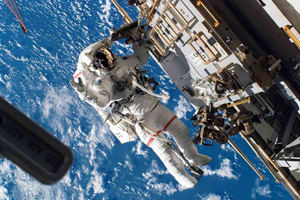
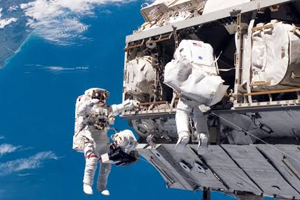
International Space Station, ~415-km LEO: Expedition 73 seven-member crew are performing maintenance on life support and electronics, sequencing DNA, studying the digestive system in microgravity, conducting the yearly inspection inside the Roscosmos modules for moisture / corrosion / damage, installing / activating a new dehumidifying system and operating an Electrostatic Levitation Furnace to heat materials to ultra-high temperature and then measure them with physics sensors.
Tiangong Space Station, ~390-km LEO: Shenzhou 20 three-member crew 4th spacewalk (SZ-20 EVA-4) ties the record for most EVAs by a Tiangong crew as they inspect its 3 modules and 2 docked spacecraft and install more panels for space debris protection; crew continues to test the Wukong Artificial Intelligence model, which has a Q&A system designed to give timely and effective support during complicated tasks such as preparing for a spacewalk, thus reducing Taikonaut stress.
Lunar News: Weekly lunar advisories [coming soon]
Near-Earth Objects Close Approaches – Tues Oct 7: Apollo Asteroid 2025 SM15 (0.020 AU); Wed Oct 8: Apollo Asteroid 2022 TU1 (0.043 AU); Thu Oct 9: Aten Asteroid 2020 QU5 (0.018 AU).
Celebrating international contributions of space science for betterment of the human condition; Oct 4 is 68th observation of 1st Space mission Sputnik One launched by Soviet Union 1957; Oct 10 is 58th observation of Outer Space Treaty going into effect 1967.
2nd annual ROBOPALOOZA.space festival will take place at the Australian Automation and Robotics Precinct (AARP), feature Student and Business Innovation Pitch Battles, IEEE Telepresence Competition with US$5,000 prize that was won last year by team from Perth. Theme: SPACE + ROBOTS + ROCK N' ROLL
To facilitate meetings between individuals and their elected officials to push back against proposed cuts to NASA science funding in FY 2026; at United States Capitol Building. Preparation on Oct 5; meetings on Oct 6.
Purpose and Scope This hybrid workshop will feature invited and contributed presentations aimed at studies of returned samples from Bennu (OSIRIS-REx mission) and Ryugu (Hayabusa2 mission), and perspectives on future asteroidal sample return. In the past five years, NASA’s OSIRIS-REx and JAXA’s Hayabusa2 missions have made history by returning the […]
What it'll cover: Context of Space Frontier Foundation Policy Work DC Insider Situation Report Moderated Q&A From the SFF Outreach Email: D.C. continues to be our nation’s capital of chaos and confusion… but with change comes opportunities to reform and advance our nation’s space agenda. Over eight months into the […]
Appearing when Earth passes through the tail of Comet 21P / Giacobini-Zinner, the comet was a perihelion in 2025; speculation has arisen this may be a year with peak yielding many hundreds per hour. However, the Full Moon the day prior may compromise viewing. Most years show 10-20 per hour, […]
From inflationary pressures and shifting interest rates to supply chain challenges and intensifying great-power competition, today’s macroeconomic and geopolitical forces are reshaping the future of space investment. For investors and businesses, navigating this environment means balancing capital market dynamics, technology cycles, and an increasingly complex landscape of export controls, trade […]
Presentation by Ann Ollila of Los Alamos National Laboratory: Advancing Spectroscopy Instrumentation for Planetary Exploration from the Subsurface to the Sky. Join here: https://sservi.nasa.gov/casa-moon-seminar-series Hosted by CASA Moon, SSERVI, Institute of Meteoritics at UNM, University of New Mexico Grand Challenge, Lunar and Planetary Institute (LPI) and RASSLE (Research Activities Supporting Science […]
Citizen Scientists can now contribute to mapping areas of the Moon dominated by impact melt deposits in our NASA-funded project. There is no cost to participate: Press release: https://science.nasa.gov/get-involved/citizen-science/help-map-the-moons-molten-flows/ Click on "Lunar Melt:" https://mappers.psi.edu/ I will hold a half-hour informational session on this next Thursday, Oct. 9 at 1 pm […]
Wenchang Space Launch Center, ~19°N, Hainan Island, China
8A is capable of taking 7,000kg to orbit, including and SSO with altitude 700km, using a liquid oxygen / liquid hydrogen 2nd stage. Wenchang is China's southernmost spaceport, selected for its low latitude, 19° north of the equator, allowing for larger payloads to be launched. It is capable of launching […]
At University of Texas Permian Basin (UTPB), College of Engineering Building Speaker sessions, panels, roundtables, debate, networking Subjects: safety, technology, business, infrastructure, legal, legislation Chair: Oscar Garcia, Chair and CEO, InterFlight Global Corporation and FastForward Group Host Midland Air and Spaceport is called "The world's first airline and spaceport complex." […]
At the European Space Research and Technology Centre (ESTEC), the largest site of the ESA, is a weekend celebration with theme Living in Space that also includes the Orionids Meteor Shower, a celebration of half a century for ESA, and is part of World Space Week.
At the University of Southern California, the world's largest gathering dedicated to human Mars exploration. For nearly three decades, the International Mars Society Convention...
NASA spacecraft surpasses another full year in orbit around Mars today, holds record for longest-surviving continually active spacecraft in orbit around a planet other...
At the Spokane Convention Center. The meeting will have a broad scope, with a wide-ranging program of science and workforce topics, and celebrating planetary...
Convene, connect, and collaborate at the 19th annual von Braun Space Exploration Symposium! This year’s event will spotlight how bold ideas, emerging technologies, and...
Themes include: Space & the Arctic; Space & AI; Space & International Collaboration. There is a Student Session, a Technical Session, a Frontier Session,...
Oslo Spaceport Norway offers monthly a knowledgeable speaker and opportunity for networking, 17:00-20:00 local time; free entry but registration required. Ground Control is for...
45 satellites to launch for Amazon Leo, formerly named Project Kuiper. This LEO mega constellation will offer broadband internet access with 3,276 satellites.
Occurring 31 October from 09:00-11:00 local time (16:00-18:00 HST, 19:00-21:00 PDT, 22:00-24:00 EDT on 30 October), this Galaxy Forum will be in hybrid format...
Originally planned around this date for Wenchang, China -- TBC (to be confirmed); As the only professional association for astronauts, ASE supports the advancement of...
Coordinating Division Division C Education, Outreach and Heritage The IAU Symposium on Innovative Research and Techniques in Astronomy Communication will take place from November...
Change clocks back 1 hour from Daylight Saving to Standard Time; does not include Hawai’i, Arizona (except the Navajo Nation), American Samoa, Guam, Northern...
ESWW is the main annual event in the European Space Weather and Space Climate calendar. It is an international meeting organised annually within the...
IAU Symposium: IAUS409 - A Journey Towards Effective Astronomy Communication; online and at National Astronomical Observatory of Japan, 2-21-2 Osawa Mitaka, Tokyo. Topics include:...
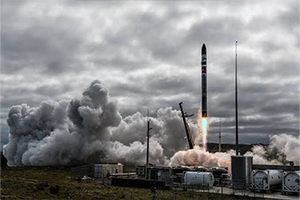
Launch Complex 1, ~39°S, Mahia Peninsula, New Zealand
iQPS Launch 9, an Earth observation satellite with Synthetic aperture radar for Japan-based imaging company iQPS, to launch on "The Sea God Surveys" mission...
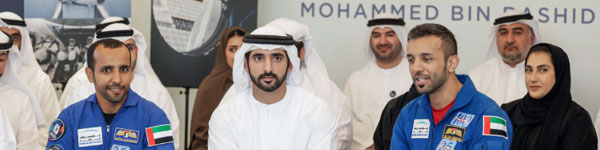 Space-Comm Expo Dubai, October 8-9 at Dubai World Trade Centre, is one of the largest space industry gatherings in the Middle East / West Asia. Hub Exhibitions is organizing the event with UAE Space Agency. This trade-only expo, accessible via space-comm.me, attracts Astronauts, CEOs and innovators for B2B deals, technology demonstrations and keynotes. The expo aligns with UAE National Space Strategy 2030, which outlines 6 objectives, 21 programs and 79 initiatives to position UAE among the top 5 space powers by 2030. Crown Prince Hamdan bin Al Maktoum, Chairman of Supreme Space Council, drives public-private partnerships to diversify the AED د.إ.20 billion (US$5.4 billion) space sector, projected to triple by 2030. November 17-21, Dubai Airshow highlights advanced aviation and strategic partnerships. Mohammed Bin Rashid Space Centre launched the 750-kg MBZ-SAT, a high-resolution Earth-observation satellite, from Vandenberg Space Force Base in January 2025 with 90% local manufacturing. Emirates Mission to the Main Asteroid Belt, launching in 2028, will flyby 6 asteroids and land on 269 Justitia in 2034. January 2024 NASA agreement will fly an Emirati Astronaut to the lunar orbit Gateway, featuring a UAE-built Emirates Airlock. Yahsat has AED د.إ.25.1 billion in future contracts. EOS-X Space offers suborbital flights from Abu Dhabi for AED د.إ.600,000. MBRSC Rashid 2 Rover targets a 2026 far-side-Moon landing via Firefly Blue Ghost lander. (Image Credits: Govt. of Dubai Media Office)
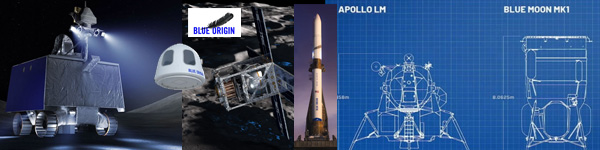 October 8, Blue Origin launches 36th New Shepard suborbital, and bridges space tourism with human expansion across the Solar System via many other projects. New partnership fostered by Blue Origin Luxembourg office with GOMSpace, ESRIC and that country’s national space agency is for Project Oasis that will integrate the Blue Origin Blue Alchemist ISRU project to manufacture on the Moon surface, processing regolith into oxygen and solar cells. US$190M NASA Commercial Lunar Payload Services award is to deliver Volatiles Investigating Polar Exploration Rover (VIPER) to Moon South Pole NET 2027, reviving the water-hunting mission previously canceled, after first Blue Origin robotic Moon lander late 2025. For VIPER, Blue Origin will modify Blue Moon Mark 1 lunar lander to mount VIPER ~450 kilograms and offload it onto Moon surface. Mark 1 flies via Blue Origin New Glenn rocket, ~45,000 kg, ~98 meters tall (with Starship ~120), seven BE-4 engines in the reusable 1st stage and two BE-3U engines in the 2nd stage. 2nd New Glenn launch, NET October 13 from Cape Canaveral, sends NASA twin Mars orbital probes Escape and Plasma Acceleration and Dynamics Explorers (ESCAPADE) to study magnetosphere, atmosphere and solar wind at the 4th planet, advancing humanity toward a multiworld future. (Image Credits: Blue Origin, NASA)
 International Space Station, ~415-km LEO: Expedition 73 seven-member crew are performing maintenance on life support and electronics, sequencing DNA, studying the digestive system in microgravity, conducting the yearly inspection inside the Roscosmos modules for moisture / corrosion / damage, installing / activating a new dehumidifying system and operating an Electrostatic Levitation Furnace to heat materials to ultra-high temperature and then measure them with physics sensors.
 Lunar News: Weekly lunar advisories [coming soon]
 Near-Earth Objects Close Approaches – Tues Oct 7: Apollo Asteroid 2025 SM15 (0.020 AU); Wed Oct 8: Apollo Asteroid 2022 TU1 (0.043 AU); Thu Oct 9: Aten Asteroid 2020 QU5 (0.018 AU).