ISRO / NSIL to Launch AST BlueBird-6 for Direct-to-Device Broadband Revolution
Satish Dhawan Space Center, Sriharikota, India, is scheduled to host LVM-3 liftoff December 20, propelling AST SpaceMobile satellite into 550 km orbit. BlueBird-6, the heaviest USA commercial communication LEO satellite at ~12,600 kg, has 223-square-meter antenna, the largest ever commercially deployed. Triple the size of BlueBirds 1 through 5 with 10x the bandwidth / data capacity, it aims for 100% USA coverage and 2.8B people worldwide for voice / data / video, helping to bridge the digital divide. New Space India Limited (NSIL), commercial arm of Indian Space Research Organization (ISRO), also handles launches of Eutelsat OneWeb and CMS-3 satellites. AST partners with Airbus and Thales Alenia Space in building BlueBird satellites. LVM-3 rocket (which sent Chandrayaan-3 to the Moon) uses 408,000 kg of solid fuel in its boosters, 230,000 kg in liquid core, and 56,000 kg of liquid oxygen/hydrogen in its cryogenic upper stage. Per-launch cost estimated at ~US$50M. ISRO looks forward to 2026 Gaganyaan-1 uncrewed test flight, and in 2028, Shukrayaan Venus orbiter, Chandrayaan-4 lunar sample return collaboration with JAXA, Mangalyaan-2 Mars mission, and 1st Bharatiya Antariksh space station module in partnership with Skyroot Aerospace et al. (Image Credits: ISRO, NSIL, AST SpaceMobile)
AGU25 Convenes 25,000+ in New Orleans December 15-19 for Earth-Space Science Nexus
American Geophysical Union hosts its 106th annual meeting at Ernest N. Morial Convention Center, drawing 25,000+ attendees from 100+ countries, with thousands of presenters across 1,500+ sessions. The event now features ~200 space-related sessions under Planetary Sciences section, focusing on Luna, Solar System planets / moons, asteroids, Kuiper Belt and expects 5,000-7,000 participants in these tracks based on past trends. Moon-specific sessions include “P11A: Lunar Volatiles and Exosphere” presented by Noah Petro of NASA; “P12B: Artemis Science Opportunities” led by Makoto Yoshikawa of JAXA; “P21C: Lunar Interior and Magnetism” by USGS Clive Neal of USGS and published author on lunar geology; “P31D: Moon’s Surface Processes” featuring ESA head Josef Aschbacher on international collaboration; “P41E: Kuiper Belt and Asteroid Impacts on Moons” with New Horizons PI Alan Stern of Southwest Research Institute. Other notables include Erika Wagner of Blue Origin on asteroid resources, NASA Planetary Science Division Director Lori Glaze keynoting Mars sessions, and Kuiper Prize winner Faith Vilas on planetary contributions. Themes span Venus atmosphere, Jupiter moon habitability, asteroid mining, Kuiper object composition and foster interdisciplinary insights for future missions. Hybrid format includes town halls on NASA opportunities, networking for educators / policymakers, plenaries, posters, exhibits. (Image Credits: AGU)
Humans in Space
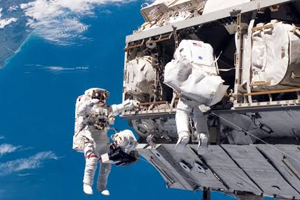
International Space Station, ~415-km LEO: Expedition 74 with Commander Mike Fincke and 6 other Astronauts / Cosmonauts working on stem cell sample stowage, measuring air flow rates, using fluorescent research microscope, maintaining Elektron oxygen generator; with departure of Soyuz MS-28 there are 7 craft docked; in general, 4 different types of crew ships and 5 different resupply ships have visited ISS.
Tiangong Space Station, ~390-km LEO: Shenzhou-21 crew stowing spacesuits and gear after recent 8-hour EVA; Shenzhou-20 craft, still attached to TSS and damaged by debris, planned to undergo hardware installation to allow it to return to Earth – potentially with return cargo; two astronaut candidates from Pakistan are training for one to become the first international visitor to TSS late next year.
Near-Earth Objects Close Approaches – Mon Dec 15: Apollo Asteroid 2025 WA3 (0.022 AU); Wed Dec 17: Aten Asteroid 2025 WN6 (0.040 AU); Thu Dec 18: Aten Asteroid 2015 XX168 (0.012 AU); Sat Dec 20: Apollo Asteroid 2010 WR7 (0.049 AU)
Scheduled for 03:35 UTC-5, United Launch Alliance (ULA) rocket will take next batch of Amazon Leo (new name) satellites for internet system managed by Amazon subsidiary Kuiper Systems. ULA is a joint venture of Lockheed Martin Space and Boeing Defense, Space & Security.
Scheduled for 17:20 Kazakhstan Time. Meteorological satellites developed by NPO Lavochkin. Launch cost estimated at US$65M. Built at Khrunichev State Research and Production Space Center, Moscow, with 43,000+ employees.
Over the next few decades, the exoplanet community is poised to advance closer to answering a fundamental question about the universe and humanity's place in it: Are we alone? High-resolution spectroscopy of exoplanets with the Extremely Large Telescopes (> 25 m) offers a unique opportunity to answer this question. The high […]
Surpassing 3rd full year / entering 4th year in lunar orbit, Korea Aerospace Research Institute (KARI) first lunar spacecraft Danuri launched in Aug 2022 and reached Moon in Dec 2022.
Taiyuan Satellite Launch Center (TSLC), ~39°N, Shanxi, China
Scheduled for 11:15 China Time. 3-stage, non-reusable orbital carrier rocket, also designated Chang Zheng 4C. This will be 60th launch attempt with 57 successful previously.
Expert panel includes speakers from Amazon Kuiper, Slingshot Aerospace, Triton Space and moderator from Space Policy Group. Noon, Eastern Standard Time. Analysis of proposed EU space legislation, impact on markets, Space Traffic Management (STM) policy of USA, more.
Innospace of Korea to use 1st launch of HANBIT-Nano to send to SSO 5 satellites from Brazil space agency AEB / Brazil university / Grahaa Space of India, 3 payloads from AEB / Brazil company that will remain attached to rocket, and empty aluminum beverage can from Brewguru of Korea.
1st launch of Galileo on Ariane 6, 5th launch of Ariane 6, scheduled for 05:01 UTC (French Guiana Time 02:01). These 2 satellites will join 27 others active in orbit. Galileo is called the world's most precise satellite navigation system, has served 5Billion+ smartphone uses since 2016, is managed / […]
Launch window 10:00-12:14 China Time. 1st stage will attempt vertical landing using engines at location 300km from launch site, Minqin County, Gansu Province.
West Texas Suborbital Launch Site / Corn Ranch, Van Horn TX, USA
Launch Site One (LSO), Van Horn, TX, United States
08:30-16:30 CST; 16th crewed flight for the New Shepard program and 37th in New Shepard program; crew is: aerospace engineer Michaela (Michi) Benthaus, physicist/investor Joey Hyde, former SpaceX engineer Hans Koenigsmann, entrepreneur Neal Milch, investor Adonis Pouroulis, and adventurer Jason Stansell.
Conference theme is "WCASET Nexus: Where Science, Education and Technology Converge" and offers both in-person and virtual participation; includes sessions on space science and technology.
Moderated by Madhu Thangavelu. 10:00-17:00 PT. Panels include: Cis-Lunar / Lunar, Artemis, Starship / SLS, Space Architecture / Philosophy / Art / Agriculture, others. Online participation available; send email to register, either <contact@aiaa-lalv.org> or <events.aiaalalv@gmail.com>. Suggested $5 donation to this 501(c)3 nonprofit for either the organization itself or its scholarship […]
Occurs 05:01 HST, 15:01 UTC; It is the winter solstice in the Northern Hemisphere, resulting in the shortest day and longest night of the year; and conversely, it is the summer solstice in the Southern Hemisphere, bringing the longest day and shortest night.
With theme "Exploring New Industrial Models, Empowering the New Aerospace Economy". 2025 marks a crucial stage for the Hainan Free Trade Port, coinciding with the full-scale customs closure operation of the island and the accelerated development of Wenchang International Aerospace City. The Forum will further leverage its unique advantages of […]
At the University of Southern California, the world's largest gathering dedicated to human Mars exploration. For nearly three decades, the International Mars Society Convention...
NASA spacecraft surpasses another full year in orbit around Mars today, holds record for longest-surviving continually active spacecraft in orbit around a planet other...
At the Spokane Convention Center. The meeting will have a broad scope, with a wide-ranging program of science and workforce topics, and celebrating planetary...
Convene, connect, and collaborate at the 19th annual von Braun Space Exploration Symposium! This year’s event will spotlight how bold ideas, emerging technologies, and...
Themes include: Space & the Arctic; Space & AI; Space & International Collaboration. There is a Student Session, a Technical Session, a Frontier Session,...
Oslo Spaceport Norway offers monthly a knowledgeable speaker and opportunity for networking, 17:00-20:00 local time; free entry but registration required. Ground Control is for...
45 satellites to launch for Amazon Leo, formerly named Project Kuiper. This LEO mega constellation will offer broadband internet access with 3,276 satellites.
Occurring 31 October from 09:00-11:00 local time (16:00-18:00 HST, 19:00-21:00 PDT, 22:00-24:00 EDT on 30 October), this Galaxy Forum will be in hybrid format...
Originally planned around this date for Wenchang, China -- TBC (to be confirmed); As the only professional association for astronauts, ASE supports the advancement of...
Coordinating Division Division C Education, Outreach and Heritage The IAU Symposium on Innovative Research and Techniques in Astronomy Communication will take place from November...
Change clocks back 1 hour from Daylight Saving to Standard Time; does not include Hawai’i, Arizona (except the Navajo Nation), American Samoa, Guam, Northern...
ESWW is the main annual event in the European Space Weather and Space Climate calendar. It is an international meeting organised annually within the...
IAU Symposium: IAUS409 - A Journey Towards Effective Astronomy Communication; online and at National Astronomical Observatory of Japan, 2-21-2 Osawa Mitaka, Tokyo. Topics include:...
Launch Complex 1, ~39°S, Mahia Peninsula, New Zealand
iQPS Launch 9, an Earth observation satellite with Synthetic aperture radar for Japan-based imaging company iQPS, to launch on "The Sea God Surveys" mission...
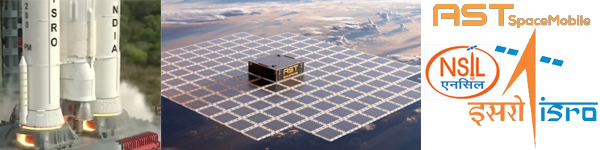 Satish Dhawan Space Center, Sriharikota, India, is scheduled to host LVM-3 liftoff December 20, propelling AST SpaceMobile satellite into 550 km orbit. BlueBird-6, the heaviest USA commercial communication LEO satellite at ~12,600 kg, has 223-square-meter antenna, the largest ever commercially deployed. Triple the size of BlueBirds 1 through 5 with 10x the bandwidth / data capacity, it aims for 100% USA coverage and 2.8B people worldwide for voice / data / video, helping to bridge the digital divide. New Space India Limited (NSIL), commercial arm of Indian Space Research Organization (ISRO), also handles launches of Eutelsat OneWeb and CMS-3 satellites. AST partners with Airbus and Thales Alenia Space in building BlueBird satellites. LVM-3 rocket (which sent Chandrayaan-3 to the Moon) uses 408,000 kg of solid fuel in its boosters, 230,000 kg in liquid core, and 56,000 kg of liquid oxygen/hydrogen in its cryogenic upper stage. Per-launch cost estimated at ~US$50M. ISRO looks forward to 2026 Gaganyaan-1 uncrewed test flight, and in 2028, Shukrayaan Venus orbiter, Chandrayaan-4 lunar sample return collaboration with JAXA, Mangalyaan-2 Mars mission, and 1st Bharatiya Antariksh space station module in partnership with Skyroot Aerospace et al. (Image Credits: ISRO, NSIL, AST SpaceMobile)
 International Space Station, ~415-km LEO: Expedition 74 with Commander Mike Fincke and 6 other Astronauts / Cosmonauts working on stem cell sample stowage, measuring air flow rates, using fluorescent research microscope, maintaining Elektron oxygen generator; with departure of Soyuz MS-28 there are 7 craft docked; in general, 4 different types of crew ships and 5 different resupply ships have visited ISS.
 Lunar Enterprise News: ispace Collaborates for Moon Transportation Systems and Infrastructure │ NGLR-1 Elevates Lunar Laser Ranging for Artemis Precision Navigation
 Near-Earth Objects Close Approaches – Mon Dec 15: Apollo Asteroid 2025 WA3 (0.022 AU); Wed Dec 17: Aten Asteroid 2025 WN6 (0.040 AU); Thu Dec 18: Aten Asteroid 2015 XX168 (0.012 AU); Sat Dec 20: Apollo Asteroid 2010 WR7 (0.049 AU)