Artemis Generation Plans Lunar Return as ISS Reaches 20 Years of Continuous Human Occupation
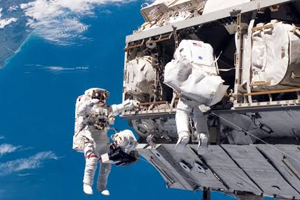
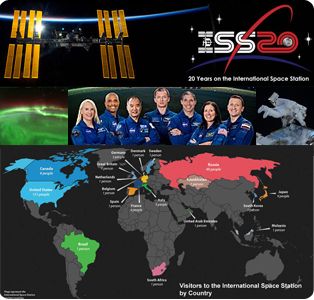
Expedition 64 with Sergey Ryzhikov, Sergey Kud-Sverchkov and Kate Rubins will celebrate ISS passing its 20th full year / entering the 21st of continuous human occupation November 2. Victor Glover is set to become the 242nd person to visit ISS as part of SpaceX Crew-1 mission mid-Nov and would be the 1st Black Astronaut to join a long-term ISS crew. From an average altitude of ~400 km, ISS orbits Earth 16 times a day – nearly the same distance to the Moon and back. Capable of docking 8 ships at once, there are 4 craft which deliver cargo (Progress, HTV, Cygnus, Dragon) and soon to be 3 qualified for humans (Soyuz, Dragon, Starliner). More than 3,000 research investigations have been conducted from 108 countries, with ~200 ongoing any given day. 20 payloads can be hosted externally including Earth sensing equipment, materials science payloads and particle physics experiments such as Alpha Magnetic Spectrometer-02. A total of 231 spacewalks (equaling 1,439 hours and 49 minutes) have been performed, the longest of which was March 2001 by STS-102 crew Susan Helms and James Voss at 8 hours 56 mins. There are >50 computers and 350,000 sensors monitoring crew and station health. While only 19 countries have sent people to ISS, perhaps the Artemis Program will represent more of the nearly 8 Billion people / 250+ countries and territories on Earth. (Image Credits: NASA)
MONDAY
Highlights… Oct 26 — ISS, ~405-km LEO: Expedition 64 takes Command as crewmembers Chris Cassidy, Anatoly Ivanishin and Ivan Vagner re-acclimate to Earth; air leak that has eluded detection for 1+ year located using tea leaves, fracture held by tape is awaiting repair.
Oct 26 — NewSpace: Intuitive Machines awarded US$47M to deliver Polar Resources Ice Mining Experiment Moon South Pole 2022; Astrobotic new 4,366-sq meter HQ will function as ‘mission control’ for 2021 Moon landing; Starship next test with nose cone integrated ahead of 17.7 km test flight.
Oct 26 — Solar System: Mars InSight heat probe, now fully buried, can begin taking temperature readings to 3-meter depth; OSIRIS-REx 1st Bennu sample mass to be determined; Univ of Leiden study of ALMA Venus data contradicts previous claim of phosphine detection.
India Approaches Major National Space Program and NewSpace Milestones
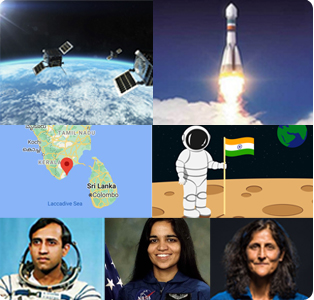
ISRO aims for an early November return to flight with PSLV-C49, the 76th launch from Satish Dhawan Space Centre. Utilizing PSLV-CA (Core Alone) configuration, RISAT-2BR2 Synthetic Aperture Radar earth observation satellite (companion to RISAT-2) and international rideshare payloads are to be lifted to 37-degree inclination orbit. Launch subcontractor Spaceflight Inc. of Seattle is providing logistical support to Kleos Space of Luxembourg, on location in Sriharikota. ‘Kleos’ Scouting Mission’ to insert the first 4 Radio Frequency Reconnaissance smallsats of future constellation. Small Sat Launch Vehicle (SSLV) inaugural flight is to follow from the same site, after launch pad retrofitting to suit the ‘Baby PSLV’ geared for commercial needs. The 34-m SSLV is to have payload capacity of 500 kg to LEO and 300-kg to SSO, and will be marketed by NewSpace India Limited, a commercial arm of ISRO for ~US$16.3M. A new spaceport in Kulasekarapattinam, Tamil Nadu, which will accommodate a due south trajectory (saving fuel that would otherwise be spent avoiding Sri Lanka downrange) is under construction to accommodate what is hoped to be regular, 2-3x monthly launch activity. Indian Human Spaceflight Program strives to realize Gaganyaan, with two orbital test flights (1,2) and crewed flight (3) set to send 1-3 Gaganauts to space by Aug 2022. India is also determined to robotically explore the Lunar surface with Chandrayaan-3 in the coming year. (Image Credits: NASA, ISRO, Google)
Oct 26-30 — American Astronomical Society Division for Planetary Sciences,Online / Spokane WA: 52nd Annual DPS Meeting 2020.
Oct 26-30 — Laboratoire d’Astrophysique de Marseille, IAU,Marseille, France and Online:Dust & Metals 2020 Conference; focusing on the rise of metals and dust in the Universe over a wide range of cosmic times; hosting 100 people on site and virtual participation.
Oct 26 — Apollo Asteroid 2020 QD5: Near Earth Flyby (0.025 AU)
Continued From…
Nov 2019 – Nov 2020 — Hayabusa2, Earth Trajectory: JAXA Hayabusa2 with two samples collected from C-type asteroid 162173 Ryugu on trajectory for Earth return.
NET Oct 22 — Virgin Galactic, Launch SpaceShipTwo, Spaceport America, Las Cruces NM: Launch window opens for SpaceShip Two ‘VSS Unity’ with 2 test pilots to perform 1st of 2 suborbital test flights.
Oct 28-29 — Secure World Foundation, Consortium for Execution of Rendezvous and Servicing Operations (CONFERS), Online: 2020 Global Satellite Servicing Forum.
Oct 28 — Apollo Asteroid 2020 TR5: Near Earth Flyby (0.010 AU)
Oct 28 — Aten Asteroid 2020 UN1: Near Earth Flyby (0.011 AU)
Oct 28 — Apollo Asteroid 2020 TM7: Near Earth Flyby (0.014 AU)
Oct 28 — Apollo Asteroid 2020 TS5: Near Earth Flyby (0.024 AU)
Oct 30 — Brazilian Space Agency (Agência Espacial Brasileira / AEB),Online / Brasilia, Brazil: Final proposals for launch license applications due from companies and agencies interested in utilizing Alcantara Spaceport, Brazil.
Oct 30 — Moon: At apogee (distance 406,416 km), 09:00.
Oct 30 — Venus: At perihelion, 0.7184 AU from Sun, 13:00.
SATURDAY
Oct 31 — CNSA, Ministry of Education, Ministry of Science and Technology, Chinese Academy of Sciences, Online / Beijing, China: Last day for students to submit ideas for payloads for Chang’e-7 lunar south pole craft, and ZhengHe mission that will return samples from Asteroid 469219 Kamoʻoalewa (2016HO3) and visit Comet Elst–Pizarro (133P).
Oct 31 – Nov 3 — Space Foundation, Colorado Springs CO: 36th Space Symposium; reset to Aug 22-26, 2021.
Oct 31 — Moon: Full / Hunter’s / Blue Moon, 04:50 – next Halloween Full Moon to occur 2039; 2.98° SE of Uranus, 06:00.
Oct 31 — Uranus: At opposition, magnitude 5.7, 06:00.
SUNDAY
NET Nov — InSight, Mars Surface: Scheduled end to planned Mars surface operations mission; future plans / goals / extension to be determined.
NET Nov 1 — SpaceX, Launch Falcon 9 / NROL-108,SLC-40, Cape Canaveral AFS: SpaceX Falcon 9 rocket to launch classified spacecraft payload for U.S. National Reconnaissance Office.
Nov 1 — Deep Space, Very Local Interstellar Medium: Voyager 2 confirms increased plasma density outside of heliosphere as first observed via Voyager 1, future readings will aid data.
Nov 1 — Standard Time (USA): Change clocks back 1 hour from Daylight Saving to Standard Time; does not include Hawai’i, American Samoa or Arizona (except the Navajo Reservation).
Nov 1 — Mercury: 4.0° NE of Spica, 10:00; at perihelion, 0.3075 AU from Sun, 17:00.
Emanating from ~6km-wide comet with 5.3-year Solar orbit, visible in constellation Aquarius near star Delta Aquarii, fast, faint meteors peak on this night, best...
The International Research Conference is a federated organization dedicated to bringing together a significant number of diverse scholarly events for presentation within the conference...
Includes ~150 meetings covering the fields of COSPAR Scientific Commissions / Panels / Task Groups, such as SC B: The Earth-Moon System, Planets, and...
From 02 to 07 August 2026, a few thousand geoscientists across diverse disciplines will gather at the 23rd annual meeting of the Asia Oceania Geosciences...
NASA Curiosity (Mars Science Laboratory) rover surpasses another full year of operations on Mars surface today; launched Nov 26, 2011 – landed Aug 5,...
Virtual Series 2026 will offer deeper conversations on why PQC matters and the practical steps businesses should be taking; starts 1:00 pm AEST. Featuring:...
This international lunar science meeting has two objectives: to provide a platform for leading experts to review recent advances across lunar research, from the...
 Oct 26 —
  Oct 26 — NewSpace: Intuitive Machines awarded US$47M to deliver
  Oct 26 — USA:
 = All times
 = All times for international terrestrial events in local time unless noted.
 = All times for space events, and…
 = All times for international space / astro events in Hawaii Standard Time unless noted. Add 10 hours to obtain UT (‘Universal Time’).
 ISRO aims for an early November return to flight with PSLV-C49, the 76th launch from Satish Dhawan Space Centre. Utilizing PSLV-CA (Core Alone) configuration, RISAT-2BR2 Synthetic Aperture Radar earth observation satellite (companion to RISAT-2) and international rideshare payloads are to be lifted to 37-degree inclination orbit. Launch subcontractor Spaceflight Inc. of Seattle is providing logistical support to Kleos Space of Luxembourg, on location in Sriharikota. ‘Kleos’ Scouting Mission’ to insert the first 4 Radio Frequency Reconnaissance smallsats of future constellation. Small Sat Launch Vehicle (SSLV) inaugural flight is to follow from the same site, after launch pad retrofitting to suit the ‘Baby PSLV’ geared for commercial needs. The 34-m SSLV is to have payload capacity of 500 kg to LEO and 300-kg to SSO, and will be marketed by NewSpace India Limited, a commercial arm of ISRO for ~US$16.3M. A new spaceport in Kulasekarapattinam, Tamil Nadu, which will accommodate a due south trajectory (saving fuel that would otherwise be spent avoiding Sri Lanka downrange) is under construction to accommodate what is hoped to be regular, 2-3x monthly launch activity. Indian Human Spaceflight Program strives to realize Gaganyaan, with two orbital test flights (1,2) and crewed flight (3) set to send 1-3 Gaganauts to space by Aug 2022. India is also determined to robotically explore the Lunar surface with Chandrayaan-3 in the coming year. (Image Credits: NASA, ISRO, Google)