ISS Hosting 10 Expedition 64 Crewmembers with Planned Launch of Soyuz MS-18
Expedition 64 is set to become a 10-member crew as Oleg Novitsky, Pyotr Dubrov and Mark Vande Hei in Soyuz MS-18 are launching and arriving April 9. Expedition 65 is planned to begin April 16 with the departure of MS-18 and Sergey Ryzhikov, Sergey Kud-Sverchkov and Kathleen Rubins landing near Dzhezkazgan, Kazakhstan. Before the ‘Dragon Riders’ Michael Hopkins, Victor Glover, Soichi Noguchi and Shannon Walker return to Earth April 28, they are expected to welcome Dragon Crew-2 April 22 (bringing tally back to 10). The Crew-1 Dragon Resilience craft will be relocated April 5 from Harmony Node to Zenith allowing for Crew-2 arrival. At its peak, the number of people at ISS reached 13 during Space Shuttle missions STS-127 / Exp 20 and STS-131 / Exp 23. The China Tianhe 1 core module is set to launch on Long March 5B from Wenchang, China April 29. Its first crew on Shenzhou 12 will fly after Tianzhou 1 cargo ship launches during Q2. NASA recently opened the Commercial LEO Destinations US$4M project to boost development of private space stations. Bigelow Expandable Activity Module is an expandable habitat technology demonstration at ISS since 2016, while Bigelow B330 module testing occurs on Earth. Axiom Space is working to begin attaching its privately developed space station modules to ISS as early as 2024. (Image Credits: NASA, Roscosmos, SpaceX)
MONDAY
Highlights… Apr 5 — ISS, ~405-km LEO: Expedition 64 crew to welcome / orient 3 additional members; transferring cargo from Progress 75P, 77P and Cygnus NG-15; after Soyuz MS-18 arrival there will be 6 craft docked to ISS; planning for Change of Command to Exp 65 next week.
Apr 5 —NewSpace: SpaceX Inspiration4 crew to include Sian Proctor, Chris Sembroski; Virgin Galactic reveals mirror-coated Spaceship 3 VSS Imagine, to be followed by VSS Inspire; BWX Technologies to continue nuclear thermal propulsion development for NASA with US$9.4M award.
Mars Ingenuity to Attempt First Flight on Another World April 11
A new era of exploration may be at hand as the 1.8-kg autonomous coaxial helicopter Ingenuity is readied for flight within Mars airspace. Just as drone technology revolutionized terrestrial applications such as surveying, search & rescue, and filmography in recent years, it is thought that these aerial robotic tools will greatly aid planetary exploration – providing invaluable reconnaissance for ground rovers, resolving structures / terrain features with far greater detail than orbit-based instruments, and allowing atmospheric sampling that would be otherwise impossible. While Ingenuity is a technology demonstration carrying no advanced scientific instruments, its 2-camera payload (Return to Earth Camera with 4208 x 3120-pixel RGB sensor and Navigation Camera with 640 x 480-pixel grayscale sensor) is expected to collect topographical information useful to Perseverance rover for route planning when traversing Jezero Crater from Octavia E. Butler Landing to areas of interest within Neretva Vallis delta. Mars possesses 1/3 Earth gravity with atmospheric density of just 1% relative to Earth, posing unique aerodynamic challenges and necessitating rotor speeds of 2,400 RPM during its 31 Earth / 30 Mars day operational window. Unlike previous interplanetary probes, Ingenuity is comprised of many “off the shelf” components (Sony lithium-ion batteries, Snapdragon 801 processor, mobile phone-grade IMU) and is the first to run open-source software, a version of Linux developed by JPL and freely available for download. (Pictured: Mars Helicopter Chief Engineer Bob Balaram, Perseverance Integration Lead for Ingenuity Farah Alibay; Image Credits: NASA, Library of Congress, Twitter)
Continued From… NET Early 2021 — ISRO, Launch SSLV / Demonstration Launch, Satish Dhawan Space Center, Sriharikota, India: New Small Satellite Launch Vehicle (SSLV) to launch on first orbital test flight.
NET Mar — International Astronautical Federation, Mohammed Bin Rashid Space Centre (MBRSC),Online:IAC 2021 Press Conference; providing updates for 72nd IAC being held Oct 25-29.
NET Apr — New Horizons, Kuiper Belt Object Trajectory: Spacecraft extended mission funding ends this month after reaching Pluto, Charon and KBO Arrokoth; future trajectory / plans to be determined; expected to operate until at least mid-2030s.
NET Apr — CNSA, Launch Long March 5 / Tianhe-1 Core Module for China Space Station,Wenchang Spacecraft Launch Center, Hainan Island, China (19° N): Tianhe-1 (Harmony of the Heavens) core module for China Space Station to launch to LEO on Long March 5; station to orbit between 350 – 450 km, accommodate 3 crew members for 6 month stays, expected to operate until at least 2032.
NET Apr — Five-hundred-meter Aperture Spherical radio Telescope (FAST), Guizhou, China: International applications for international scientific community participation in FAST to be reviewed starting this month, becoming effective in August 2021.
Apr 6 — Apollo Asteroid 2015 MB54: Near-Earth Flyby (0.035 AU)
WEDNESDAY
Apr 7 — OSIRIS-REx, Asteroid 101955 Bennu (1999 RQ36): Origins-Spectral Interpretation-Resource Identification-Security-Regolith Explorer (OSIRIS-REx) to perform last flyby of Bennu, and depart for Earth on May 10.
Apr 7 — SpaceX, Launch Falcon 9 / Starlink V1.0-L23,SLC-40, Cape Canaveral SFS FL: Falcon 9 to launch next batch of ~60 satellites for SpaceX Starlink broadband network; 12:34 EDT.
Apr 7 — ESA, Online / Noordwijk, The Netherlands: ESA new Director General Josef Aschbacher to discuss ‘ESA Agenda 2025‘ with live update, 14:00-15:00 CET.
Apr 8 — Smithsonian National Air and Space Museum, Online / Washington DC:The Space Shuttle at 40.
Apr 8 — Bruce Museum, Online / Greenwich CT: Women in Contemporary Science: How to STEM the Leaky Pipeline; featuring Tarika Barrett (Girls Who Code), Catherine Early (Science Museum of Minnesota), Tara McAllister (University of Auckland), Jessica Ware, (American Museum of Natural History), and others; 19:00-20:30 EDT.
FRIDAY
Apr 9 — Roscosmos State Corporation, Launch Soyuz MS-18 / ISS 64S, Baikonur Cosmodrome, Kazakhstan: An RSA Soyuz rocket set to launch members of ISS Expedition 64/65 Commander Oleg Viktorovich and Flight Engineers Pyotr Valerievich and Mark Vande Hei; to dock at ISS 07:07 EDT, live coverage available.
Apr 11 — Ingenuity Helicopter, Jezero Crater, Mars Surface: First controlled powered flight on another planet to be attempted today by Ingenuity, hovering about 3 meters for 30 seconds; mission power expected to last up to 30 days.
Apr 11 — Moon: 2.71° SE of Mercury, 00:00; New Moon, 16:32.
Emanating from ~6km-wide comet with 5.3-year Solar orbit, visible in constellation Aquarius near star Delta Aquarii, fast, faint meteors peak on this night, best...
The International Research Conference is a federated organization dedicated to bringing together a significant number of diverse scholarly events for presentation within the conference...
Includes ~150 meetings covering the fields of COSPAR Scientific Commissions / Panels / Task Groups, such as SC B: The Earth-Moon System, Planets, and...
From 02 to 07 August 2026, a few thousand geoscientists across diverse disciplines will gather at the 23rd annual meeting of the Asia Oceania Geosciences...
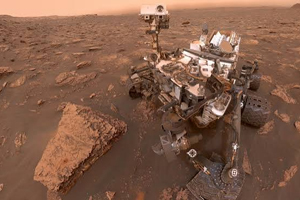
NASA Curiosity (Mars Science Laboratory) rover surpasses another full year of operations on Mars surface today; launched Nov 26, 2011 – landed Aug 5,...
This international lunar science meeting has two objectives: to provide a platform for leading experts to review recent advances across lunar research, from the...
At CSIR International Convention Centre. Key topics are Earth Observation, Developing Space Tourism, Space Supply Manufacturing. Cultural tours are offered.
Participants will receive theoretical and hands-on training in electron imaging and X-ray spectroscopy for application to planetary samples. This training opportunity is targeted at...
"Leading Australia’s Space Future for Our Strategic Advantage". Southern Space 2026 brings together decision-makers who set the direction for Australia’s space sector. It is...
Includes presentation of the Neil Armstrong Award of Excellence, activities for the new class of Astronaut Scholars, 2-day Technical Conference where Scholars present their...
Key themes include: Characterizing exoplanet-host solar-like stars; Star-planet interactions; Planet populations around solar-like stars. At University of Liège.
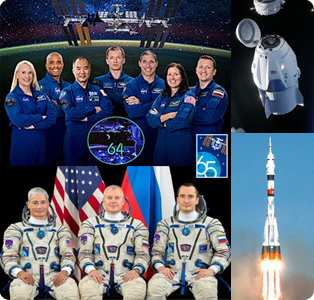
 Apr 5 — ISS, ~405-km LEO: Expedition 64 crew to welcome / orient 3 additional members; transferring cargo from Progress 75P, 77P and Cygnus NG-15; after Soyuz MS-18 arrival there will be 6 craft docked to ISS; planning for Change of Command to Exp 65 next week.
 Apr 5 — NewSpace:
  Apr 5 — USA:
 = All times
 = All times for international terrestrial events in local time unless noted.
 = All times for space events, and…
 = All times for international space / astro events in Hawaii Standard Time unless noted. Add 10 hours to obtain UT (‘Universal Time’).
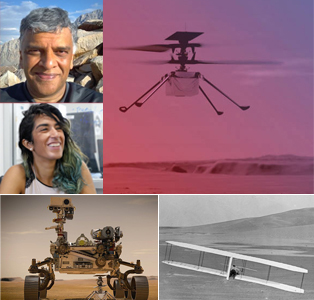 A new era of exploration may be at hand as the 1.8-kg autonomous coaxial helicopter Ingenuity is readied for flight within Mars airspace. Just as drone technology revolutionized terrestrial applications such as surveying, search & rescue, and filmography in recent years, it is thought that these aerial robotic tools will greatly aid planetary exploration – providing invaluable reconnaissance for ground rovers, resolving structures / terrain features with far greater detail than orbit-based instruments, and allowing atmospheric sampling that would be otherwise impossible. While Ingenuity is a technology demonstration carrying no advanced scientific instruments, its 2-camera payload (Return to Earth Camera with 4208 x 3120-pixel RGB sensor and Navigation Camera with 640 x 480-pixel grayscale sensor) is expected to collect topographical information useful to Perseverance rover for route planning when traversing Jezero Crater from Octavia E. Butler Landing to areas of interest within Neretva Vallis delta. Mars possesses 1/3 Earth gravity with atmospheric density of just 1% relative to Earth, posing unique aerodynamic challenges and necessitating rotor speeds of 2,400 RPM during its 31 Earth / 30 Mars day operational window. Unlike previous interplanetary probes, Ingenuity is comprised of many “off the shelf” components (Sony lithium-ion batteries, Snapdragon 801 processor, mobile phone-grade IMU) and is the first to run open-source software, a version of Linux developed by JPL and