Interstellar Voyagers Begin 45th Years in Space, New Horizons Surpasses 50 AU
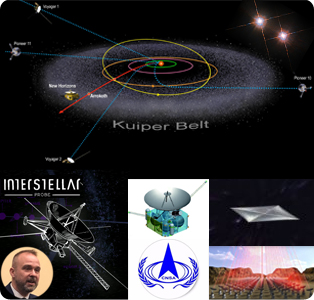
The most distant and longest-operating twin Voyager spacecraft are expected to communicate with Deep Space Network through 2036, collect engineering data through 2030, and science data through 2025. Voyager 1, traveling ~16.99 kps with 4 working instruments, will enter its 45th year in space Sep 5, and was the first craft to enter interstellar space Aug 25, 2012. Voyager 2 currently has 5 instruments powered on and entered its 45th year in space Aug 20, interstellar space in 2018 while traveling ~15.37 kps with respect to Sun. In April 2023 V2 is expected to pass Pioneer 10 which is traveling at 11.95 kps (launched 49 years ago), and predicted to have surpassed 122 AU / interstellar space in 2019. New Horizons became the 5th craft to reach 50 AU from the Sun this April, and its 3rd possible Kuiper Belt Object flyby is being planned before 2030. It will likely surpass 100 AU in 2038, and enter interstellar space ~2040. Proposed Interstellar Probe mission, led by Pontus Brandt of JHU APL, could launch early 2030s and reach the heliosphere boundary in just 15 years. China / CNSA Interstellar Express may launch 2 probes 2024 to reach 100 AU by 2049, centennial of PRC foundation. Breakthrough Starshot continues R&D for microsat StarChips to travel at .2c reaching Alpha Centauri (4.27 LY) away within 20 years. (Image Credits: SwRI, NASA, JHU APL, Scientia Sinica, CAS / NAOC, RAS, BI)
MONDAY
Highlights… Aug 30 — ISS, ~405-km LEO: Expedition 65 seven-member crew working with new “Butterfly IQ Ultrasound” device, plant stress and genetic changes study; transferring cargo from Progress 78P, NG-16 Cygnus and Dragon CRS-23; Cosmonauts to work externally on Nauka this week.
Aug 30 — Tiangong Space Station, ~370-km LEO: Shenzhou 12 three-member crew storing EVA equipment after successful spacewalk, setting up space centrifuge and hazardous trace gas removal subsystem; commercial companies may provide future cargo services for TSS.
Aug 30 —NewSpace: Intuitive Machines to employ MDA sensors on lunar landers; Starlink has 600,000+ customers awaiting internet service; Virgin Orbit to go public with US$3.2B valuation via SPAC.
Aug 30 — Solar System: NASA shares Perseverance images of Deimos from Mars surface; 2 red objects in main asteroid belt being studied by JAXA, may have trans-Neptunian origin.
Aug 30 —Galaxy: Cambridge Astronomers searching for biosignatures in Hycean exoplanets; Harvard cosmological model predicts 10% of black hole mass in universe are in ‘wanderers’.
Aug 30 — Hawai’i: Legal status of alternative site for Large Telescope in Canary Islands in question; IfA astronomer working with Víctor M. Blanco 4-meter Telescope in Chile to characterize asteroid with 113-day orbital period.
= All times for terrestrial events in local time unless noted.
= All times for international terrestrial events in local time unless noted.
= All times for space events, and…
= All times for international space / astro events in Hawaii Standard Time unless noted. Add 10 hours to obtain UT (‘Universal Time’).
2021 Annual Meeting of Lunar Exploration Analysis Group Focuses on Near-Term Missions
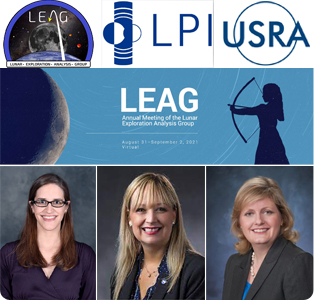
The 18th LEAG is being held online August 31 – September 2, presented by Lunar Planetary Institute in Houston TX and Universities Space Research Association in Columbia MD, with international lunar scientists. With theme “Lunar Science and Exploration in the Next Five Years”, the 3-day gathering will be welcomed by Convener (L-R) Amy Fagan of Western Carolina University and starts with an in-depth review of NASA SMD progress, with updates from Astrophysics, Heliophysics, Planetary, Earth, Biological & Physical Science divisions. Reports on Artemis program will be given by NASA officials Niki Werkheiser (STMD), Julie Robinson (HEOMD) as well as updates from 11 of 13 Artemis 1 secondary payload cubesat missions: ArgoMoon, EQUULEUS, OMOTENASHI, BioSentinel, CuSP, LunaH-Map, Lunar Flashlight, LunIR, Lunar IceCube and “NASA’s Cube Quest Challenge” winners Team Miles and CU Earth Escape Explorer. The 4 international lunar missions expected to launch in the next 12 months will be reported on by D. K. Kim (KARI / Korea Pathfinder Lunar Orbiter), T. P. Das (ISRO / Chandrayaan-3), M. Ohtake (JAXA / Small Lander for Investigating Moon) and I. Mitrofanov (Roscosmos / Luna-25). Commercial Moon missions will also be strongly represented, with Dan Hendrickson of Astrobotic (Peregrine Lander), Trent Martin of Intuitive Machines (Nova-C), Colin Ake of Masten (XL-1) and William Coogan of Firefly (Blue Ghost) giving remarks on their companies’ respective CLPS lunar efforts. (Image Credits: LEAG, LPI, USRA, NASA)
Aug 30 — Van Allen Probes,LEO: Spacecraft reach 9 full years / begin 10th year in space today, launched 2012; adding to the understanding of Earth radiation belt environment and its variability.
Aug 2 – Oct 31 — SpaceBase, Planet, Christchurch, New Zealand and Online: Space for Planet Earth Challenge; seeking innovative ideas from New Zealand, Australia, and Pacific Island residents at High School and University / Start-up level to address climate change through space technologies.
Sep 2 — ISS, Russia EVA #49, ~405-km LEO: Expedition 65 Cosmonauts Oleg Novitskiy and Pyotr Dubrov to perform Russia spacewalk #49 to begin outfitting Nauka Multipurpose Laboratory Module starting 11:35 EDT for ~7 hours; live coverage available.
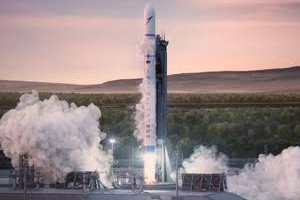
Sep 2 — Firefly Aerospace, Launch Alpha / DFAST Demonstrator, DREAM, Vandenberg SFB CA: First orbital launch attempt for Alpha rocket launching Benchmark Space Systems DFAST propulsion system tech demo and Dedicated Research and Education Accelerator Mission (DREAM).
Sep 2 — Moon: 6.6° S of Castor, 13:00; 2.98° S of Pollux, 19:00.
FRIDAY
Sep 3 — The Space Show,Online / Tiburon CA: Dr. David Livingston talks with Roman Chiporukha of Spacevip.com about future generations of private astronauts, flow of information, public NewSpace participation.
Sep 3 — Moon: 3.1° NNE of Beehive Cluster, 21:00.
SATURDAY
NET Sep 4 — SpaceX, Launch Falcon 9 / Starlink 2-1,LC-39A Kennedy Space Center FL: SpaceX Falcon 9 to launch next batch of communication satellites.
SUNDAY
Sep 5 — Voyager 1, Interstellar Space: NASA spacecraft begins 45th year in space today, launched Sep 5, 1977; farthest spacecraft from Earth, first to reach interstellar space.
Sep 5 — Moon: 4.5° NNE of Regulus, 14:00.
Sep 5 — Mercury: At aphelion, 0.4667 AU from Sun, 14:00.
Sep 5 — Venus: 1.57° NNE of Spica, 11:00.
Sep 5 — Apollo Asteroid 2015 SW6 : Near-Earth Flyby (0.041 AU)
Emanating from ~6km-wide comet with 5.3-year Solar orbit, visible in constellation Aquarius near star Delta Aquarii, fast, faint meteors peak on this night, best...
The International Research Conference is a federated organization dedicated to bringing together a significant number of diverse scholarly events for presentation within the conference...
Includes ~150 meetings covering the fields of COSPAR Scientific Commissions / Panels / Task Groups, such as SC B: The Earth-Moon System, Planets, and...
From 02 to 07 August 2026, a few thousand geoscientists across diverse disciplines will gather at the 23rd annual meeting of the Asia Oceania Geosciences...
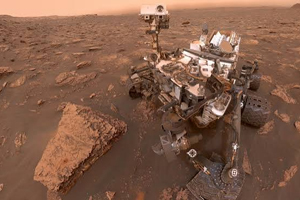
NASA Curiosity (Mars Science Laboratory) rover surpasses another full year of operations on Mars surface today; launched Nov 26, 2011 – landed Aug 5,...
This international lunar science meeting has two objectives: to provide a platform for leading experts to review recent advances across lunar research, from the...
At CSIR International Convention Centre. Key topics are Earth Observation, Developing Space Tourism, Space Supply Manufacturing. Cultural tours are offered.
Participants will receive theoretical and hands-on training in electron imaging and X-ray spectroscopy for application to planetary samples. This training opportunity is targeted at...
"Leading Australia’s Space Future for Our Strategic Advantage". Southern Space 2026 brings together decision-makers who set the direction for Australia’s space sector. It is...
 Aug 30 — ISS, ~405-km LEO: Expedition 65 seven-member crew working with new “
 Aug 30 — NewSpace: Intuitive Machines to employ
  Aug 30 — USA: Blue Origin working on reusable upper stage
 = All times for terrestrial events in local time unless noted.
 = All times for international terrestrial events in local time unless noted.
 = All times for space events, and…
 = All times for international space / astro events in Hawaii Standard Time unless noted. Add 10 hours to obtain UT (‘Universal Time’).