1st USA Woman VP Harris Should Lead NSC to Prioritize 1st Woman on the Moon, Earth Climate Observation, Peace
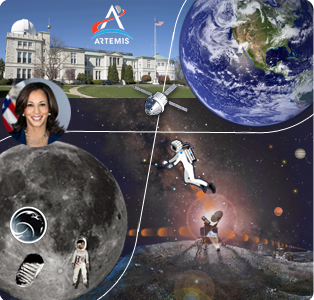
Dedicated to the incredible, innovative Artemis program to land the First Woman and First Person of Color on the Moon asap ~2025, and developing cislunar architecture to sustain a human lunar base in peace for all — USA Vice President Kamala Harris has the responsibility to undertake and expand this 21st Century vision for millions of Americans, billions of humans and generations to come. The 2020s landing of first women on the Moon might be as influential as the landing of first men on the Moon, and will expand the sphere of women’s influence and activity by many millions of times. VP Harris and the National Space Council Users’ Advisory Group should strongly advocate for human landings to garner the vital support and funding to utilize and explore the Moon for scientific, commercial, private, public, inclusive and inspirational common wealth and egalitarian considerations. Much as EarthRise was instrumental for Earth environmental consciousness, Astronauts on the new frontier will naturally look out and observe Earth from a unique vantage point at the Moon South Pole. Living on the grounds of Naval Observatory, VP Harris may appreciate its authority on Earth orientation, astrometry and celestial observation – which if performed from the Moon could produce more precise values. Being the 1st Woman, 1st Black and 1st South Asian-American Vice President – hopes are high she will lead the Artemis generation on the farthest journey yet. (Image Credits: White House, NASA, UNSO, ILOA Hawai’i)
MONDAY
Nov 15 — ISS, ~405-km LEO: Seven-member Expedition 66 with newly arrived SpaceX Crew 3 (Kayla Barron, Raja Chari, Tom Marshburn, Matthias Maurer) planning for Cygnus NG-16 “S.S. Ellison Onizuka” release this week, preparing for U.S. EVA #78 in Nov, working with Plant Habitat-04 and HAM radio experiments.
Nov 15 — Tiangong Space Station, ~370-km LEO: Now 1 month into 6-month mission, three crew members of Shenzhou-13 continuing to install equipment and carry out tests on Tianhe core module; 1 or 2 additional EVAs being planned.
Highlights…
NewSpace: SpinLaunch plans 30 suborbital test flights at Spaceport America over 6-8 months; Virgin Galactic aims for Unity monthly flights NET Q4 2022, bimonthly Imagine flights NET 2023; iSpace of Beijing working on commercial agreements to launch from Wenchang, Hainan, “China’s Hawaii”.
Solar System: Attempts to model Jupiter Great Red Spot (extending 320-km deep) continue with Juno data; Russia Luna-25 prepping for July 2022 launch, while Luna-27 to be ‘full-fledged international project’; solar weather ramp up to 2023-28 maximum apparent as auroras increase.
USA: VP Harris to convene NSC with continuity of purpose / greater emphasis on climate expected; New NOAA restrictions on commercial remote sensing may limit competitiveness; simulated Lunar Operations lab at GRC working on mini rover fleet.
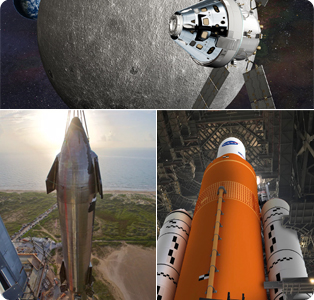
2 Moonships, SLS / Orion and Starship, Near Completion as Artemis 3 Human Landing Now Set for 2025
Boeing Space Launch System is 111.25 m tall / 9.4 m diameter in Block 1 configuration fully stacked with Orion, a joint project between Lockheed Martin and Airbus; it is capable of carrying 95 t to LEO / 27 t to Trans Lunar Injection. SLS / Orion are stacked at NASA Kennedy Space Center FL and are expected to fly in February 2022 for inaugural flight (Artemis 1) around Moon – to be followed by a crewed Artemis 2, taking astronauts ~65,000 km past the Moon, the furthest humans have been from Earth. Human landings, planned NET 2025 at Shackleton Rim, will utilize a SpaceX Starship Moon variant, funded with US$2.9B HLS contract. Starship serial number 15 (SN15) stands 120 m height / 9 m diameter when stacked on Super Heavy rocket claims an astounding 150 t LEO payload capacity – and a similar capacity to TLI with multiple launches, employing a cargo/tanker variant for in-space refueling. Starship has powered up its 3 raptor engines for testing at SpaceX facility ‘Starbase’ near Boca Chica TX and pending FAA approval for first semi-orbital test launch. Super Heavy Rocket will descent into Gulf of Mexico for recovery, whereas SN15 will “soft land” in the Pacific Ocean ~ 100 km north of the Hawaiian Island Kauai, coming to rest within Pacific Missile Range Facility Barking Sands – largest testing range on Earth covering 2,850 km2 water / controlling 108,880 km2 airspace. (Image Credits: Lockheed Martin, NASA, SpaceX)
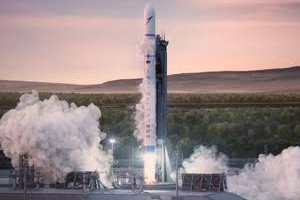
Nov 15 — Rocket Lab,Launch Electron / BlackSky Global 10 & 11, Launch Complex 1A, Mahia Peninsula, New Zealand: 14-day launch window opens for mission ‘Love At First Insight’ to loft 2 Earth-observation satellites for BlackSky; will attempt splash down and recovery of Electron first stage and use helicopter to test communications and tracking.
Nov 15 — Arianespace, Launch Vega / CERES,Kourou, French Guiana: Arianespace Vega rocket, designated VV20, to launch 3 CERES signals intelligence satellites for France military.
Nov 15 — Jupiter: At east quadrature, 90° from Sun, 10:00.
Nov 15 — Aten Asteroid 2010 VK139: Near-Earth Flyby (0.016 AU)
Nov 15 — Apollo Asteroid 2016 VR: Near-Earth Flyby (0.020 AU)
Nov 15 — Apollo Asteroid 2019 VL5: Near-Earth Flyby (0.022 AU)
Nov 15 — Apollo Asteroid 2021 VM1: Near-Earth Flyby (0.024 AU)
Nov 15 — Apollo Asteroid 2021 VG3: Near-Earth Flyby (0.026 AU)
Continued From…
Nov 4 – Jun 29 — Russian Academy of Sciences, Institute of Biomedical Problems, NASA Human Exploration Research Analog (HERA),Moscow, Russia: Mixed gender crew of 6 to participate in 8-month space / lunar simulation mission SIRIUS-21 (Scientific International Research In Unique Terrestrial Station).
NET Nov 9 — Astra, Launch Rocket 3 LV0007 / STP-27AD2, Pacific Spaceport Complex, Kodiak AK: Launch window opens for today until Oct 31, and back up dates November 5-12; commercial launch vehicle carrying second of 3 USSF test payloads.
Nov 17 — Leonid Shower Peak: Appearing to radiate from constellation Leo, Leonids are associated with the comet Tempel–Tuttle; can produce 15 meteors per hour (2 days before full Moon).
Nov 17 — Moon: 1.37° SE of Uranus, 18:00.
Nov 17 — Aten Asteroid 2021 VS5: Near-Earth Flyby (0.009 AU)
Nov 17 — Apollo Asteroid 2021 VR6: Near-Earth Flyby (0.019 AU)
Nov 17 — Comet 73P-AA/Schwassmann-Wachmann: At Perihelion (1.011 AU)
Nov 18 — Moon: Full / Beaver Moon, 22:58; partial eclipse of Moon lasting 208 minutes, 23 seconds; visible in some parts of Alaska and Hawaii today (beginning ~21:00 and max 23:00), and completely visible over Asia, Australia, Americas tomorrow.
Nov 19-21 — China Manned Space Agency, Zhejiang University, Chinese Society of Astronautics,Hangzhou, China:China Manned Space International Symposium; featuring topics related to human spaceflight, human lunar exploration and deep space exploration.
Nov 19 — Moon: 4.2° SE of Pleiades, 07:00.
Nov 19 — Apollo Asteroid 2021 TR15: Near-Earth Flyby (0.030 AU)
Nov 19 — Apollo Asteroid 2021 VR: Near-Earth Flyby (0.040 AU)
SATURDAY
Nov 20 — ISS, Release of Cygnus NG-16, ~405-km LEO: Release of the Northrop Grumman “S. S. Ellison Onizuka” Cygnus NG-16 cargo craft with trash for Earth atmosphere disintegration; starts 10:45 EST, live coverage available.
Nov 20 — Swift, LEO: Observing gamma-ray bursts & their afterglows in gamma-ray, X-ray, ultraviolet, optical wavelengths from LEO, multiwavelength craft reaches 17 full years / begins 18th year of operations in space today, launched in 2004.
Emanating from ~6km-wide comet with 5.3-year Solar orbit, visible in constellation Aquarius near star Delta Aquarii, fast, faint meteors peak on this night, best...
The International Research Conference is a federated organization dedicated to bringing together a significant number of diverse scholarly events for presentation within the conference...
Includes ~150 meetings covering the fields of COSPAR Scientific Commissions / Panels / Task Groups, such as SC B: The Earth-Moon System, Planets, and...
From 02 to 07 August 2026, a few thousand geoscientists across diverse disciplines will gather at the 23rd annual meeting of the Asia Oceania Geosciences...
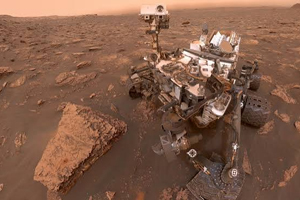
NASA Curiosity (Mars Science Laboratory) rover surpasses another full year of operations on Mars surface today; launched Nov 26, 2011 – landed Aug 5,...
This international lunar science meeting has two objectives: to provide a platform for leading experts to review recent advances across lunar research, from the...
At CSIR International Convention Centre. Key topics are Earth Observation, Developing Space Tourism, Space Supply Manufacturing. Cultural tours are offered.
Participants will receive theoretical and hands-on training in electron imaging and X-ray spectroscopy for application to planetary samples. This training opportunity is targeted at...
"Leading Australia’s Space Future for Our Strategic Advantage". Southern Space 2026 brings together decision-makers who set the direction for Australia’s space sector. It is...
 NewSpace:
  Solar System: Attempts to model Jupiter
  USA:
USA: 
 = All times for terrestrial events in local time unless noted.
 = All times for international terrestrial events in local time unless noted.
 = All times for space events, and…
 = All times for international space / astro events in Hawaii Standard Time unless noted. Add 10 hours to obtain UT (‘Universal Time’).