Juno to Surpass 6 Full Years at Jupiter, Speeding Toward Europa Close Flyby
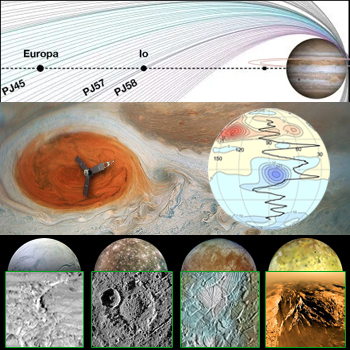
On July 4, giant Jupiter and its 80 known satellites will be celebrated with artificial satellite Juno starting its 7th year in Jupiter orbit. Having launched August 2011, the spacecraft, in extended mission phase with 9 instruments, is estimated to cost US$1.46B for operations and data analysis through 2022. Perijove 45 on September 29 will accelerate Juno to ~200,000 kph relative to Jupiter due to its gravity (2.5x that of Earth), and set it up for Europa flyby at 350 km while reducing orbital period from 43 to 38 days. Well before the last orbit / Perijove 76 in September 2025, additional close flybys of Europa and Io will occur, as will the first exploration of Jupiter faint rings, Great Blue Spot magnetic flux investigations, gravitational field mapping, element-ratio measurements and impactful high-res optical images. Leading the mission is PI Scott Bolton of SwRI, and coinvestigators include Toby Owen (U of Hawaii), Andrew Ingersoll (Caltech), Frances Bagenal (U of CO – Boulder), and Candy Hansen (Planetary Science Institute). Highlighting the next Galileo moon explorer launching October 2024, Dave Doody of JPL will talk July 9 on ‘The Upcoming Europa Clipper Mission’ during AIAA LA-LV Town Hall. ESA JUICE is planning to launch 2023 on an Ariane 5, while Gan De mission to Jupiter from China is proposed to launch October 2029. (Image Credits: NASA, JPL, SwRI)
MONDAY
☆ Jul 4 — ISS, ~405-km LEO: Expedition 67 seven-member crew (3 NASA, 3 Roscosmos, 1 ESA) tending radish sprouts for XROOTS hydroponic / aeroponic study, maintaining Intelligent Glass Optics study on AI processing, conducting human research on radiation and immunity.
☆ Jul 4 — Tiangong Space Station, ~370-km LEO: Shenzhou 14 three-member crew working to configure and test optical atomic clock with goal of one quintillionth / second accuracy, Shenzhou-13 crew ‘feeling good’, recount toenail clipping travails.
Highlights…
o NewSpace: Ohio State University analyzing in-space manufactured product (2-g potassium dihydrogen phosphate sample acquired from Redwire for US$4k) for defects; SpaceX preparing Super Heavy B7 for static fire testing on Boca Chica launchpad, supported by ‘chopstick’ robotic arms.
☆ Solar System: LRO investigating double crater on Moon near Hertzsprung crater presumed to have been created by LM-3C rocket impact; CNSA to release 1,040 GB of Tianwen-1 Mars data internationally, considering Neptune mission powered by 10 kWe fission reactor.
☆ Galaxy: Leibniz Institute for Astrophysics Potsdam model elucidates galaxy formation / IR and radio radiation release; International team utilizing SOFIA and Herschel Space Telescope data reveal ‘missing’ intergalactic medium metals.
o Global: Institute of Biomedical Problems of RAS & NASA Human Research Program planning SIRIUS-22/23 after completion of 240-day analog mission SIRIUS-21; 100-kg e THEOS-2 SmallSAT, developed via 4-year Surrey training program, in transit to Thailand space agency GISTDA.
●USA: ICESat-2 to continue work mapping Antarctic ice volume past nominal 3-year mission end; Black In Astro Community working to increase black representation in academic Astronomy; MIT researchers propose stationing silicon ‘bubbles’ at Sun-Earth L1 to deflect 1.8% of solar radiance.
Vega C Inaugural Launch Set for July 7 as Europe Advances Space Commercialization, Art and Science
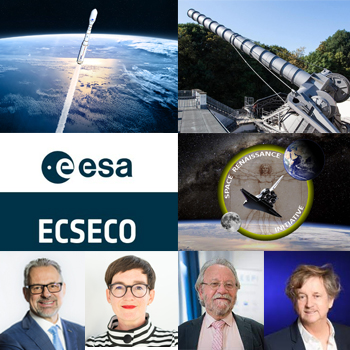
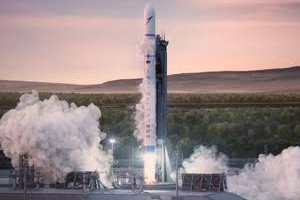
ESA is introducing European Centre for Space Economy and Commerce (ECSECO) at live event streamed from Vienna, Austria July 4. ECSECO will be modeled on European Centre for Space Law, with administration based at European Space Policy Institute (ESPI) and mission to “provide a European platform for interdisciplinary discussions and research on space economy and commerce”. Keynote speakers include (L-R) ESA Director Josef Aschbacher, Austria Technology Minister Henriette Spyra, and current ESPI Director Jean-Jacques Tortora – incoming ESPI Director Hermann Ludwig Moeller will moderate a panel discussion, and an ESA-ESPI MoU will be signed. On July 5, Arianespace is to launch 35-m Vega-C (consolidated) rocket, a more powerful and versatile version of ESA / ASI SLLV. Vega-C is capable of lofting 2,300 kg to 700 km SSO, features new first stage P120C (to be shared with upcoming Ariane 6) and a larger composite fairing, doubling payload volume. Vespa-C payload adapter and Small Spacecraft Mission Service dispenser allow multiple rideshare configurations. Continuing the pursuit of ‘Astronautical Humanism’ first articulated in Greater Earth Manifesto of 1998, Space Renaissance International hosts Space Renaissance Art & Science Festival at Archenhold Observatory in Berlin, Germany July 7-9. The festival will focus on Philosophy & Policy, Astronauts & Civilians, and Space Art with dual tracks in English and German. Attendees will enjoy night observation with 68-cm aperture, 21-m focal length ‘Celestial Cannon’ refracting telescope Himmelskanone. (Image Credits: ESA, ECSECO, Gov of Austria, SRI, Arianespace, Archenhold Observatory)
★ Jul 4 — Juno, Jupiter Orbit: Spacecraft reaches 6th full year at Jupiter today; one-way transmission signal to Earth is 48 minutes, mission extended through September 2025.
☆ Jul 4 — Apollo Asteroid 2022 LX1: Near-Earth Flyby (0.076 AU)
Continued From…
★ Jun 28 – Nov 13 — CAPSTONE, Near-Rectilinear Halo Orbit Trajectory: Cislunar Autonomous Positioning System Technology Operations and Navigation Experiment heading to operating position at NRHO / cislunar space.
TUESDAY
o Jul 5 — KARI, Incheon International Airport, S Korea:South Korea lunar orbiter ‘Danuri’ to be sent on its way to Cape Canaveral SFS today for August 5 launch.
● Jul 5 — The Space Show,Online / Tiburon CA: Dr. David Livingston talks with space historian Bob Zimmerman.
☆ Jul 5 — Apollo Asteroid 2022 MA1: Near-Earth Flyby (0.054 AU)
WEDNESDAY
☆ Jul 6 — Mercury: 0.86° S of M35 cluster, 02:00.
THURSDAY
☆ Jul 7 — Arianespace, Launch Vega C / LARES 2, Kourou, French Guiana: Inaugural flight of Vega C with LARES 2 satellite for ASI, Italian Space Agency for geodynamics and general relativity research.
★ Jul 7 — SpaceX, Launch Falcon 9 / Starlink 4-21, LC-39A, KSC FL: Another batch of Starlink satellites to be launched, first stage booster to land on drone ship in Atlantic Ocean.
☆ Jul 7 — Moon: At first quarter, 16:14; 4.4° NNE of Spica, 10:00.
FRIDAY
★ Jul 8 — SpaceX, Launch Falcon 9 / Starlink 3-1, SLC-4E, Vandenberg SFB CA: Batch of Starlink satellites to be launched into a new shell at an inclination of 97.6 degrees (Starlink to have 5 shells total), first stage booster to land on drone ship in Pacific Ocean.
☆ Jul 8 — Apollo Asteroid 2020 GE: Near-Earth Flyby (0.062 AU)
SATURDAY
● Jul 9 — AIAA LA-LV Section,Hybrid / Lawndale CA and Online:AIAA LA-LV Section Town Hall Meeting; also featuring ‘The Upcoming Europa Clipper Mission’ by Dave Doody, Space Flight Operations Engineer, 11:00 PDT.
☆ Jul 9 — Apollo Asteroid 2022 MX: Near-Earth Flyby (0.086 AU)
SUNDAY
☆ Jul 10 — Mercury: At perihelion, 0.3075 AU from Sun, 12:00.
In celebration of the 25th anniversary of the creation of the Astrophysics Group at the University of Exeter, we are pleased to announce the international...
Emanating from ~6km-wide comet with 5.3-year Solar orbit, visible in constellation Aquarius near star Delta Aquarii, fast, faint meteors peak on this night, best...
The International Research Conference is a federated organization dedicated to bringing together a significant number of diverse scholarly events for presentation within the conference...
Includes ~150 meetings covering the fields of COSPAR Scientific Commissions / Panels / Task Groups, such as SC B: The Earth-Moon System, Planets, and...
From 02 to 07 August 2026, a few thousand geoscientists across diverse disciplines will gather at the 23rd annual meeting of the Asia Oceania Geosciences...
NASA Curiosity (Mars Science Laboratory) rover surpasses another full year of operations on Mars surface today; launched Nov 26, 2011 – landed Aug 5,...
This international lunar science meeting has two objectives: to provide a platform for leading experts to review recent advances across lunar research, from the...
At CSIR International Convention Centre. Key topics are Earth Observation, Developing Space Tourism, Space Supply Manufacturing. Cultural tours are offered.
Participants will receive theoretical and hands-on training in electron imaging and X-ray spectroscopy for application to planetary samples. This training opportunity is targeted at...