ISS Expedition 68 Commencing with Soyuz MS-21 Departure, SpaceX Crew 5 Arrival
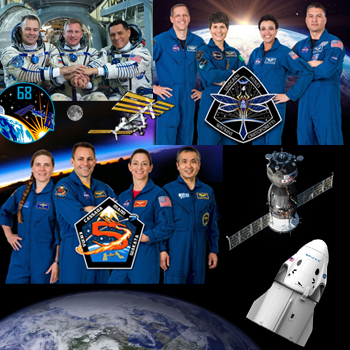
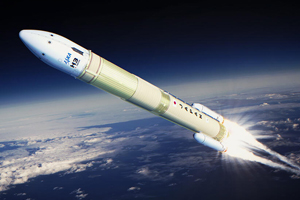
Artemis 1 / Space Launch System may liftoff September 27 for its circumlunar flight while 3 members of Expedition 66-67 are scheduled to return to Earth Sep 29, and 4 others on SpaceX Crew 5 are preparing for launch October 3. International Space Station Change of Command Ceremony is set for Sep 28 with Oleg Artemyev handing command to Samantha Cristoforetti prior to his departure alongside Denis Matveev and Sergey Korsakov in Soyuz MS-21. Expedition 68 will remain a seven-member crew for <5 days when it will welcome Crew 5 spacecraft carrying Nicole Aunapu Mann (who will become the 1st Native American Woman in Space), Josh Cassada (1st flight), Koichi Wakata (5th flight), and the only active woman Cosmonaut Anna Kikina (1st flight). This team of 11 (6 NASA, 3 Roscosmos, 1 ESA, 1 JAXA) will work on numerous scientific and technical experiments, perform EVAs, Earth observation, ISS maintenance and public outreach / education. Crew 4 craft is set to depart Oct 30 carrying Cristoforetti, Robert Hines, Kjell Lindgren and Jessica Watkins. Expedition 69, set to begin March 2023, is planned to see first space flights for Sultan Al Neyadi of UAE, Loral O’Hara & Warren Hoburg of USA, and Nikolai Chub & Andrey Fedyaev of Russia. (Image Credits: NASA, SpaceX)
MONDAY
☆ Sep 26 — ISS,~415-km LEO: Expedition 67 seven-member crew to become Expedition 68 this week with Samantha Cristoforetti as Commander, will see 3 Cosmonauts return to Earth, continue work with Astrobees, foams and emulsions experiment, Sally Ride EarthKAM.
☆ Sep 26 — Tiangong Space Station, ~390-km LEO: Shenzhou 14 three-member crew looking toward Mengtian Experiment Module 2 launch by end of October, followed by Tianzhou 5 cargo ship Nov 3, Shenzhou 15 three-person crew Nov 28.
Highlights…
o NewSpace: Yang Yiqiang, founder of CAS Space in Beijing, aiming for suborbital tourism flights NET 2025; Nanoracks / Voyager to nurture commercial space and education in Latin America & Ukraine under MoU with 6 national space agencies; Starlink now active on 7 continents.
☆ Solar System: Water found in Ryugu asteroid sample and meteorite recovered in UK suggest H2O may be harvested from SSSBs; CNSA Chang’E-7 to carry UAE Rashid 2 rover to Moon South Pole region NET 2026; ILOA and Canadensys Aerospace reach agreement for ILO-1, ILO-2 prime instruments for Astronomy from the Moon.
☆ Galaxy: Max Planck Institute for Astronomy study identifies star cluster near center of MWG as remnants of 12.5B years old protogalaxy; ALMA and Event Horizon observations of hot gas bubble orbiting Sagittarius A* at 0.3c suggest its accretion disk is magnetically arrested with clockwise motion.
o Global: ArianeGroup proposes 25,000-kg Susie vertically landing reusable capsule concept to ESA for deep space access; Axiom brokers deal sending Saudi Arabia astronauts to ISS on Ax-2 (NET Q2 2023), Türkiye astronaut possibly Ax-3 (NET late 2023); France to increase space budget by 25% (US$9.85B / 3 years), ESA also seeks 25% increase ($18.4B / 3 years) in member state dues.
●USA: SpaceX Super Heavy rocket prototype B8 on Orbital Launch Mount for tests as B7 being bolstered ahead of full stack WDR / 33-engine firing and next iteration B9 being built, orbital test expected NET Nov; NASA to proceed with Artemis 1 launch attempt 27 Sept following leak mitigation, Flight Termination System certification extension.
● Hawai’i: Hawaii State Supreme Court considering challenge of ‘industrial’ use of 525 acres of Mauna Kea Conservation District Lands for Astronomy Precinct; Harvard CfA / Max Planck GAIA observations of G-type (yellow dwarf) star thought to be in binary system with nearby black hole being verified by Keck Observatory.
● = Terrestrial events, and…
o = International terrestrial events in local time.
★ = Space events, and… ☆ = International space / astro events in Hawaii Standard Time unless noted. Add 10 hours to obtain UT (‘Universal Time’).
Asteroid Redirect DART Prepares for Impact, Juno Making 44th Flyby, New Horizons Starts 2nd Extended Mission
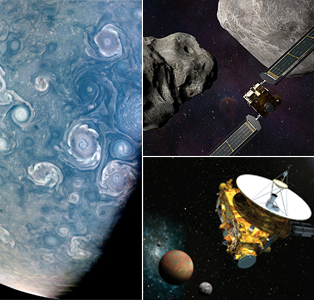
The first mission intent on altering the orbital path of a celestial object, NASA Double Asteroid Redirection Test (DART), is to impact 160-m diameter Dimorphos, the smaller body of binary asteroid system Didymos – named for the larger body, 780-m diameter Didymos – on September 26 at 23:14 UTC. The DART spacecraft with mass ~570 kg will be traveling at 6.6 km/s at time of collision with 5,000,000,000-kg Dimorphos, the kinetic energy from which is expected to shorten the orbit time of the smaller asteroid by up to 10 minutes. The effort is to be supported by Hubble and JWST space observatories and imaged up close by Light Italian CubeSat for Imaging of Asteroids (LICIACube) 6U CubeSat, which was deployed from DART on Sep 11. The sole instrument on DART is Didymos Reconnaissance and Asteroid Camera for Optical navigation (DRACO), an updated version of Long Range Reconnaissance Imager (LORRI) from New Horizons, which is set to begin its second extended mission Oct 1. Currently in the Kuiper Belt at 53.2 AU, the next phase of operations will see New Horizons reactivate from hibernation on March 1 2023, transmitting remainder of Arrokoth data while pursuing new observations of KBOs and heliosphere. DRACO autopilot system SMART Nav was calibrated on Jupiter moon Europa, which will also be observed by JUNO – the craft will reach 355 km from the surface of Europa on Perijove 45 on September 29 at 17:11 UTC. (Image Credits: NASA, SwRI, JHUAPL)
★ Sep 26 — Double Asteroid Redirection Test (DART), Dimorphos Impact: NASA / APL mission to impact minor-planet moon Dimorphos of the double asteroid Didymos for planetary defense test, 19:14 EDT; live feed starts at 17:30 EDT.
★ Sep 26 — SpaceX, Launch Falcon 9 / Starlink 4-36, LC-40, Cape Canaveral SFS FL: Falcon 9 rocket to launch next batch of Starlink internet satellites.
☆ Sep 26 — Jupiter: At closest opposition since 1963 (3.95 AU), 09:00.
☆ Sep 26 — Mercury: 3.2° SSW of Venus, 14:00.
☆ Sep 26 — Apollo Asteroid 2022 SO: Near-Earth Flyby (0.067 AU)
Continued From…
★ Jun 28 – Nov 13 — CAPSTONE, Near-Rectilinear Halo Orbit Trajectory: Cislunar Autonomous Positioning System Technology Operations and Navigation Experiment heading to operating position at NRHO / cislunar space.
☆ Aug 4 – Dec 16 — Korea Pathfinder Lunar Orbiter (KPLO), Lunar Trajectory: South Korea ‘Danuri’ to search for lunar resources, test technologies using Ballistic Lunar Transfer, 3 highly elliptical Earth orbits to initiate a trans-lunar injection and arrive at 100-km lunar orbit.
o Aug 8 – Nov 11 — IAU, NAOJ, NARIT, Online / Global: NameExoWorlds 2022.
TUESDAY
★ NET Sep 27 — NASA, Launch SLS / Orion / Artemis 1, LC-39B, KSC FL: First test flight of NASA Space Launch System with uncrewed Multi-Purpose Crew Vehicle and ESA Service Module; window opens 11:37 EDT; to feature configuration for 70-metric-ton lift capacity; Orion spacecraft to perform circumlunar trajectory during 39 day mission; will carry 10 CubeSats; next launch opportunity Oct 2.
☆ Sep 27 — Apollo Asteroid 2020 HN3: Near-Earth Flyby (0.082 AU)
WEDNESDAY
☆ Sep 28 — Astrosat, 650-km Near Equatorial LEO: ISRO first dedicated multi-wavelength space observatory reaches 7th full year / begins its 8th year in space today, launched 2015.
☆ Sep 28 — Apollo Asteroid 2022 SZ: Near-Earth Flyby (0.035 AU)
☆ Sep 28 — Apollo Asteroid 406213 (2007 AB2): Near-Earth Flyby (0.055 AU)
☆ Sep 28 — Apollo Asteroid 2022 RC5: Near-Earth Flyby (0.057 AU)
THURSDAY
☆ Sep 29 — ISS, Soyuz MS-21 Crew Undocking / Return to Earth, ~415-km LEO: Soyuz MS-21 and Expedition 66-67 crew Oleg Artemyev, Denis Matveev, Sergey Korsakov scheduled to return to Earth.
★ Sep 29 — Juno, Perijove 45 / 44th Science Flyby,Jupiter Orbit: NASA craft to perform Jupiter flyby during Perijove 45, its 45th close flyby of Jupiter and 44th science flyby with instruments turned on; will also perform 320-km flyby of Europa, reducing orbital period from about 43 days to 38 days.
★ Sep 29 — SpaceX, Launch Falcon 9 / SDA Tranche-0,SLC-4E, Vandenberg SFB CA: Falcon 9 rocket to launch 14 Tranche-0 demo satellites for USA DoD Space Development Agency.
☆ Sep 29 — Apollo Asteroid 2017 FQ63: Near-Earth Flyby (0.098 AU)
FRIDAY
★ Sep 30 — ULA, Launch Atlas 5 / SES 20 & SES 21,SLC-41,Cape Canaveral SFS FL: United Launch Alliance Atlas 5 rocket will launch the SES 20 and SES 21 communications satellites for SES of Luxembourg.
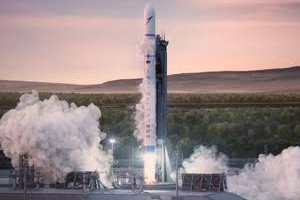
★ Sep 30 — Firefly Aerospace, Launch Alpha / Multi-payload, SLC-2W, Vandenberg SFB CA: Firefly Alpha rocket to attempt second test flight with a rideshare payload / multiple small satellites.
o Sep 30 — International Lunar Observatory Association, Space Age Publishing Company, Scarsdale NY:Galaxy Forum New York 2022 Scarsdale; featuring Bailey Burns of Paragon Development Corp. and Steve Durst of ILOA Hawai’i.
☆ Sep 30 — Apollo Asteroid 2020 TV: Near-Earth Flyby (0.077 AU)
SATURDAY
☆ Oct 1 — Deep Space, Venus Orbit: JAXA Akatsuki with 6 science instruments (totaling 34 kg) heading toward 7th full year at Venus while missions under development are Rocket Lab Venus Probe, ISRO Shukrayaan-1, CNSA VOICE, NASA VERITAS and DAVINCI, Roscomos Venera-D, and ESA EnVision.
★ Oct 1 — New Horizons, Kuiper Belt: NASA spacecraft to enter second extended mission phase; continues in hibernation mode until March 1, 2023.
o Oct 1 — Stratospheric Observatory for Infrared Astronomy (SOFIA), Palmdale CA: NASA / DLR observatory to complete operations after more than a decade of observations of celestial magnetic fields, star-forming regions, comets, nebulae, and the galactic center.
In celebration of the 25th anniversary of the creation of the Astrophysics Group at the University of Exeter, we are pleased to announce the international...
Emanating from ~6km-wide comet with 5.3-year Solar orbit, visible in constellation Aquarius near star Delta Aquarii, fast, faint meteors peak on this night, best...
The International Research Conference is a federated organization dedicated to bringing together a significant number of diverse scholarly events for presentation within the conference...
Includes ~150 meetings covering the fields of COSPAR Scientific Commissions / Panels / Task Groups, such as SC B: The Earth-Moon System, Planets, and...
From 02 to 07 August 2026, a few thousand geoscientists across diverse disciplines will gather at the 23rd annual meeting of the Asia Oceania Geosciences...
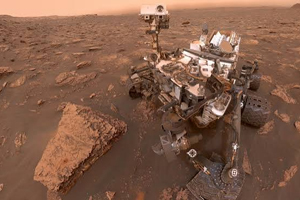
NASA Curiosity (Mars Science Laboratory) rover surpasses another full year of operations on Mars surface today; launched Nov 26, 2011 – landed Aug 5,...
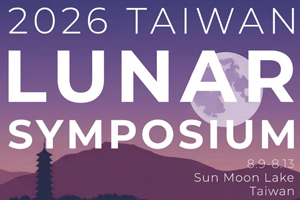
This international lunar science meeting has two objectives: to provide a platform for leading experts to review recent advances across lunar research, from the...
At CSIR International Convention Centre. Key topics are Earth Observation, Developing Space Tourism, Space Supply Manufacturing. Cultural tours are offered.
Participants will receive theoretical and hands-on training in electron imaging and X-ray spectroscopy for application to planetary samples. This training opportunity is targeted at...