SpaceX Ascends as World Spacefaring Power with Unmatched Launch Cadence, Crew and Mass to Orbit
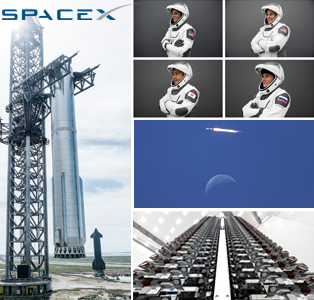
By various metrics, SpaceX is now a leading global space power both in comparison to other commercial efforts and full-fledged national and multinational space agencies: upcoming launch of Crew-5 to ISS, scheduled for October 5 at KSC, will be the 43rd orbital launch for Falcon 9 in 2022, surpassing CNSA Long March family of rockets, which launched 42 times within the same period. This rapid, weekly cadence puts SpaceX on track to meet 52-launch set back in February, while Falcon 9 in Q2 delivered 2x overall mass to orbit (158,666 kg) than all other global launch providers. Crew-5 Astronauts (clockwise) Nicole Mann (NASA), Josh Cassada (NASA), Anna Kikina (Roscosmos) and Koichi Wakata (JAXA) prepare for their work commute to ISS via SpaceX Falcon 9, a nearly routine trip featuring autonomous docking, bringing the total count to 17 humans who have reached orbit in 2022 – 8 with Falcon 9 / Crew Dragon, 3 on CNSA Shenzhou, and 6 on Roscosmos Soyuz. Global LEO communication constellation Starlink, designed and manufactured in Redmond WA SpaceX facility, now operates on 7 continents via 1M+ ground terminals. Starship / Super Heavy prototypes currently undergoing trials and hot-fire tests are expected to launch for an orbital test NET November, possibly beating NASA flagship SLS / Orion to first flight. Starship is central to the SpaceX vision of humanity as multiworld species, intended to ferry international Artemis Astronauts to the lunar surface and eventually on into deeper space, Mars and the wider Solar System. (Image Credits: SpaceX)
MONDAY
☆ Oct 3 — ISS,~415-km LEO: Expedition 68 with Samantha Cristoforetti as Commander to welcome 4 members of Crew-5 bringing total crew to 11, ships docked to 5, and Bigelow BEAM attached.
☆ Oct 3 — Tiangong Space Station, ~390-km LEO: Shenzhou 14 three-member crew continue work to integrate modules, analyzing EVA small mechanical arm performance, testing newly installed external circuits.
Highlights…
o NewSpace: Europe startups Rocket Factory Augsburg, Skyrora, Isar Aerospace plan 2023 launches from Scotland & Norway; Astrobotic to provide power on Moon with Vertical Solar Array Technology / LunaGrid, construction beginning NET 2026; Intuitive Machines to build 40kW lunar fission surface reactor in partnership with X-energy.
☆ Solar System: Signals from Zhurong 100m ground-penetrating, high-frequency radar on Mars being analyzed for indication of historical flooding; Researchers studying geomagnetic data to determine if solar storm that sparked NOAA K7 warning was caused by coronal mass ejection.
☆ Galaxy: Earth location 26,000 LY from MWG center may be photometric microlensing ‘blind spot’, limiting detection by extraterrestrial civilizations; Spiral galaxy IC 5332 structure being observed by JWST while investigation of MIRI instrument grating wheel anomaly ongoing; Hubble data on protective corona enveloping Large & Small Magellanic Clouds furthers galaxy formation understanding.
o Global: KARI opting to seek alternative providers for upcoming satellite launches previously booked to fly on Angara 1.2 and Soyuz, incurring extra US$61M in estimated costs; 1,656 star clusters within Milky Way being studied following discovery by China astronomers utilizing data released from ESA Gaia.
●USA: NASA Explorers video series season 5 “Artemis Generation” to highlight space education, lunar geology, human exploration of Moon South Pole; Artemis 1 undergoing leak troubleshooting and Flight Termination System battery swap in VAB with next launch opportunity likely November.
● Hawai’i: UH88 (Mauna Kea) and Faulkes North telescopes (Haleakalā) monitoring Dimorphos trajectory following NASA IRTF, CFHT (Mauna Kea), ATLAS-MLO (Mauna Loa), and ATLAS-HKO (Haleakalā) observations of DART impact; EPA suggests analysis of proposed Hawaii Big Telescope impact on cultural resources be conducted.
● = Terrestrial events, and…
o = International terrestrial events in local time.
★ = Space events, and… ☆ = International space / astro events in Hawaii Standard Time unless noted. Add 10 hours to obtain UT (‘Universal Time’).
World Space Week 2022 Gears Up for Thousands of Events Highlighting Space and Sustainability
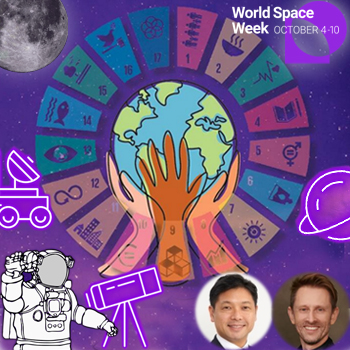
Expecting more than 1,650 events in 95 countries on 6 continents, and in LEO, World Space Week 2022 will be celebrated October 4-10. While Artemis Accords are paving a path to develop future Moon surface / cislunar realities for a Multi World Civilization, WSW recognizes the historic 65th observation of 1957 Sputnik One launch on Oct 4 and the 55th year of the 1967 Outer Space Treaty going into effect Oct 10. It is led by WSW Association which currently has 90 national coordinators and 2 local coordinators (Hong Kong, Palestine). WSW has been celebrated as a United Nations declared annual event since 1999 under COPUOS and UNOOSA. This year, sponsors include, Astroscale, Lockheed Martin and Viasat. Addressing sustainability in and from space, WSW will focus on issues such as space debris, environmental challenges and climate change. Nobu Okada (Astroscale Founder) will be WSW Honorary Chair and Chris Boshuizen (Planet Labs Cofounder, New Shepard spaceflight participant) is its Spokesperson to encourage global participation. Some events include: Italy & Australia – Collaboration and Investment Opportunities in Space being featured in Perth, Australia; Astronomy News Space Talks in Florianopolis, Brazil; Extraterrestrial Diplomacy Conference 2022 in Ottawa, Canada; African Women Rights and their Role in Sustainable Development (AWRSD) from Egypt; PhilSA Build Your Own Model Satellite from Philippines. (Image Credits: WSWA, Blue Origin)
☆ Oct 3 — Apollo Asteroid 2022 SC9: Near-Earth Flyby (0.034 AU)
☆ Oct 3 — Apollo Asteroid 2019 TY6: Near-Earth Flyby (0.091 AU)
Continued From…
★ Jun 28 – Nov 13 — CAPSTONE, Near-Rectilinear Halo Orbit Trajectory: Cislunar Autonomous Positioning System Technology Operations and Navigation Experiment heading to operating position at NRHO / cislunar space.
☆ Aug 4 – Dec 16 — Korea Pathfinder Lunar Orbiter (KPLO), Lunar Trajectory: South Korea ‘Danuri’ to search for lunar resources, test technologies using Ballistic Lunar Transfer, 3 highly elliptical Earth orbits to initiate a trans-lunar injection and arrive at 100-km lunar orbit.
o Aug 8 – Nov 11 — IAU, NAOJ, NARIT, Online / Global: NameExoWorlds 2022.
● Oct 4-6 — Applied Technology Institute (ATI), Online / Riva MD:ATI Course: Satellite Communications Systems – Advanced; taught by Bruce Elbert of Wisconsin, Madison and Christopher Hoeber of Cornell University; US$2,090 per person.
o Oct 4-10 — World Space Week Association, Global:World Space Week 2022: Space and Sustainability; to celebrate international contributions of space science and technology to the betterment of the human condition; Oct 4 is 65th observation of 1st Space mission Sputnik One launched by Soviet Union 1957; Oct 10 is 55th observation of Outer Space Treaty going into effect 1967.
☆ Oct 4 — Moon: At perigee, distance 369,295 km, 06:41.
☆ Oct 4 — Amor Asteroid 2020 TA1: Near-Earth Flyby (0.066 AU)
☆ Oct 4 — Apollo Asteroid 65803 Didymos (1996 GT): Near-Earth Flyby (0.071 AU)
WEDNESDAY
★ Oct 5 — SpaceX, Launch Falcon 9 / Crew 5 (US Crew Vehicle-5), LC-39A, Kennedy Space Center FL: SpaceX Crew Dragon to launch its sixth crewed mission / fifth mission carrying ISS crew: Nicole Aunapu Mann (to become 1st Native American Woman in Space), Josh Cassada (1st flight), Koichi Wakata (5th flight), Anna Kikina (1st flight).
☆ Oct 5 —Rocket Lab, Launch Electron / GAzelle, LC 1B, Mahia Peninsula, New Zealand: Electron rocket to launch GAzelle smallsat (formerly Orbital Test Bed 3) for General Atomics, which carries Argos 4 Advanced Data Collection System payload for NOAA, CNES, USA Space Force.
● Oct 5 — Washington Space Business Roundtable (WSBR), Washington DC:WSBR Luncheon; with Chirag Parikh of USA National Space Council and meteorologist Meredith Garofalo.
☆ Oct 5 — Moon: 3.9° SE of Saturn, 09:00.
☆ Oct 5 — Aten Asteroid 2018 VG: Near-Earth Flyby (0.047 AU)
THURSDAY
★ Oct 6 — SpaceX, Launch Falcon 9 / Galaxy 33 & 34, LC-40, Cape Canaveral SFS FL: Falcon 9 rocket to launch Galaxy 33 and Galaxy 34 commercial communications satellites, built by Northrop Grumman for Intelsat.
☆ Oct 6 — Mercury: At perihelion, 0.3075 AU from Sun, 11:00.
☆ Oct 6 — Apollo Asteroid 2021 TJ10: Near-Earth Flyby (0.050 AU)
☆ Oct 6 — Apollo Asteroid 2006 SG7: Near-Earth Flyby (0.052 AU)
☆ Oct 6 — Amor Asteroid 2022 SB8: Near-Earth Flyby (0.061 AU)
☆ Oct 6 — Aten Asteroid 2018 PZ21: Near-Earth Flyby (0.063 AU)
FRIDAY
☆ Oct 7 — Moon: 2.79° SE of Neptune, 20:00.
☆ Oct 7 — Amor Asteroid 2013 TJ6: Near-Earth Flyby (0.030 AU)
☆ Oct 7 — Amor Asteroid 2022 SW4: Near-Earth Flyby (0.062 AU)
☆ Oct 7 — Amor Asteroid 2022 SC2: Near-Earth Flyby (0.073 AU)
☆ Oct 7 — Apollo Asteroid 2019 QO6: Near-Earth Flyby (0.087 AU)
SATURDAY
o Oct 8 — British Interplanetary Society, Worcester, United Kingdom: BIS West Midlands Space Day; 10:30-16:00.
☆ Oct 8 — Moon: 1.87° SE of Jupiter, 11:00.
☆ Oct 8 — Draconids Meteor Shower Peak: Appearing to radiate from constellation Draco, Draconids offer slow moving (20 km/s) meteors which are faint and fragment easily, about 10-20 per hour; peak 15:00.
☆ Oct 8 — Apollo Asteroid 2019 SB6: Near-Earth Flyby (0.079 AU)
☆ Oct 8 — Amor Asteroid 2022 RC9: Near-Earth Flyby (0.086 AU)
SUNDAY
☆ Oct 9 — Moon: Full Hunter’s Moon, 10:54.
☆ Oct 9 — Aten Asteroid 2022 FX1: Near-Earth Flyby (0.090 AU)
☆ Oct 9 — Amor Asteroid 477719 (2010 SG15): Near-Earth Flyby (0.092 AU)
In celebration of the 25th anniversary of the creation of the Astrophysics Group at the University of Exeter, we are pleased to announce the international...
Emanating from ~6km-wide comet with 5.3-year Solar orbit, visible in constellation Aquarius near star Delta Aquarii, fast, faint meteors peak on this night, best...
The International Research Conference is a federated organization dedicated to bringing together a significant number of diverse scholarly events for presentation within the conference...
Includes ~150 meetings covering the fields of COSPAR Scientific Commissions / Panels / Task Groups, such as SC B: The Earth-Moon System, Planets, and...
From 02 to 07 August 2026, a few thousand geoscientists across diverse disciplines will gather at the 23rd annual meeting of the Asia Oceania Geosciences...
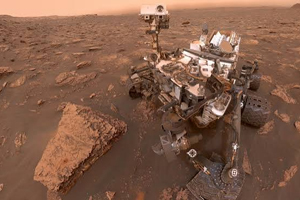
NASA Curiosity (Mars Science Laboratory) rover surpasses another full year of operations on Mars surface today; launched Nov 26, 2011 – landed Aug 5,...
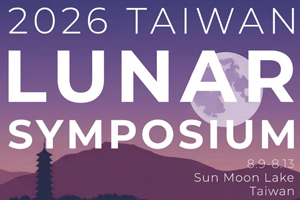
This international lunar science meeting has two objectives: to provide a platform for leading experts to review recent advances across lunar research, from the...
At CSIR International Convention Centre. Key topics are Earth Observation, Developing Space Tourism, Space Supply Manufacturing. Cultural tours are offered.
Participants will receive theoretical and hands-on training in electron imaging and X-ray spectroscopy for application to planetary samples. This training opportunity is targeted at...