ISS Expedition 71 Planning Series of 3 EVAs; Starliner Astronauts Staying Longer
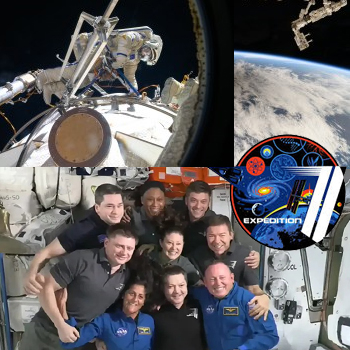
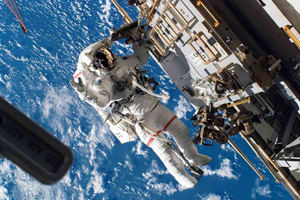
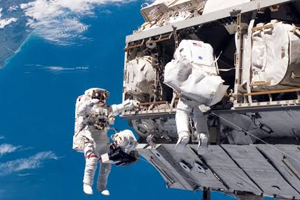
The International Space Station (ISS) continues its shining example of humans exploring, working and living beyond Earth. NASA Astronauts Suni Williams and Barry Wilmore are staying longer after arriving on NASA Commercial Crew Program Boeing Starliner CST-100 to join Oleg Kononenko, Commander, and Flight Engineers Nikolai Chub, Tracy Caldwell-Dyson, Michael Barratt, Matthew Dominick, Jeanette Epps and Alexander Grebenkin. The Sunday, June 23 USA Spacewalk 90 will stream live for approximately six hours beginning 17:00 HST. USA EVA 91 and 92 will follow in July. June 18 sees Yahoo Finance speaking with Jeanette Epps and Tracy Dyson, streaming on NASA+ at 06:05 HST, and Matt Dominick will connect with KNSD-TV, San Diego at 08:30 HST. Science work includes collecting saliva and blood samples in support of the Immunity Assay science session, analyzing cells and tissues for possible unwanted effects of microgravity on the immune response. An example of Ham Radio contact is with Agrupamento de Escolas and Dr. Serafim Leite of Portugal, where the crew fields questions such as how long astronauts need to train before going into space, how fast the ISS moves, and what astronauts do in their free time. ISS Ham information here. (Image Credits: NASA, ISS Partners)
MONDAY
☆ Jun 17 — International Space Station,~415-km LEO: Expedition 71 planning to complete three EVAs in June-July, bringing total spacewalks for ISS to 272; seven-member crew with 2 from Boeing Starliner working with plasma crystal experiment, maintaining Iceberg cold stowage facility; Starliner helium leaks extends mission.
☆ Jun 17 — Tiangong Space Station, ~390-km LEO: Shenzhou 18 three-member crew planning next EVA (total for TSS 16 to date), to install more experiment payloads and monitor space-debris protection gear.
☆ Galaxy: International teams of astronomers using Swift data and AI to analyze distance of gamma-ray bursts and expansion of Universe; most recent study of satellite galaxy 380,000 ly from Earth suggests self-interacting dark matter may explain its low-density halo.
●USA: Artemis 3 mission may modify plans using SLS, Orion, Starship to accomplish 2026 human Moon landing, while SpaceX continues success of Starship tests; congress seeks to reduce budget cuts for Chandra space telescope future operations.
Europe Hosts UN COPUOS, 12th ELS, and Many Lunar-Related Events
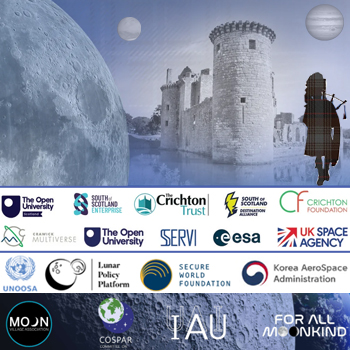
The 12th European Lunar Symposium (ELS) is ongoing June 16-21 in Dumfries and Galloway, Scotland, United Kingdom. Hosted by SSERVI, Open University, UKSA, ESA, and local Scotland organizers, the 12th ELS will cover lunar missions of LRO, IM-1, Peregrine, Artemis, Chang’E, moonlight, SELENE, ILEWG EuroMoonMars and many others. Among the ~70 speakers, the Space Agency Panel will feature Lori Glaze (NASA), James Carpenter (ESA), Masaki Fujimoto (JAXA), Hessa Rashid (MBRSC/UAE) and Anil Bhardwaj (ISRO). In Vienna, Austria, the United Nations Committee on Peaceful Uses of Outer Space (COPUOS) is holding its 67th session June 19-28. There will be morning and afternoon plenary sessions and technical presentations, as well as 15 side events including the UNOOSA-sponsored ‘United Nations Conference on Sustainable Lunar Activities‘ which aims to identify commonalities among key lunar actors’ potentials and avenues for global coordination. The Moon Village Association / International Astronomical Union / For All Moonkind event ‘Sustainable Lunar Environment: Challenges and Opportunities‘ will feature Giuseppe Reibaldi, Ian Crawford, Pascale Ehrenfreund, Richard Green and Michelle Hanlon for an hour discussion. A Lunar Policy Platform / Secure World Foundation / Republic of Korea side event ‘Reflections on the United Nations Conference on Sustainable Lunar Activities: Priorities and Capacity Building‘ will take place over ~3 hours and see talks by UNOOSA Director Aarti Holla Maini, and representatives from Korea AeroSpace Administration, UNAM Mexico, EURO2MOON Luxembourg. (Image Credits: ELS Organizations, UNOOSA, MVA, et al)
● Jun 17 — Maunakea Visitor Information Station, International Lunar Observatory Association, Hale Pohaku ~9,200 ft, Mauna Kea HI: Maunakea-Malapert Moon Presentation and Observation; ILOA discusses the ‘Mountain on the Moon’ Malapert Massif, followed by Moon gazing lead by VIS astronomers; starts 18:00 HST, limited to 45 people.
● Jun 17 — IEEE Computer Society, Seattle WA: 3rd AI for Space Workshop 2024; emphasis on vision of and learning algorithms for autonomous space systems; Seattle Convention Center, US$100-425.
★ NET Jun / Summer — SpaceX, Launch Falcon 9 / Polaris Dawn Crew Dragon, LC-39A, Kennedy Space Center FL: Jared Isaacman, Scott Poteet, Sarah Gillis and Anna Menon to reach apogee of 1,400 km, perform first commercial EVA, and test spacecraft-to-spacecraft communications with Starlink on 5-day mission.
o Jun 16-21 — SSERVI, The Open University, UKSA, ESA, Dumfries and Galloway, Scotland, United Kingdom:12th European Lunar Symposium; at Easterbrook Hall, Crichton Campus.
o Jun 16-21 — Society of Photographic Instrumentation Engineers (SPIE), National Astronomical Observatory of Japan (NAOJ), Optronics, Yokohama, Japan: SPIE Astronomical Telescopes + Instrumentation.
TUESDAY
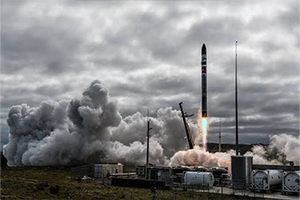
☆ Jun 18 — Rocket Lab, Launch Electron / Kinéis 1-5, Launch Complex, Mahia Peninsula, New Zealand: Launch of mission dubbed “No Time Toulouse” of 5 satellites for France Kinéis IoT constellation designed to operate with 25 nanosatellites of 30 kg each.
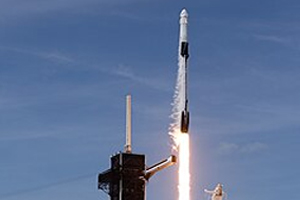
★ Jun 18 — SpaceX, Launch Falcon 9 / Astra 1P/SES-24, SLC 40, Cape Canaveral SFS FL: Launch of ASTRA 1P broadcast satellite for SES to Geostationary Transfer Orbit.
● Jun 18 — 41st Observation of the 1st USA Woman in Space, Nationwide USA / Global: Celebrating the first American woman to fly in Space, Sally Ride on Space Shuttle Challenger STS-7 mission in 1983, while USA plans First Woman to the Moon South Pole 2026 via developing Artemis program.
☆ Jun 20 — June Solstice: Longest day of the year (opposite in Southern Hemisphere) as Sun reaches a point farthest north of celestial equator, 10:51.
☾ Jun 20 — Moon: 0.50° ENE of Antares, occultation, 02:00.
☆ Jun 20 — Apollo Asteroid 2010 XB24: Near-Earth Flyby (0.088 AU)
FRIDAY
☆ Jun 21 — CNSA, Launch Long March 2C / Space Variable Objects Monitor (SVOM), LC-2, Xichang Satellite Launch Center, China: Long March 2C rocket to launch France / China multi-band astronomical observatory to monitor gamma-ray bursts from 625-km orbit.
☆ Jun 21 — Amor Asteroid 2024 LO2: Near-Earth Flyby (0.036 AU)
SATURDAY
☆ Jun 22 — Apollo Asteroid 2024 LJ: Near-Earth Flyby (0.022 AU)
SUNDAY
☆ Jun 23 — International Space Station, U.S. EVA #90,~415-km LEO: Expedition 71 planning 6.5-hour spacewalk starting 17:00 HST, live coverage available.
☾ Jun 23 — Lunar Reconnaissance Orbiter, Moon Orbit: NASA spacecraft reaches 15 full years / enters 16th year in Moon orbit today; launched Jun 18, 2009, arrived at Moon 5 days later.
☆ Jun 23 — Amor Asteroid 2024 KN1: Near-Earth Flyby (0.037 AU)
At the Spokane Convention Center. The meeting will have a broad scope, with a wide-ranging program of science and workforce topics, and celebrating planetary...
Convene, connect, and collaborate at the 19th annual von Braun Space Exploration Symposium! This year’s event will spotlight how bold ideas, emerging technologies, and...
Themes include: Space & the Arctic; Space & AI; Space & International Collaboration. There is a Student Session, a Technical Session, a Frontier Session,...
Oslo Spaceport Norway offers monthly a knowledgeable speaker and opportunity for networking, 17:00-20:00 local time; free entry but registration required. Ground Control is for...
45 satellites to launch for Amazon Leo, formerly named Project Kuiper. This LEO mega constellation will offer broadband internet access with 3,276 satellites.
Occurring 31 October from 09:00-11:00 local time (16:00-18:00 HST, 19:00-21:00 PDT, 22:00-24:00 EDT on 30 October), this Galaxy Forum will be in hybrid format...
Originally planned around this date for Wenchang, China -- TBC (to be confirmed); As the only professional association for astronauts, ASE supports the advancement of...
Coordinating Division Division C Education, Outreach and Heritage The IAU Symposium on Innovative Research and Techniques in Astronomy Communication will take place from November...
Change clocks back 1 hour from Daylight Saving to Standard Time; does not include Hawai’i, Arizona (except the Navajo Nation), American Samoa, Guam, Northern...
ESWW is the main annual event in the European Space Weather and Space Climate calendar. It is an international meeting organised annually within the...
IAU Symposium: IAUS409 - A Journey Towards Effective Astronomy Communication; online and at National Astronomical Observatory of Japan, 2-21-2 Osawa Mitaka, Tokyo. Topics include:...
Launch Complex 1, ~39°S, Mahia Peninsula, New Zealand
iQPS Launch 9, an Earth observation satellite with Synthetic aperture radar for Japan-based imaging company iQPS, to launch on "The Sea God Surveys" mission...
Launch window 10:34am - 2:34pm local time for the 15th batch of classified satellites for a reconnaissance constellation built by SpaceX and Northrop Grumman...
Expecting senior government and executives from NASA, Firefly, Blue Origin to discuss innovation, competitive advantages and a "space industrial revolution in LEO". Capped at...
Launch Complex 1, ~39°S, Mahia Peninsula, New Zealand
iQPS Launch 10, an Earth observation satellite with Synthetic aperture radar for Japan-based imaging company iQPS, to launch on “The Mountain God Rises” mission...