Chang’E-6 Lunar Farside Samples Planned to Land in Inner Mongolia June 25
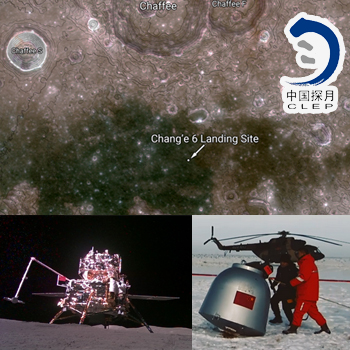
The first–ever Moon farside sample is targeted to return to Earth on June 25 for China National Space Administration under its highly successful Chang’E (CE) program. The samples, which may be ~2 kg from a depth of ~2 meters, will potentially influence the International Lunar Research Station site selection and future landing missions, depending on the abundance of water / chemicals or other characteristics such as ages of basalt materials or ejecta from the South Pole-Aitken basin impact. Researchers are eager to compare the nearside samples collected by Apollo Astronauts and CE-5 mission with the farside regolith composition, which should reveal clues about the history of the early Solar System. CE-6 lander was further pinpointed by a team working with NASA Lunar Reconnaissance Orbiter which estimated its location to be -41.6385°N, 206.0148°E and -5,256 meters elevation relative to the lunar geodetic reference (+/- 30 meters). CE-6 is the second robotic lunar sample return mission from China, and similar to CE-5 it has a lander, ascender, orbiter and returner. The CE-6 rover was not revealed until after launch. The lander and rover could possibly survive the lunar night, but they do not have RTGs like the CE-3 and CE-4 missions. The next CE mission, CE-7 in late 2026, will include a lander, rover, mini-hopping probe, orbiter and 7 international payloads. (Image Credits: CNSA, CGTV, NASA, GSFC, Arizona State University)
MONDAY
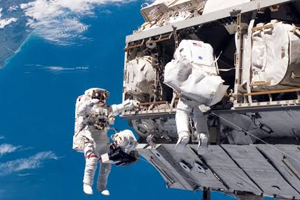
☆Jun 24 — International Space Station,~415-km LEO: Expedition 71 seven-member crew to oversee departure of Boeing Starliner CST-100 with Sunita Williams and Butch Wilmore mid-week, depending on craft thrust issue resolutions; 2 crew members to perform 6.5-hour US EVA #90 starting 08:00 EDT today, live coverage available; planning for follow-up spacwalk next week.
☆Jun 24 — Tiangong Space Station, ~390-km LEO: Shenzhou 18 three-member crew undergoing tests to compare operational physical strength in space vs on Earth; planned to complete >90 experiments during 6-month mission; portions of recently completed 8.5-hour EVA shared with public via high-res video.
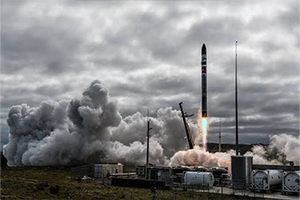
o NewSpace: ALUULA Composites of Canada collaborating with Max Space of USA to design expandable lunar habitats launching NET 2026 via SpaceX; Rocket Lab working toward medium-lift rocket launches of Neutron in 2025, becomes ‘fastest to 50’ commercial launch provider with Electron vehicle; Merida Aerospace of Florida aiming to build National Rocket and Space Center in Mexico Yucatan region, cooperate with Mexican Space Agency (AEM).
o Global: ESA aids Chang’E-6 sample return via tracking from its Maspalomas station in Gran Canaria island in Spain; India Vyomnauts to begin training at Johnson Space Center, enhance Artemis / lunar collaboration with USA; China Long March 10 aimed at landing people on Moon before 2030 passes first stage static fire test.
● Hawai’i: ILOA Hawai’i to work with Hong Kong University, NAOC, NARIT for astronomical imager to fly on Chang’E-7 Moon lander; Mauna Kea monthly star and Moon observation events being sponsored by VIS and volunteers; Gemini Observatory confirms pair of merging quasars seen 900M years after Big Bang, aids research into understanding quasar roles during Epoch of Reionization.
● = Terrestrial and… o = International terrestrial events
☾ = Moon activity
★ = Space and… ☆ = International space / astro events in Hawaii Standard Time unless noted. Add 10 hours to obtain UT (‘Universal Time’).
SpaceX Falcon Heavy to Launch NOAA GOES-U Weather Satellite to ~35,800 Km GEO
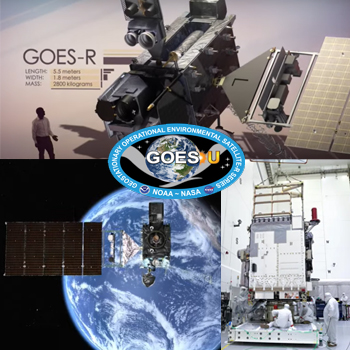
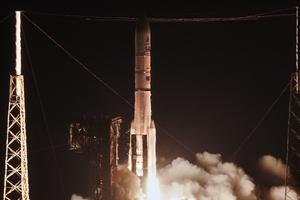
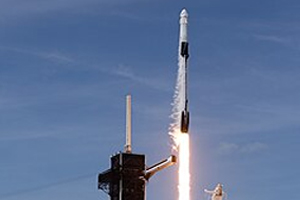
A two-hour launch window opens at 17:16 EDT June 25 for the fourth and final GOES-R Series satellite, GOES-U. The Lockheed Martin-built satellite is atop a SpaceX Falcon Heavy rocket. Lift off is from LC39A, Kennedy Space Center, FL, with 2,200+ kg of hypergolic propellant and oxidizer. GOES-U will become GOES-19 after testing, perhaps next April, replacing GOES-16 to observe all of the Americas and the Atlantic Ocean. The GEO location will be reached in about three weeks. A first on board is the Naval Research Lab-built Compact Coronagraph (CCOR-1) that blocks the disc of the Sun for viewing the corona and its mass ejections every 30 minutes instead of the current 8-hour wait. The Lockheed Martin-built Geostationary Lightning Mapper (GLM) is able to distinguish between average lightning strikes and fire-hazardous ones with continuing current, and tracks storm-intensity changes with photos 500 times per second. The Advanced Baseline Imager (ABI), built by L3Harris Technologies, photographs wide areas of Earth in 16 wavelengths every ten minutes and zooms into storms to send images every 30 seconds. Also on board: Solar Ultraviolet Imager (SUVI), Space Environment In-Situ Suite (SEISS) to detect energetic particles harmful to satellites and astronauts on the ISS, Extreme Ultraviolet and X-Ray Irradiance Sensors, Magnetometer. (Image Credits: NASA, NOAA)
☾ Jun 25 — Chang’E-6 Lunar Sample Return, Inner Mongolia, China: About 2kg of samples from lunar regolith taken from scooping / drilling on lunar farside from a depth of up to 2 meters in return capsule to be returned to Earth around this date.
★ Jun 25 — SpaceX, Launch Falcon Heavy / GOES-U,Launch Complex 39A, Kennedy Space Center FL: Launch of the 4th and final satellite in National Oceanic and Atmospheric Administration Geostationary Operational Environmental Satellites (GOES) – R Series.
☆ Jun 26 — Aten Asteroid 2023 HM: Near-Earth Flyby (0.095 AU)
THURSDAY
★ Jun 27 — Interface Region Imaging Spectrograph (IRIS), Sun-Synchronous Orbit: NASA observation satellite investigating the physical conditions of the chromosphere of Sun reaches 11 full reaches / enters 12th year in space, launched 2013.
★ Jun 27 — SpaceX, Launch Falcon 9 / Starlink 10-3, SLC-40, Cape Canaveral SFS FL: Falcon 9 to launch next batch of Starlink v2-mini satellites.
☾ Jun 27 — Moon: At perigee, distance 369,295 km, 01:33; 0.33° NE of Saturn / occultation, 06:00; 0.31° N of Neptune / occultation, 23:00.
☆ Jun 27 — Amor Asteroid 2019 NJ: Near-Earth Flyby (0.044 AU)
☆ Jun 28 — Aten Asteroid 2022 MM1: Near-Earth Flyby (0.019 AU)
SATURDAY
☆ Jun 29 — Apollo Asteroid 2022 HD1: Near-Earth Flyby (0.044 AU)
SUNDAY
★ Jun 30 — Parker Solar Probe, Heliocentric Orbit: Spacecraft reaches 20th perihelion today.
o Jun 30 — CNSA, Online / Beijing, China: Proposals for Chang’E-8 international payloads due.
o Jun 30 — Asteroid Foundation, Global: Asteroid Day 2024; education, events, films and entertainment hosted by organizations and individuals to increase awareness about asteroids.
☆ Jun 30 — Apollo Asteroid 2017 MB3: Near-Earth Flyby (0.012 AU)
At the Spokane Convention Center. The meeting will have a broad scope, with a wide-ranging program of science and workforce topics, and celebrating planetary...
Convene, connect, and collaborate at the 19th annual von Braun Space Exploration Symposium! This year’s event will spotlight how bold ideas, emerging technologies, and...
Themes include: Space & the Arctic; Space & AI; Space & International Collaboration. There is a Student Session, a Technical Session, a Frontier Session,...
Oslo Spaceport Norway offers monthly a knowledgeable speaker and opportunity for networking, 17:00-20:00 local time; free entry but registration required. Ground Control is for...
45 satellites to launch for Amazon Leo, formerly named Project Kuiper. This LEO mega constellation will offer broadband internet access with 3,276 satellites.
Occurring 31 October from 09:00-11:00 local time (16:00-18:00 HST, 19:00-21:00 PDT, 22:00-24:00 EDT on 30 October), this Galaxy Forum will be in hybrid format...
Originally planned around this date for Wenchang, China -- TBC (to be confirmed); As the only professional association for astronauts, ASE supports the advancement of...
Coordinating Division Division C Education, Outreach and Heritage The IAU Symposium on Innovative Research and Techniques in Astronomy Communication will take place from November...
Change clocks back 1 hour from Daylight Saving to Standard Time; does not include Hawai’i, Arizona (except the Navajo Nation), American Samoa, Guam, Northern...
ESWW is the main annual event in the European Space Weather and Space Climate calendar. It is an international meeting organised annually within the...
IAU Symposium: IAUS409 - A Journey Towards Effective Astronomy Communication; online and at National Astronomical Observatory of Japan, 2-21-2 Osawa Mitaka, Tokyo. Topics include:...
Launch Complex 1, ~39°S, Mahia Peninsula, New Zealand
iQPS Launch 9, an Earth observation satellite with Synthetic aperture radar for Japan-based imaging company iQPS, to launch on "The Sea God Surveys" mission...
Launch window 10:34am - 2:34pm local time for the 15th batch of classified satellites for a reconnaissance constellation built by SpaceX and Northrop Grumman...
Expecting senior government and executives from NASA, Firefly, Blue Origin to discuss innovation, competitive advantages and a "space industrial revolution in LEO". Capped at...
Launch Complex 1, ~39°S, Mahia Peninsula, New Zealand
iQPS Launch 10, an Earth observation satellite with Synthetic aperture radar for Japan-based imaging company iQPS, to launch on “The Mountain God Rises” mission...