NASA Moon to Mars Focus: International Conference on Mars and Lunar-Robust Exploration Science Forum
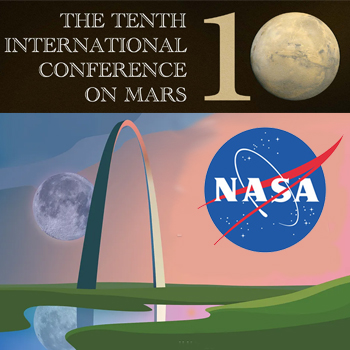
Four members of NASA Jet Propulsion Laboratory, and representatives of California Institute of Technology and NASA Mars Exploration Program convene The Tenth International Conference on Mars in Pasadena, July 22-25. Goals are an overview of Mars knowledge gained since the Mariner 4 first flyby in July 1965, an identification of crucial planetary science questions and exploration planning. The Science Organizing Committee is a stellar group of scientists with participants from Japan, Canada, France, Belgium, Switzerland, England, the ESA, Canada, nine USA states and Washington DC. There will be an evening public talk on July 24. Each day includes plenary, recap, poster highlights and oral sessions in two tracks. The final day has a session to synthesize conference content and prepare a draft report. NASA Solar System Exploration Virtual Institute (SSERVI) will hold NASA Exploration Science Forum 2024 at Washington University in St. Louis, Missouri, July 23-25. A live and virtual conference, it attracts >5,000 persons for ~70 lunar and ~20 other scientific presentations. In-person public talk is “Origin of the Moon”. Over 40 posters are presented. Eugene Shoemaker Distinguished Scientist Medal, Michael J. Wargo Exploration Science Award, Angioletta Coradini Mid-Career Award and Niebur Award all will be presented. Associated in-person event is July 22, the 15th annual Lunar and Small Bodies Graduate Forum to present four SSERVI research topics including Missions and Human Exploration. (Image credits: NASA)
MONDAY
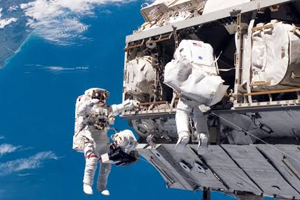
☆Jul 22 — International Space Station,~415-km LEO: Expedition 71 seven-member crew delay EVAs and continue work with two Boeing CST-100 Astronauts for the foreseeable future, pending Starliner safety review conclusions; ongoing experiments include with Lumina optical fiber, hydroponic plant water flow, and protein crystallization research.
☆Jul 22 — Tiangong Space Station, ~390-km LEO: Shenzhou 18 three-member crew Ye Guangfu, Li Guangsu and Li Cong monitoring zebrafish and hornwort research project, and conducting plant stem cell studies; CMSA publishes high-res images of recent EVA.
Highlights…
o NewSpace: Astrobotic launch of Griffin lunar lander officially delayed to Sep 2025, while Intuitive Machines IM-2 and Firefly Blue Ghost lunar landers aim for 2024 launch; Skyroot Aerospace of India planning Vikram-1 first flight after successful proof pressure test of Kalam-1200 first stage; Astroscale Japan ADRAS-J demo satellite engaging in autonomous operations / debris inspections in LEO.
● Jul 22-25 — Lunar and Planetary Institute, Universities Space Research Association, California Institute of Technology (Caltech), Mars Exploration Program, Pasadena CA:The Tenth International Conference on Mars.
☆ Jul 22 — Pluto: At opposition in longitude, magnitude 14.4, 11:00.
● = Terrestrial and… o = International terrestrial events
☾ = Moon activity
★ = Space and… ☆ = International space / astro events; in Hawaii Standard Time unless noted. Add 10 hours to obtain UT (‘Universal Time’).
S Korea Hosts Next Planetary / Space Conference, Advances KLPO and KASA
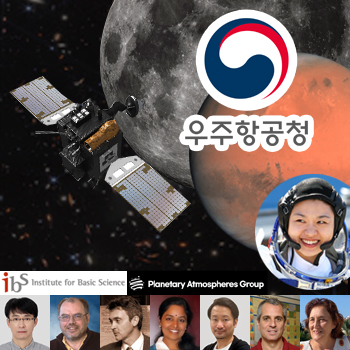
Coordinated as a satellite event to the 3,000-attendee 45th COSPAR, the Institute for Basic Science Conference on Planetary Science and Space Exploration (PSSE 2024) is set to occur July 22-25 in Daejeon. It will include diverse participation from international organizations such as Chinese Academy of Sciences, Indian Space Research Organisation, Johns Hopkins Applied Physics Lab, NASA Goddard Space Flight Center, Sorbonne Université, Kyoto Sangyo University, ESA, Space Research Institute (IKI) and Israel Weizmann Institute of Science. The tracks are Moon, Earth and near Earth; Terrestrial Planets; Atmospheric chemistry and dynamics; Gas giants and moons; and Solar System. Mission data being discussed will come from Juno, ExoMars, JWST, Venera-D and Akatsuki. The second talk on day one will be ‘An Overview of the Korean Moon mission, KPLO’ by Eunhyeuk Kim from Korea Aerospace Research Institute (KARI). KLPO (aka Danuri) is the first space and first lunar mission from South Korea, launched 2022. Its 5 instruments will continue collecting data from lunar orbit until at least 2025 in the extended mission phase. KARI is now working with the newly formed Korea Aerospace Administration (KASA), which is planned to invest US$72B to accomplish a 2045 Mars landing, with first robotic lunar landing by 2032. Korea was the 10th nation to sign the Artemis accords and has only one Astronaut to date, Soyeon Yi, who flew to ISS in 2008. (Image credits: Institute for Basic Science, KASA, KARI, NASA)
o Jul 1 – Aug 30 — Academia Sinica Institute of Astronomy and Astrophysics, Taipei, Taiwan: 2024 Summer Student Program; students conduct original research under supervision of professional astronomers.
TUESDAY
★ Jul 23 — Chandra X-ray Observatory, HEO: NASA spacecraft in extended mission phase reaches 25th full year / begins 26th year of operations in space; instruments able to detect X-ray sources 100 times fainter than any previous X-ray telescope; launched 1999.
At the Spokane Convention Center. The meeting will have a broad scope, with a wide-ranging program of science and workforce topics, and celebrating planetary...
Convene, connect, and collaborate at the 19th annual von Braun Space Exploration Symposium! This year’s event will spotlight how bold ideas, emerging technologies, and...
Themes include: Space & the Arctic; Space & AI; Space & International Collaboration. There is a Student Session, a Technical Session, a Frontier Session,...
Oslo Spaceport Norway offers monthly a knowledgeable speaker and opportunity for networking, 17:00-20:00 local time; free entry but registration required. Ground Control is for...
45 satellites to launch for Amazon Leo, formerly named Project Kuiper. This LEO mega constellation will offer broadband internet access with 3,276 satellites.
Occurring 31 October from 09:00-11:00 local time (16:00-18:00 HST, 19:00-21:00 PDT, 22:00-24:00 EDT on 30 October), this Galaxy Forum will be in hybrid format...
Originally planned around this date for Wenchang, China -- TBC (to be confirmed); As the only professional association for astronauts, ASE supports the advancement of...
Coordinating Division Division C Education, Outreach and Heritage The IAU Symposium on Innovative Research and Techniques in Astronomy Communication will take place from November...
Change clocks back 1 hour from Daylight Saving to Standard Time; does not include Hawai’i, Arizona (except the Navajo Nation), American Samoa, Guam, Northern...
ESWW is the main annual event in the European Space Weather and Space Climate calendar. It is an international meeting organised annually within the...
IAU Symposium: IAUS409 - A Journey Towards Effective Astronomy Communication; online and at National Astronomical Observatory of Japan, 2-21-2 Osawa Mitaka, Tokyo. Topics include:...
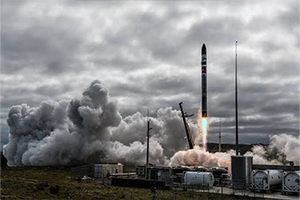
Launch Complex 1, ~39°S, Mahia Peninsula, New Zealand
iQPS Launch 9, an Earth observation satellite with Synthetic aperture radar for Japan-based imaging company iQPS, to launch on "The Sea God Surveys" mission...
Launch window 10:34am - 2:34pm local time for the 15th batch of classified satellites for a reconnaissance constellation built by SpaceX and Northrop Grumman...
Expecting senior government and executives from NASA, Firefly, Blue Origin to discuss innovation, competitive advantages and a "space industrial revolution in LEO". Capped at...
Launch Complex 1, ~39°S, Mahia Peninsula, New Zealand
iQPS Launch 10, an Earth observation satellite with Synthetic aperture radar for Japan-based imaging company iQPS, to launch on “The Mountain God Rises” mission...