First Africa General Assembly Held by International Astronomical Union in its 106th Year
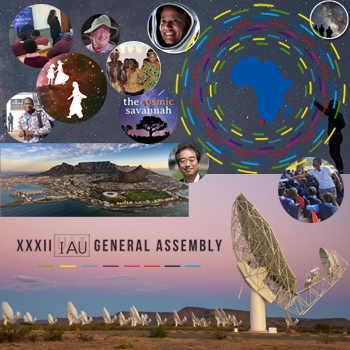
The XXXII IAU General Assembly (GA2024) is taking place in Cape Town, South Africa, August 6-15. This historic first meeting on Africa soil will have 200 scientific sessions, posters, live 10-minute link to International Space Station Astronauts, a public talk by Sian Proctor, workshops, hackathons, unconference sessions, outreach & public engagement events, exhibition hall, pop-up radio station, marketplace, technical tours, an art exhibit – and include free online open access to all talks. The goal of GA2024 is to share scientific advancements while learning about Africa contributions to infrastructure, society, equity, diversity, sustainability and the environment. There are over 2,200 registered participants (in-person and virtual) and 2,681 accepted abstracts for the meeting, which is chaired by Kevin Govender and includes 6 Symposia, 12 Focus Meetings, 6 Working Groups, 9 Division Days and 5 IAU Offices Institutional Meetings. Some of the lunar astronautical and astronomical talks are Mark McCleran on “Proposed Grid System and Projected Coordinate Reference Systems for Lunar Surface Navigation and The Artemis Missions”; Gaurav Singh “Data Processing And Scientific Exploration of the Moon-Based Ultraviolet Telescope on the Chang’E-3 Lander”; and Steve Durst “Status of the International Lunar Observatory”. Cultural Astronomy presentations include “Unearthing Rich Cultural Astronomy in Ghana” by Emmanuel Proven-Adzri, “Commission C5 Cultural Astronomy” by IAU Chair Steven Gullberg, and “Astronomy Day in Schools” by Akihiko Tomita. Women in Astronomy covers “Addressing Gender Disparities in Astronomy” by Mamta Pommier, “Training and Support for Women Astronomers” by Priya Shah, and “The Role of Women in Astronomical Observation and Astrophotography in Iraq” by Najah Al-Salihy. (Image credits: IAU, SpaceInAfrica, et al)
MONDAY
☆Aug 5 — International Space Station,~415-km LEO: Expedition 71 seven members plus 2 Boeing Starliner crew plan to oversee the rendezvous, capture and installation of Northrop Grumman Cygnus NG-21 cargo spacecraft today; working with Thor-Davis thunderstorm study and KERMIT Research Microscope Testbed; Starliner CST-100 is now 61 days docked at ISS (originally slated for 8 days with max of 45 due to battery rating).
☆Aug 5 — Tiangong Space Station, ~390-km LEO: Shenzhou 18 three-member crew performing studies in space through use of devices to counteract bone loss, stimulate nerves and muscles – will continue biomechanical characteristic comparisons after returning to Earth in late October.
o NewSpace Weekly Highlights: SpaceX seeks to increase launch cadence of Starship from Starbase in South Texas to ≤ 25 and landings of Starship & Super Heavy first stage to ≤ 50; Venture capital firm SpaceFund finds the space industry grows even when other economic sectors decline during 2006 to present; Morpheus in Germany produces electric rocket-propulsion systems from new 1,260-square-meter factory and seeks to boost manufacturing from 100 to 500 yearly; China’s commercial space market likely to reach 2.34 trillion yuan (US$326 billion) in 2024 as estimated annual growth rate is >20% from 2017 to 2024, according to iiMedia Research; Nonprofit NewSpace Nexus fosters “an entrepreneurial, business-focused commercial space ecosystem in New Mexico” and mounts annual conferences, 3 since its founding in 2019 by State of New Mexico, Virgin Galactic and others; ISRO evaluating 6 of estimated 189 space technology startups in India for future collaborations; Astrolab and Group of Humans offer companies opportunity to place ads on Astrolab’s FLEX Moon rover launching NET 2026; iSpace Japan to soon receive Luxembourg-built micro-lunar rover to integrate on HAKUTO-R lander launching late 2024.
★ Aug 5 — Juno, Jupiter Orbit: NASA craft reaches 13 full years in space today, having launched in 2011 and reaching Jupiter on July 4, 2016; one-way transmission signal to Earth is 48 minutes, mission extended through September 2025.
☆Aug 5 — CNSA, Launch Long March 6A / G60 Qianfan Xingzuo F1,Taiyuan Satellite Launch Center, China: Launch expected to carry first 18 of China G60 “Thousand Sails Constellation” of more than 12,000 satellites, aiming to provide global internet access and national data security.
● = Terrestrial and… o = International terrestrial events
☾ = Moon activity
★ = Space and… ☆ = International space / astro events; in Hawaii Standard Time unless noted. Add 10 hours to obtain UT (‘Universal Time’).
Utah State University Convenes 3,400 for 38th AIAA-USU Small Satellite Conference
The 38th Small Satellite Conference August 3-8 with theme ‘Automation Enabling New Capabilities’ shows an astounding global collaboration among academia, industry and government entities. Represented for both technical sessions and poster presentations will be over 80 learning institutions, more than 100 companies, dozens of nation-level agencies – coming from at least 36 countries plus 25 USA states. A majority of the displays and 15-minute lectures show academicians working with engineers / scientists from companies and state agencies, and many show inter-country colleagues. Scattered-in are participants from a couple high schools, 4-H, homeschooling, and the age 10-18 Wolfpack CubeSat group. Keynote speaker Steve Isakowitz heads 4,600 employees at The Aerospace Corporation and is also an initiator of Space Workforce 2030, which has 30 companies advancing diversity and representation in the space industry since 2022. Being highlighted are missions expected to launch within the next 18 months: TRACERS by Millennium Space Systems, ACMES Triton Satellite by Orion Space Solutions, GARAI Mission by SATLANTIS and OHB Sweden. Held each year since 1987 at the campus in Logan, Utah, the conference has grown from less than 100 attendees to over 3,400. Awards are given to undergraduate and graduate students. “Small satellites” are generally assumed to be 250 kg or less. Pat Patterson, Director of Advanced Concepts at the USU Space Dynamics Laboratory, is Chairman of this annual event. (Image credits: The Aerospace Corporation, Utah State University)
☾ Aug 5 — Moon: With Venus, and Regulus within circle of diameter 2.66°, 12:00; 2.66° NNE of Regulus, 13:00; 1.57° NNE of Venus, 14:00; 6.8° NNE of Mercury, 21:00.
☆ Aug 5 — Aten Asteroid 2023 HB7: Near-Earth Flyby (0.037 AU)
☆ Aug 5 — Aten Asteroid 2017 TU1: Near-Earth Flyby (0.025 AU)
o Jul 1 – Aug 30 — Academia Sinica Institute of Astronomy and Astrophysics, Taipei, Taiwan: 2024 Summer Student Program; students conduct original research under supervision of professional astronomers.
★ NET Jul 31 — SpaceX, Launch Falcon 9 / Polaris Dawn Crew Dragon, LC-39A, Kennedy Space Center FL: Jared Isaacman, Scott Poteet, Sarah Gillis and Anna Menon to reach apogee of 1,400 km, perform first commercial EVA, and test spacecraft-to-spacecraft communications with Starlink on 5-day mission.
☆NET Aug 6 — ISRO, Launch SSLV Flight 3 / Rideshare, Satish Dhawan Space Center, India: India Small Satellite Launch Vehicle to carry multiple payloads, including Space Rickshaw-0 and IITMSAT, on 3rd flight; SSLV has payload capacity of 500 kg to Low Earth orbit or 300 kg to SSO.
o Aug 6-15 — International Astronomical Union, South Africa National Research Foundation, African Astronomical Society, South African Institute of Physics, Academy of Science of South Africa, Cape Town and Western Cape Convention Bureau, et al,Cape Town, South Africa:XXXII (32nd) IAU General Assembly.
WEDNESDAY
★ Aug 7 — SpaceX, Falcon 9 / Starlink Group 8-3,Cape Canaveral SFS FL: Falcon 9 to launch next batch of Starlink v2-mini satellites.
☾ Aug 10 — Moon: 0.66° NE of Spica, occultation, 02:00.
☆ Aug 10 — Amor Asteroid 2024 KH3: Near-Earth Flyby (0.037 AU)
SUNDAY
● Aug 11 — The Space Show,Online / Las Vegas NV: Dr. David Livingston hosts Camisha Simmons, Founder and Managing Member of Simmons Legal.
☆ Aug 11 — Perseid Meteor Shower Peak: Appearing to radiate from constellation Perseus, shower can produce up to 100 meteors per hour, which are fast, bright and frequently leave persistent trains, 14:00.
At the Spokane Convention Center. The meeting will have a broad scope, with a wide-ranging program of science and workforce topics, and celebrating planetary...
Convene, connect, and collaborate at the 19th annual von Braun Space Exploration Symposium! This year’s event will spotlight how bold ideas, emerging technologies, and...
Themes include: Space & the Arctic; Space & AI; Space & International Collaboration. There is a Student Session, a Technical Session, a Frontier Session,...
Oslo Spaceport Norway offers monthly a knowledgeable speaker and opportunity for networking, 17:00-20:00 local time; free entry but registration required. Ground Control is for...
45 satellites to launch for Amazon Leo, formerly named Project Kuiper. This LEO mega constellation will offer broadband internet access with 3,276 satellites.
Occurring 31 October from 09:00-11:00 local time (16:00-18:00 HST, 19:00-21:00 PDT, 22:00-24:00 EDT on 30 October), this Galaxy Forum will be in hybrid format...
Originally planned around this date for Wenchang, China -- TBC (to be confirmed); As the only professional association for astronauts, ASE supports the advancement of...
Coordinating Division Division C Education, Outreach and Heritage The IAU Symposium on Innovative Research and Techniques in Astronomy Communication will take place from November...
Change clocks back 1 hour from Daylight Saving to Standard Time; does not include Hawai’i, Arizona (except the Navajo Nation), American Samoa, Guam, Northern...
ESWW is the main annual event in the European Space Weather and Space Climate calendar. It is an international meeting organised annually within the...
IAU Symposium: IAUS409 - A Journey Towards Effective Astronomy Communication; online and at National Astronomical Observatory of Japan, 2-21-2 Osawa Mitaka, Tokyo. Topics include:...
Launch Complex 1, ~39°S, Mahia Peninsula, New Zealand
iQPS Launch 9, an Earth observation satellite with Synthetic aperture radar for Japan-based imaging company iQPS, to launch on "The Sea God Surveys" mission...
Launch window 10:34am - 2:34pm local time for the 15th batch of classified satellites for a reconnaissance constellation built by SpaceX and Northrop Grumman...
Expecting senior government and executives from NASA, Firefly, Blue Origin to discuss innovation, competitive advantages and a "space industrial revolution in LEO". Capped at...
Launch Complex 1, ~39°S, Mahia Peninsula, New Zealand
iQPS Launch 10, an Earth observation satellite with Synthetic aperture radar for Japan-based imaging company iQPS, to launch on “The Mountain God Rises” mission...