SpaceX Polaris Dawn Trailblazing the Way for Humans in Space
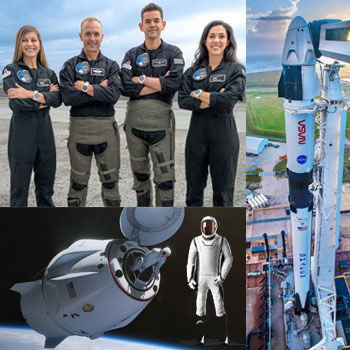
The Polaris missions will test and develop new spaceflight technology that will benefit Artemis and beyond. The planned first of three, Polaris Dawn aims to visit the inner Van Allen radiation belt, typically between 6K and 12K km above Earth’s surface, most intense over equator and absent above the poles. This will be the highest spaceflight since Apollo. At height ~700 km, 2 of the crew will do a first-ever commercial EVA in newly designed spacesuits developed for future long-duration missions. The spacesuit construction includes the same material used on Falcon interstage and Dragon trunk, provides greater mobility / safety, a dial to access additional oxygen, helmet glass with indium tin oxide / copper and internal camera / readout of sensors during EVA. The suit allows scaling to different body types. SpaceX says they seek “to create greater accessibility to space for all of humanity.” A Starlink laser-based space communication system will be tested, needed for Moon, Mars and beyond. Dozens of tests and measurements devised by prestigious institutions will be done to further knowledge of human health in space, such as effects of radiation exposure. The crew has trained more than two years via centrifuge, skydiving, Zero-G flight training, classroom, medical testing and EVA simulation underwater. Spacesuit vacuum testing was done in the same facility used during Gemini and Apollo.(Pictured L-R: Anna Menon, Mission Specialist / Medical Officer; Scott Poteet, Mission Pilot; Jared Isaacman, Mission Commander; Sarah Gillis, Mission Specialist. Image credit: SpaceX)
MONDAY
☆Aug 26 — International Space Station,~415-km LEO: Crew of nine from Expedition 71 and Boeing Starliner working with experiments for sleep performance, 3D printing, airflow, HAM radio, crystal growth, and auditing various tools for EVAs.
☆Aug 26 — Tiangong Space Station, ~390-km LEO: Shenzhou 18 three-member crew maintaining botany research, along with 23 internal experiment racks; exposed / external experiments include 22 platforms on Wentian and 30 on Mengtian modules.
o Jul 1 – Aug 30 — Academia Sinica Institute of Astronomy and Astrophysics, Taipei, Taiwan: 2024 Summer Student Program; students conduct original research under supervision of professional astronomers.
Voyagers 1 and 2, Farthest Craft From Earth, Turn 47 During Interstellar Travel
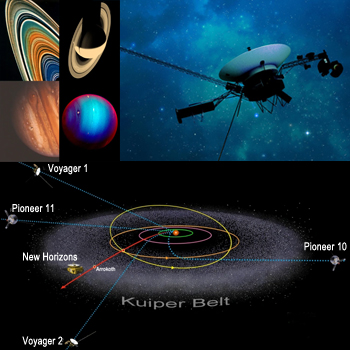
Entering their 48th year in Space, the two Voyager spacecraft continue their missions while in Interstellar Space. Voyager 1 resumed sending readable data back to Earth from a distance of 162 AU with a one-way radio signal of ~22.5 hours, after engineers overcame a computer chip memory issue a few months ago. Currently the craft has 4 of 11 science instruments turned on and functioning. It entered Interstellar space in 2012 and launched September 5, 1977. Voyager 2 is 136 AU from Earth, working with 5 instruments, and entered Interstellar Space in 2018. The Voyagers are the longest-running and most-distant spacecraft for NASA. They are expected to have enough electrical power and thruster fuel to operate until at least 2025. Though communications would be lost by that point, Voyager 1 should come within 1.7 LY of star AC+79 3888 (Gliese 445) in the year 42013, while Voyager 2 comes within 11.7 LY (9.7 trillion miles) of the star Ross 248 (also known as HH Andromedae or Gliese 905) around the same time. (Image credits: NASA, JPL, Caltech)
TUESDAY
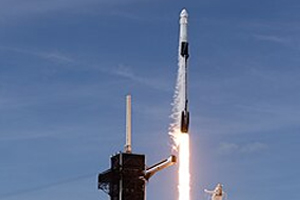
★ NET Aug 27 — SpaceX, Launch Falcon 9 / Polaris Dawn Crew Dragon, LC-39A, Kennedy Space Center FL: Jared Isaacman, Scott Poteet, Sarah Gillis and Anna Menon to reach apogee of 1,400 km, perform first commercial EVA, and test spacecraft-to-spacecraft communications with Starlink on 5-day mission, 03:38 EDT.
★ Aug 27 — SpaceX, Launch Falcon 9 / Starlink Group 8-10, SLC-40, Cape Canaveral SFS FL: Falcon 9 to launch next batch of Starlink v2-mini satellites; 03:13 EDT.
☾ Aug 27 — Moon: 5.6° N of Jupiter, 02:00; 5.3° N of Mars, 15:00.
☆ Aug 27 — Amor Asteroid (2024 MZ): Near-Earth Flyby (0.08 AU)
WEDNESDAY
☾ Aug 28 — Moon: 4.3° N of M35 cluster, 04:00.
☆ Aug 28 — Apollo Asteroid (2201 RA10): Near-Earth Flyby (0.01 AU)
★ Aug 29 — Blue Origin, New Shepard / NS-26, Corn Ranch, Van Horn TX; 26th suborbital flight of New Shepard carrying 6 passengers, 13:00 UTC.
● Aug 29 — NASA Advisory Council’s Human Exploration and Operations Committee (NAC-HEO), Washington DC:Meeting of NAC-HEO 2024.
☾ Aug 29 — Moon: 5.0° S of Castor, 14:00; 1.73° S of Pollux, 20:00.
☆ Aug 29 — Aten Asteroid (2012 SX49): Near-Earth Flyby (0.02 AU)
FRIDAY
★ Aug 30 — Van Allen Probes,LEO: Spacecraft reach 12 full years / begin 13th year in space today, launched 2012; adding to the understanding of Earth radiation belt environment and its variability.
● Aug 30 — The Space Show, Online / Las Vegas NV: Dr. David Livingston hosts Sandra Hauplik-Meusburger, researcher and architect specializing in socio-spatial sustainable and compact design solutions for both terrestrial and extra-terrestrial environments.
☾ Aug 30 — Moon: 3.2° NNE of Beehive Cluster, 23:00.
☆ Aug 30 — Aten Asteroid (2016 RJ20): Near-Earth Flyby (0.05 AU)
☆ Sep 1 — Deep Space: As New Horizons moves through Kuiper Belt, detecting what may be extended area beyond 50 AU, Earth-based Subaru telescope in Hawai’i aids mission by providing observations of KBOs.
☾ Sep 1 — Moon: 4.6° NNE of Mercury, 04:00; 2.66° NNE of Regulus, 19:00.
☆ Sep 1 — Uranus: 5.3° SSW of the Pleiades, 01:00.
☆ Sep 1 — Apollo Asteroid (2021 JT): Near-Earth Flyby (0.04 AU)
At the Spokane Convention Center. The meeting will have a broad scope, with a wide-ranging program of science and workforce topics, and celebrating planetary...
Convene, connect, and collaborate at the 19th annual von Braun Space Exploration Symposium! This year’s event will spotlight how bold ideas, emerging technologies, and...
Themes include: Space & the Arctic; Space & AI; Space & International Collaboration. There is a Student Session, a Technical Session, a Frontier Session,...
Oslo Spaceport Norway offers monthly a knowledgeable speaker and opportunity for networking, 17:00-20:00 local time; free entry but registration required. Ground Control is for...
45 satellites to launch for Amazon Leo, formerly named Project Kuiper. This LEO mega constellation will offer broadband internet access with 3,276 satellites.
Occurring 31 October from 09:00-11:00 local time (16:00-18:00 HST, 19:00-21:00 PDT, 22:00-24:00 EDT on 30 October), this Galaxy Forum will be in hybrid format...
Originally planned around this date for Wenchang, China -- TBC (to be confirmed); As the only professional association for astronauts, ASE supports the advancement of...
Coordinating Division Division C Education, Outreach and Heritage The IAU Symposium on Innovative Research and Techniques in Astronomy Communication will take place from November...
Change clocks back 1 hour from Daylight Saving to Standard Time; does not include Hawai’i, Arizona (except the Navajo Nation), American Samoa, Guam, Northern...
ESWW is the main annual event in the European Space Weather and Space Climate calendar. It is an international meeting organised annually within the...
IAU Symposium: IAUS409 - A Journey Towards Effective Astronomy Communication; online and at National Astronomical Observatory of Japan, 2-21-2 Osawa Mitaka, Tokyo. Topics include:...
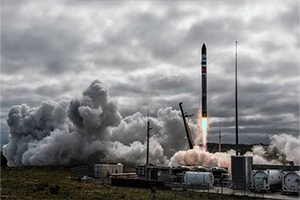
Launch Complex 1, ~39°S, Mahia Peninsula, New Zealand
iQPS Launch 9, an Earth observation satellite with Synthetic aperture radar for Japan-based imaging company iQPS, to launch on "The Sea God Surveys" mission...
Launch window 10:34am - 2:34pm local time for the 15th batch of classified satellites for a reconnaissance constellation built by SpaceX and Northrop Grumman...
Expecting senior government and executives from NASA, Firefly, Blue Origin to discuss innovation, competitive advantages and a "space industrial revolution in LEO". Capped at...
Launch Complex 1, ~39°S, Mahia Peninsula, New Zealand
iQPS Launch 10, an Earth observation satellite with Synthetic aperture radar for Japan-based imaging company iQPS, to launch on “The Mountain God Rises” mission...