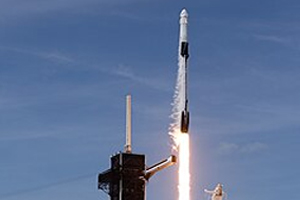
Europa Clipper Preparing to Sail Across the Solar System with Falcon Heavy NET Oct 10 Launch
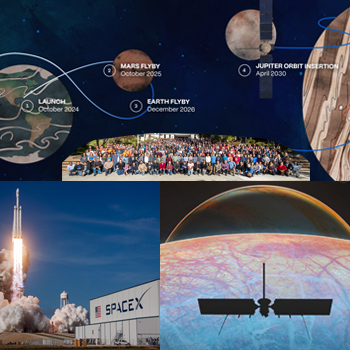
The 21-day window for Falcon Heavy launch of the 3,241-kg (dry) NASA Europa Clipper from Launch Complex-39A Kennedy Space Center, Florida, opens on October 10. This long-awaited mission is successor to the Galileo mission (1995–2003), which indicated there may be a subsurface ocean under the ice crust of Jupiter’s moon Europa. Juno made the closest flyby of it thus far, coming within 355 km of the surface in 2022. The ESA JUICE is planned to fly by Europa 2 times starting in 2032. On its trip, Europa Clipper will come within 500-1,000 km of Mars in 2025, Earth @3,200 km in December 2026, and insert itself into Jupiter orbit around April 2030. Jupiter accounts for >70% of the total planetary mass in the Solar System and currently has 95 moons recognized by the IAU. After 6 months of observations at Jupiter, Europa Clipper will be directed in October 2030 to make multiple flybys of the other 3 Galileo moons including Ganymede, the largest moon in the Solar System, transitioning toward 2031 Europa orbital insertion. The science campaign at Europa begins in May 2031, and the craft is intended to perform at least 44 close flybys (25 to 2,700 km) of the icy moon. The exciting objectives of the mission are to investigate the habitability of Europa (liquid water, chemistry, energy) and help with site selection for a future Europa Lander. (Image credits: JPL, Caltech, NASA, SpaceX)
MONDAY
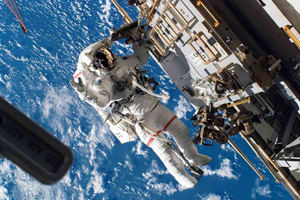
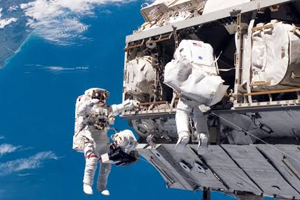
☆Oct 7 — International Space Station, ~415-km LEO: Expedition 72 eleven-member crew fulfilling routine work duties of the original SpaceX Crew-9 who did not fly (Stephanie Wilson and Zena Cardman); 4 Astronauts who have been aboard ISS since March will head home this month on SpaceX Crew-8 vehicle.
☆Oct 7 — Tiangong Space Station, ~390-km LEO: Taikonaut Commander Ye Guangfu said, in honor of Golden Week, that the TSS “represents decades of effort by generations of space workers,” and Taikonauts Li Cong and Li Guansu, expressed gratitude to countless scientists and engineers; all 3 wished prosperity, happiness and well-being for China’s people; looking forward to Shenzhou-19 crew launching of end of month.
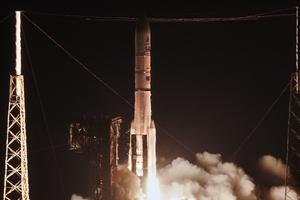
★ NET Oct 7 — SpaceX, Launch Falcon 9 Block 5 / Hera,SLC 4E, Cape Canaveral SFS FL: Robotic exploration mission to Didymos binary asteroid system by European Space Agency Space Safety program to measure size of impact crater / debris cloud and momentum transfer, similar to NASA DART test, launch cost ~US$52M; 10:52 EDT.
★ Oct 7 — Blue Origin, Launch New Shepard NS-27,Corn Ranch, Van Horn TX: Twenty-seventh flight of New Shepard, flying uncrewed suborbital mission.
UN, SGAC and Numerous Preliminary Events For 75th IAC in Milan
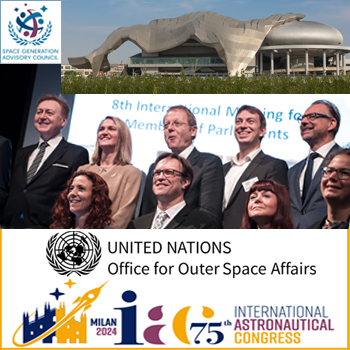
With 8,000+ participants arriving for the annual International Astronautical Federation (IAF) International Astronautical Congress (IAC), October 14-18 this year, associated events are logical. Oct 11-13 sees United Nations Office for Outer Space Affairs (UNOOSA) with IAF organizing the Workshop on Space Technology for Socio-Economic Benefits: Space Sustainability as a Game-Changer for Development, inviting ~150 participants from space agencies, research institutes, space-focused NGOs, academia and government to plan benefit for future generations, a primary aspect of “sustainability” along with environmental concerns. Space Generation Advisory Council (SGAC) for the Space Generation Congress (SGC) annually selects ~150 outstanding students / young professionals who “share a passion for space.” Chosen in a highly competitive process, SGC participants are invited to speak opinions and perspectives on international space development, and this 22nd edition, held Oct 10-12, will address sustainability both in space and on Earth. 14th IAF International Meeting for Ministers and Members of Parliaments will assemble October 13 at 09:30 with welcome remarks. Four 45-minute sessions will center on international coordination for protecting the outer space environment and that of Earth, leveraging space technologies to solve global challenges, Earth observation and space technology to mediate human effects on our planet such as deforestation and pollution, fostering cooperation for space solutions to prevent / evaluate / mitigate weather disasters. Each session ends with a roundtable discussion. A press conference may be held. (Image credits: IAF, SGAC, UNOOSA)
Ongoing…
● Sep 4 – Nov 25 —NASA, Online:Lunar Navigation Challenge; ahead of Artemis mission, 2 prizes available for orienteering aid and mapping bottom of Shackleton Crater.
o Oct 4-10 — World Space Week Association, Global:World Space Week 2024; to celebrate international contributions of space science and technology to the betterment of the human condition; Oct 4 is 67th observation of 1st Space mission Sputnik One launched by Soviet Union 1957; Oct 10 is 57th observation of Outer Space Treaty going into effect 1967.
● Oct 6-10 —American Astronomical Society Division of Planetary Sciences, Boise ID: AAS DPS 2024 Meeting.
TUESDAY
● Oct 8 — National Space Society, Online: “Roadmap to Space” Art Contest; for ages 12-25 (Grade 7 through university) entry deadline 23:59 PDT; winning art will enter space on a Blue Origin rocket and be announced at 2024 SmallSat Education Conference, Kennedy Space Center.
o Oct 8-9 — Snowdonia Aerospace, Gwynedd, Wales, United Kingdom: WSW: STEM Event; with 140 high school students for science demonstrations and model-rocket launch; at Snowdonia Aerospace Centre, Llanbedr Airfield, 10:00-14:00.
☆ Oct 8 — Apollo Asteroid 2016 JG38: Near-Earth Flyby (0.034 AU)
WEDNESDAY
o Oct 9 — Academia Sinica Institute of Astronomy and Astrophysics, Taipei, Taiwan: Colloquium; presented by Zhi-Yun Li of University of Virginia, 14:20-15:20.
☆ Oct 9 — Mercury: 2.39° NNE of Spica.
☆ Oct 9 — Apollo Asteroid 2018 QE: Near-Earth Flyby (0.003 AU)
THURSDAY
★ Oct 10 — SpaceX, Launch Falcon Heavy / Europa Clipper, LC-39A, Kennedy Space Center FL:NASA orbiter and lander to investigate Jupiter moon Europa subsurface ocean, habitability & observe future landing sites; launch cost ~US$90M; 06:31 HST.
☆ Oct 10 — Apollo Asteroid 2024 SM: Near-Earth Flyby (0.019 AU)
FRIDAY
● Oct 11 — International Lunar Observatory Association (ILOA Hawai’i),Scarsdale NY:Galaxy Forum Scarsdale High School 2024; featuring ILOA Director speaking on the USA return to the Moon and ILO-X mission.
At the Spokane Convention Center. The meeting will have a broad scope, with a wide-ranging program of science and workforce topics, and celebrating planetary...
Convene, connect, and collaborate at the 19th annual von Braun Space Exploration Symposium! This year’s event will spotlight how bold ideas, emerging technologies, and...
Themes include: Space & the Arctic; Space & AI; Space & International Collaboration. There is a Student Session, a Technical Session, a Frontier Session,...
Oslo Spaceport Norway offers monthly a knowledgeable speaker and opportunity for networking, 17:00-20:00 local time; free entry but registration required. Ground Control is for...
45 satellites to launch for Amazon Leo, formerly named Project Kuiper. This LEO mega constellation will offer broadband internet access with 3,276 satellites.
Occurring 31 October from 09:00-11:00 local time (16:00-18:00 HST, 19:00-21:00 PDT, 22:00-24:00 EDT on 30 October), this Galaxy Forum will be in hybrid format...
Originally planned around this date for Wenchang, China -- TBC (to be confirmed); As the only professional association for astronauts, ASE supports the advancement of...
Coordinating Division Division C Education, Outreach and Heritage The IAU Symposium on Innovative Research and Techniques in Astronomy Communication will take place from November...
Change clocks back 1 hour from Daylight Saving to Standard Time; does not include Hawai’i, Arizona (except the Navajo Nation), American Samoa, Guam, Northern...
ESWW is the main annual event in the European Space Weather and Space Climate calendar. It is an international meeting organised annually within the...
IAU Symposium: IAUS409 - A Journey Towards Effective Astronomy Communication; online and at National Astronomical Observatory of Japan, 2-21-2 Osawa Mitaka, Tokyo. Topics include:...
Launch Complex 1, ~39°S, Mahia Peninsula, New Zealand
iQPS Launch 9, an Earth observation satellite with Synthetic aperture radar for Japan-based imaging company iQPS, to launch on "The Sea God Surveys" mission...
Launch window 10:34am - 2:34pm local time for the 15th batch of classified satellites for a reconnaissance constellation built by SpaceX and Northrop Grumman...
Expecting senior government and executives from NASA, Firefly, Blue Origin to discuss innovation, competitive advantages and a "space industrial revolution in LEO". Capped at...
Launch Complex 1, ~39°S, Mahia Peninsula, New Zealand
iQPS Launch 10, an Earth observation satellite with Synthetic aperture radar for Japan-based imaging company iQPS, to launch on “The Mountain God Rises” mission...