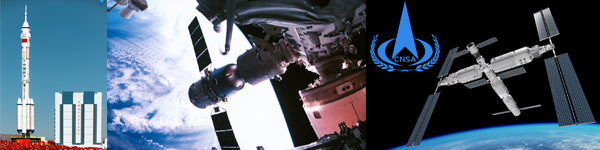
 The Shenzhou 23 mission is scheduled to launch NET May 24. Although originally planned for November, the craft was moved sooner consequent to the space debris impact on the Shenzhou 20 spacecraft. The 3-member crew will be introduced to the public at a pre-launch press conference with the possible reveal of the Taikonaut who will stay in space for a year, the other 2 returning after a standard 6-month stay. In October, Shenzhou 24 will be the next crew rotation—one with international significance as a Pakistani Astronaut will stay for a few days, returning to Earth with two Shenzhou 23 Taikonauts. Science for both Shenzhou 23 and 24 is planned at a high level; the docked Tianzhou-10 cargo ship delivering 67 experiments (768 kg, for 41 research projects). During the one-year stay, cardiovascular system, eye health, psychological state and genetic shifts will be tracked. Other life study includes animal embryo growth, stem cell differentiation and bone cell degradation. Physical science projects include: seeing how fluids behave, mix and transfer heat without gravity, vital for designing better spacecraft fuel tanks and thermal systems; melting, mixing and solidifying exotic metal alloys and crystals inside high-temperature materials racks. Crews will continue

Spacecraft Rendezvous and Proximity Operations
Online short course on Rendezvous and Proximity Operations (RPO), critical for crew transfer, in-space assembly and space debris removal, among other uses. Instructor is Pradipto Ghosh; 12 classroom hours / 2.4 CEU-PDH; online via Zoom with replays available. Students will receive Certificates of Completion from both AIAA and Johns Hopkins […]
US$1595 – US$1795