The Student
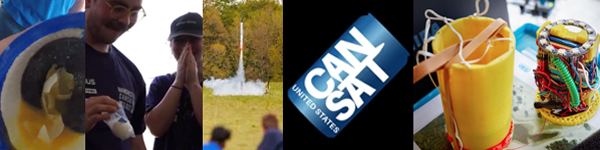
CanSat Competition challenges university teams from around the world to design, build and fly a payload that simulates an aerospace-industry project. Organizer American Astronautical Society (AAS) hopes to
engage a next generation of scientists and engineers. CanSat work provides hands-on experience in aerospace systems design. Parameters change every year; 2026 rules include payload deployment via motor when the rocket reaches peak altitude of 1 km, an automatically opening parachute, descent at 15 meters per second (or less) to 800 meters, where the payload must exit the container and descend via a paraglider method at an average of 5 meters/second toward a specified landing site. A video camera must show payload separation and paraglider descent. At 2 meters above the ground, there must be a further separation and an intact “instrument” landing, shown by a second video camera, with the intact “instrument” being an egg! Additionally, sensors must collect and transmit data the entire time, including interior temperature, battery voltage and current, altitude, tilt angle, rotation rate and GPS position.
The CanSat names derives from all of these elements needing to fit in a soda can. Taking
two semesters the missions go through Preliminary Design Review (PDR), Critical Design Review (CDR), and Flight Readiness Review (FRR), and rockets are provided by AAS. (Image Credits: AAS)