Inner Solar System Exploration Advancing with MESSENGER Mercury Orbital Insertion, Phobos and Deimos International Conference
On March 14-16, space scientists, engineers, space exploration professionals and students from around the world will come together at NASA Ames in Silicon Valley CA for the 2nd International Conference on the Exploration of Phobos and Deimos. With several international spacecraft missions and concept studies underway and new scientific data available from the NASA Mars Reconnaissance Orbiter and the ESA Mars Express, there is a growing interest in the exploration of the 2 Martian moons. The conference will be divided into 4 plenary sessions on science, robotic reconnaissance, human exploration, and recommendations for next steps. Veteran astronauts Buzz Aldrin (CL) and Tom Jones (BL) will give keynote addresses on the implications and challenges of human missions to NEOs, Phobos and Deimos. This week will also see the 1st spacecraft enter into orbit of Mercury when the MESSENGER spacecraft (BR) conducts a 15-minute orbit insertion maneuver at 20:45 EDT on Mar 17. After a 6.5 year mission in which the craft conducted 6 planetary flybys, 5 major propulsion maneuvers, and 16 trajectory-correction maneuvers, MESSENGER will begin a 1-year science campaign to understand the innermost planet. (Credit: NASA, John Hopkins University, skyhighgallery.com, comcast.net)
NASTAR Offers 3-day Suborbital Training Program
The National AeroSpace Training and Research (NASTAR) Center has organized a 3-day Suborbital Scientist Training Program on March 14-16 in Philadelphia PA. As the official space training provider to Virgin Galactic, NASTAR provides altitude and space flight training to prospective ‘Suborbital Scientist-Astronauts’ who must endure the physiological and psychological rigors of spaceflight. Nearly 200 people have completed space training at NASTAR. Day 1 begins with courses in Altitude Physiology followed by a high altitude flight to 5.49km. On days 2 and 3, participants will use the Space Training Simulator (STS-400) and perform tolerance flights at 3Gz, 3Gx, 6Gz, 6Gx to isolate the G vector forces as well as a 3G and 6G suborbital space flight. Participants must be 18 years of age or older and meet NASTAR simulator requirements as well as provide a current FAA Medical Class 3 Certificate. NASTAR has planned 4 more Suborbital Scientist Training Programs taking place May 9-11, September 12-14 and November 14-16. Pictured: Richard Branson (TL), Virgin Galactic. (Credit: NASTAR)
= All times for terrestrial events in local time unless noted.
= All times for international terrestrial events in local time unless noted.
= All times for space events, and…
= All times for international space / astro events in Hawaii Standard Time unless noted. Add 10 hours to obtain UT (‘Universal Time;’ Greenwich, England).
Mar 14 — International Space Station, LEO: Cmdr. Scott Kelly and Flight Engineers Oleg Skripochka and Alexander Kaleri prepare for their return home March 16 as rest of crew members continue with station maintenance and scientific experiments.
Mar 14 — NASA Lunar Reconnaissance Orbiter (LRO), Lunar Orbit: All systems nominal in scientific phase of mission as LRO continues to make digital elevation and terrain maps that will be a fundamental reference for future human exploration.
Mar 14 — Mars Reconnaissance Orbiter (MRO), Red Planet: NASA MRO, which recently turned 5, has transmitted more data to Earth — 131 trillion bits and more than 70,000 images so far, than all other interplanetary missions combined and continues with exceptional data return of the Red Planet.
Mar 14-15 — UK Space Agency,London, England: ‘Microgravity Workshop,’ event to review the current needs of the research community and to discuss new and existing opportunities which may help to meet those needs.
Mar 14-16 — NASTAR Center,Philadelphia PA: ‘NASTAR Suborbital Scientist Training Program,’ provides researchers, professors and graduate students with hands-on space flight physiology training to prepare them to design experiments and perform research aboard commercial suborbital space flights.
Mar 14-17 — Satellite Today, Satellite News, Communications Technology, et al,Washington DC: ‘Satellite 2011: Celebrating 30 Years,’ conference to focus on opportunities in main vertical markets — military, broadcast, enterprise, mobile, telcos and commercial as well as provide fresh data, keen market intelligence and the strategies needed to achieve new levels of excellence and business development.
Mar 14 — Asteroid (Near-Earth Flyby): 2008 FL7 (0.033 AU); 2005 ES70 (0.058 AU).
Continued from . . .
Jan 29 — Casa Romantica Cultural Center and Gardens, NASA, San Clemente CA: ‘They Came From Outer Space,’ this fun and educational exhibition for the whole family is presented through NASA and explores how many of the everyday products we use were developed for the space program; through Mar 27.
Mar 13 — ProSpace,Washington DC: ‘17th Annual March Storm,’ members to take their Citizens’ Space Agenda to Capitol Hill and brief members of the House and Senate on their plan to create new high paying jobs through innovation in the commercial space sector; through Mar 15.
Mar 15 — Moon: 4.6° SSW of Beehive Cluster; 20:00.
Mar 15 — Gamma Normid Meteors: A weak shower best seen from the southern hemisphere, the Gamma Normids radiate from the fourth magnitude star Gamma Normae.
Mar 16 — NASA Headquarters, Washington DC; Online : NASA invites Twitter followers to a behind-the scenes NASA Tweetup with astronaut Doug Wheelock from 15:00-17:30 EDT.
Mar 16 — Intelligence Squared Ltd, Royal Geographical Society,London, United Kingdom: ‘A Journey Into Outer Space,’ featuring speakers Martin Rees, Charles Simonyi and Colin Pillinger.
Mar 17 — MESSENGER,Mercury Orbit: NASA Messenger probe to settle into orbit around Mercury, making it the 1st spacecraft ever to orbit the innermost planet.
Mar 17 — Library of Congress, Goddard Space Flight Center, Washington DC: ‘The Many Colors of the Sun,’ Goddard project scientist for NASA Solar Dynamics Observatory Dean Pesnell to give lecture at 11:30 EDT.
Mar 18-19 — York University, Toronto, Ontario, Canada: ‘STAR Symposium,’ event will feature talks by engaging speakers from the worlds of science and astronomy.
Mar 19 — Goddard Space Flight Center, Nationwide:‘Sun-Earth Day 2012 / Tweet-up,’ series of programs and events that occur throughout the year culminating with a celebration on / near the Spring Equinox.
Mar 19 — NASA, Pasadena CA; Houston TX; Champlin MN; Laurel MD; Online:‘Thrill of Discovery Educator Workshops,’ a one-day workshop to be held at Jet Propulsion Laboratory, Johnson Space Center, Jackson Middle School Observatory and John Hopkins University.
Mar 19-22 — The Arecibo Observatory, Arecibo PR:‘Fab 5 Fest,’ a celebration of achievements for Joel Weisberg, Jim Cordes, Joanna Rankin, Tim Hankins and Barney Rickett.
Mar 19 — Moon: Full Moon, 08:10; At Perigee (Distance 55.91 Earth-Radii), 09:00.
Mar 19 — Asteroid 2011 EK: Near-Earth Flyby (0.082 AU).
SUNDAY
Mar 20 — Canberra Deep Space Communication Complex, Canberra, Australia: ‘2011 Space Open Day,’ an opportunity for the public to take bus and walking tours for a close up look at the space tracking station.
Mar 20 — Spring / Vernal Equinox: The Sun rises exactly in the east traveling through the sky for 12 hours and sets exactly in the west; Every place on Earth experiences a 12-hour day twice a year on the Spring and Fall Equinox; 13:21.
Mar 20 — Moon: 7.5° SSW of Saturn, 11:00; 2.5° SW of Spica, 23:00.
Mar 20 — Comet C / 2011 C1 (McNaught): Closest Approach to Earth (0.914 AU).
Mar 20 — Asteroid (Near-Earth Flyby): 2011 CY46 (0.048 AU); 2008 EF85 (0.066 AU).
Includes ~150 meetings covering the fields of COSPAR Scientific Commissions / Panels / Task Groups, such as SC B: The Earth-Moon System, Planets, and...
At the Palais des Nations and online. Outer space is entering a renewed phase of strategic importance, defined by rapid innovation, growing competition and deepening...
This international lunar science meeting has two objectives: to provide a platform for leading experts to review recent advances across lunar research, from the...
At CSIR International Convention Centre. Key topics are Earth Observation, Developing Space Tourism, Space Supply Manufacturing. Cultural tours are offered.
(No earlier than 10 Aug) Japan to launch the MICHIBIKI No. 7 | Quasi-Zenith Satellite System (QZS-7) navigation satellite. Launch window remains open through...
Participants will receive theoretical and hands-on training in electron imaging and X-ray spectroscopy for application to planetary samples. This training opportunity is targeted at...
"Leading Australia’s Space Future for Our Strategic Advantage". Southern Space 2026 brings together decision-makers who set the direction for Australia’s space sector. It is...
The second test launch of LandSpace's ZQ-3 rocket with undisclosed test payloads. Zhuque-3 first stage booster will attempt to land on its downrange landing...
A total solar eclipse with a magnitude of 1.0386 (greatest eclipse 17:47:06 UTC) will be visible in parts of Greenland, Iceland, northern Russia, the Atlantic...
Includes presentation of the Neil Armstrong Award of Excellence, activities for the new class of Astronaut Scholars, 2-day Technical Conference where Scholars present their...
During U.S. spacewalk 97, two astronauts will replace a Space-to-Ground antenna on the orbital complex. The antenna is a critical communication system NASA uses...
Key themes include: Characterizing exoplanet-host solar-like stars; Star-planet interactions; Planet populations around solar-like stars. At University of Liège.
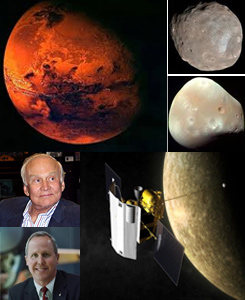 On March 14-16, space scientists, engineers, space exploration professionals and students from around the world will come together at NASA Ames in Silicon Valley CA for the 2nd International Conference on the Exploration of Phobos and Deimos. With several international spacecraft missions and concept studies underway and new scientific data available from the NASA Mars Reconnaissance Orbiter and the ESA Mars Express, there is a growing interest in the exploration of the 2 Martian moons. The conference will be divided into 4 plenary sessions on science, robotic reconnaissance, human exploration, and recommendations for next steps. Veteran astronauts Buzz Aldrin (CL) and Tom Jones (BL) will give keynote addresses on the implications and challenges of human missions to NEOs, Phobos and Deimos. This week will also see the 1st spacecraft enter into orbit of Mercury when the MESSENGER spacecraft (BR) conducts a 15-minute orbit insertion maneuver at 20:45 EDT on Mar 17. After a 6.5 year mission in which the craft conducted 6 planetary flybys, 5 major propulsion maneuvers, and 16 trajectory-correction maneuvers, MESSENGER will begin a 1-year science campaign to understand the innermost planet. (Credit: NASA, John Hopkins University, skyhighgallery.com, comcast.net)
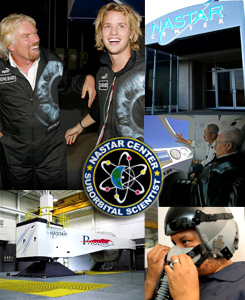 The National AeroSpace Training and Research (NASTAR) Center has organized a 3-day Suborbital Scientist Training Program on March 14-16 in Philadelphia PA. As the official space training provider to Virgin Galactic, NASTAR provides altitude and space flight training to prospective ‘Suborbital Scientist-Astronauts’ who must endure the physiological and psychological rigors of spaceflight. Nearly 200 people have completed space training at NASTAR. Day 1 begins with courses in Altitude Physiology followed by a high altitude flight to 5.49km. On days 2 and 3, participants will use the Space Training Simulator (STS-400) and perform tolerance flights at 3Gz, 3Gx, 6Gz, 6Gx to isolate the G vector forces as well as a 3G and 6G suborbital space flight. Participants must be 18 years of age or older and meet NASTAR simulator requirements as well as provide a current FAA Medical Class 3 Certificate. NASTAR has planned 4 more Suborbital Scientist Training Programs taking place May 9-11, September 12-14 and November 14-16. Pictured: Richard Branson (TL), Virgin Galactic. (Credit: NASTAR)
 = All times for terrestrial events in local time unless noted.
 = All times for international terrestrial events in local time unless noted.
 = All times for space events, and…
 = All times for international space / astro events in Hawaii Standard Time unless noted. Add 10 hours to obtain UT (‘Universal Time;’ Greenwich, England).
 Mar 14 — International Space Station, LEO: Cmdr. Scott Kelly and Flight Engineers Oleg Skripochka and Alexander Kaleri prepare for their return home March 16 as rest of crew members continue with station maintenance and scientific experiments.