New Era of USA Space Exploration Dawns as Scientists, Entrepreneurs, Students Gather for Lunar Science Forum
Space Shuttle Atlantis, the final mission of the 30 year program, is set to land at Kennedy Space Center in Florida at 05:56 EDT on July 21, marking the beginning of a new phase of American space exploration 1 day after the world commemorates Apollo 11 Space Day. Many of the entrepreneurs, space scientists and students who will be the likely catalysts for the next great achievements in exploration will be in Moffett Field CA for the 4th NASA Ames Lunar Science Conference when Atlantis touches down. Held on July 19-21, the forum will feature sessions on Geology, Recent Missions, Commercial Missions, Human Exploration, Lunar Atmosphere, and Astrophysics / Heliophysics from the Moon. The Conference will be preceded by the 2nd annual Lunar Graduate Conference on July 17 and the Next Generation Lunar Scientists and Engineers Workshop on July 18. In a separate ongoing event, the Lunar and Planetary Institute is hosting a special 10-week summer intern program in Houston TX to evaluate possible landing sites for human and robotic lunar missions. (Credit: NASA)
Astronomy Observation Focus of China International Workshop & Russia Launch
International efforts to advance astronomical research from Antarctica and Space will take place this week with 2 events held in Beijing, China, and Baikonur, Kazakhstan. On July 18-23, the National Astronomical Observatory of China and Chinese Academy of Sciences (CAS) will co-sponsor ‘Frontiers of Cosmology at Dome A, Antarctica.’ Dome A, the highest point on the Antarctic plateau located 1200km inland and 4093m elevation above sea level offers ideal atmospheric conditions for astronomical observation. Data will be presented from the PLATeau Observatory (PLATO), the CAS Dome A–WSN wireless based observation system and the Kunlun Station (BR), with much attention on further expanding these facilities. On NET Jul 18 local time, Russia is set to launch the Spektr-R (TR) astronomy observatory, a 10m radio telescope aboard a Zenit-3F rocket from Baikonur Cosmodrome. The International collaborative mission initiated by Astro Space Center will use the space telescope to conduct interferometer observations in conjunction with ground radio telescopes in Australia and Russia. Spektr–R will be placed in a high elliptical orbit passing 500km above Earth at perigee and as far as 340,000km away in apogee. The spacecraft will spend the 1st 45 days in commission phase followed by the scientific phase. The mission is expected to remain in operations for at least 9 years. (Credit: space.skyrocket.de, sciencepoles.org, unsw.edu.au)
= All times for terrestrial events in local time unless noted.
= All times for international terrestrial events in local time unless noted.
= All times for space events, and…
= All times for international space / astro events in Hawaii Standard Time unless noted. Add 10 hours to obtain UT (‘Universal Time;’ Greenwich, England).
Jul 18 — International Space Station, LEO: E-28 crew members finish reloading Raffaello with almost 2590kg of unneeded equipment and trash which will be replaced in Space Shuttle Atlantis’ cargo bay this morning for return to Earth.
Jul 18 — NASA Lunar Reconnaissance Orbiter (LRO), Lunar Orbit: All systems nominal in scientific phase of mission as LRO continues to make digital elevation and terrain maps that will be a fundamental reference for future human exploration.
Jul 18 — Mars, Red Planet: Scientists from SETI Institute and Ames Research Center continue to investigate new research suggesting that traces of Mars’ wet past are hidden under a thin varnish of iron oxide or rust that may go undetected from space-borne instruments.
NET Jul 18 — RSA, Launch Zenit 3F / Spektr R, Baikonur Cosmodrome, Kazakhstan: Zenit rocket set to launch Spektr R radio astronomy observatory at local time 02:31 GMT and work in conjunction with ground telescopes to study variety of astronomical objects.
Jul 18 — Ames Research Center, Moffett Field CA: Unveiling of new book, ‘Getting a Feel for Lunar Craters,’ by David Hurd for blind and visually impaired readers; NASA Lunar Science Institute, 18:00.
Jul 18 — NASA, United Launch Alliance (ULA), Centennial CO: NASA and & ULA managers to hold news conference to announce a new Commercial Crew Development agreement at 11:00 MDT.
Jul 18-23 — National Science Foundation of China, Chinese Academy of Sciences, National Astronomical Observatories of China, et al, Beijing, China: ‘Frontiers of Cosmology at Dome A, Antarctica.’
Jul 18 — Moon: 3.4° N of Antares; 16:00.
Continued from . . .
May 31 — NASA Lunar Science Institute, Lunar and Planetary Institute, Houston TX: ‘Lunar Exploration Summer Intern Program,’ 10-week program to evaluate possible landing sites for robotic and human exploration missions; through Aug 5.
Jun 13 — Space Voyage Academy, Littleton CO: ‘Space Voyage Summer Academy Camp,’ an enrichment program about space for students ages 5-16; through Jul 29.
Jun 27 — Google Lunar X Prize Foundation, LEGO Group, Playa Vista CA; Online: ‘LEGO Moonbots 2.0;’ through Aug 15.
Jul 11 — International Space University – Space Studies Institute, Graz, Austria: ‘24th Space Studies Program;’ through Sep 9.
Jul 20 — 42nd Apollo 11 Observation,Nationwide USA / Global: 1st Human mission to land on Moon in 1969; 1st steps by humans on another planetary body taken by Commander Neil Armstrong and Lunar Module Pilot Buzz Aldrin.
NET Jul 21 — ISC, Launch Dnepr / Multi-Payload, Yasny, Russia: An ISC Kosmotras Dnepr rocket set to launch the Sich 2 Earth Observation satellite for Ukraine, the NigeriaSat 2 and NigeriaSat X remote sensing satellites for Nigeria, the RASAT demonstration satellite for Turkey, the EduSAT spacecraft for the University of Rome and other payloads.
Jul 21 — The Smithsonian National Air and Space Museum, Washington DC: ‘Buzz Aldrin’s Space Suit,’ Cathy Lewis, Lisa Young.
Includes ~150 meetings covering the fields of COSPAR Scientific Commissions / Panels / Task Groups, such as SC B: The Earth-Moon System, Planets, and...
At the Palais des Nations and online. Outer space is entering a renewed phase of strategic importance, defined by rapid innovation, growing competition and deepening...
This international lunar science meeting has two objectives: to provide a platform for leading experts to review recent advances across lunar research, from the...
At CSIR International Convention Centre. Key topics are Earth Observation, Developing Space Tourism, Space Supply Manufacturing. Cultural tours are offered.
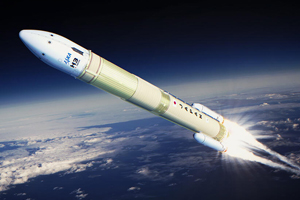
(No earlier than 10 Aug) Japan to launch the MICHIBIKI No. 7 | Quasi-Zenith Satellite System (QZS-7) navigation satellite. Launch window remains open through...
Participants will receive theoretical and hands-on training in electron imaging and X-ray spectroscopy for application to planetary samples. This training opportunity is targeted at...
"Leading Australia’s Space Future for Our Strategic Advantage". Southern Space 2026 brings together decision-makers who set the direction for Australia’s space sector. It is...
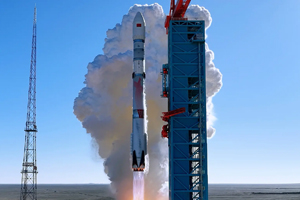
The second test launch of LandSpace's ZQ-3 rocket with undisclosed test payloads. Zhuque-3 first stage booster will attempt to land on its downrange landing...
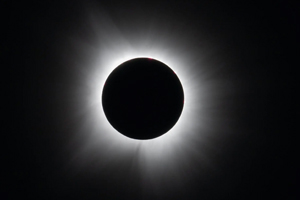
A total solar eclipse with a magnitude of 1.0386 (greatest eclipse 17:47:06 UTC) will be visible in parts of Greenland, Iceland, northern Russia, the Atlantic...
Includes presentation of the Neil Armstrong Award of Excellence, activities for the new class of Astronaut Scholars, 2-day Technical Conference where Scholars present their...
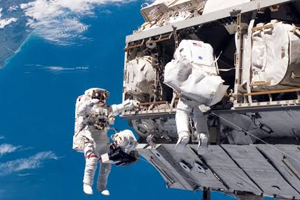
During U.S. spacewalk 97, two astronauts will replace a Space-to-Ground antenna on the orbital complex. The antenna is a critical communication system NASA uses...
Key themes include: Characterizing exoplanet-host solar-like stars; Star-planet interactions; Planet populations around solar-like stars. At University of Liège.
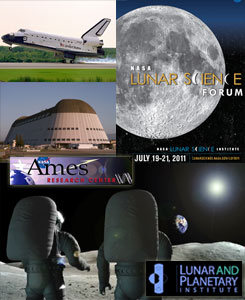 Space Shuttle Atlantis, the final mission of the 30 year program, is set to land at Kennedy Space Center in Florida at 05:56 EDT on July 21, marking the beginning of a new phase of American space exploration 1 day after the world commemorates Apollo 11 Space Day. Many of the entrepreneurs, space scientists and students who will be the likely catalysts for the next great achievements in exploration will be in Moffett Field CA for the 4th NASA Ames Lunar Science Conference when Atlantis touches down. Held on July 19-21, the forum will feature sessions on Geology, Recent Missions, Commercial Missions, Human Exploration, Lunar Atmosphere, and Astrophysics / Heliophysics from the Moon. The Conference will be preceded by the 2nd annual Lunar Graduate Conference on July 17 and the Next Generation Lunar Scientists and Engineers Workshop on July 18. In a separate ongoing event, the Lunar and Planetary Institute is hosting a special 10-week summer intern program in Houston TX to evaluate possible landing sites for human and robotic lunar missions. (Credit: NASA)
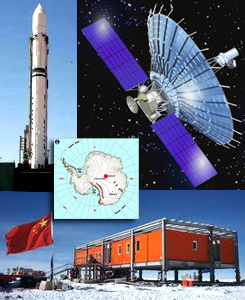 International efforts to advance astronomical research from Antarctica and Space will take place this week with 2 events held in Beijing, China, and Baikonur, Kazakhstan. On July 18-23, the National Astronomical Observatory of China and Chinese Academy of Sciences (CAS) will co-sponsor ‘Frontiers of Cosmology at Dome A, Antarctica.’ Dome A, the highest point on the Antarctic plateau located 1200km inland and 4093m elevation above sea level offers ideal atmospheric conditions for astronomical observation. Data will be presented from the PLATeau Observatory (PLATO), the CAS Dome A–WSN wireless based observation system and the Kunlun Station (BR), with much attention on further expanding these facilities. On NET Jul 18 local time, Russia is set to launch the Spektr-R (TR) astronomy observatory, a 10m radio telescope aboard a Zenit-3F rocket from Baikonur Cosmodrome. The International collaborative mission initiated by Astro Space Center will use the space telescope to conduct interferometer observations in conjunction with ground radio telescopes in Australia and Russia. Spektr–R will be placed in a high elliptical orbit passing 500km above Earth at perigee and as far as 340,000km away in apogee. The spacecraft will spend the 1st 45 days in commission phase followed by the scientific phase. The mission is expected to remain in operations for at least 9 years. (Credit: space.skyrocket.de, sciencepoles.org, unsw.edu.au)
 = All times for terrestrial events in local time unless noted.
 = All times for international terrestrial events in local time unless noted.
 = All times for space events, and…
 = All times for international space / astro events in Hawaii Standard Time unless noted. Add 10 hours to obtain UT (‘Universal Time;’ Greenwich, England).
 Jul 18 — International Space Station, LEO: E-28 crew members finish reloading Raffaello with almost 2590kg of unneeded equipment and trash which will be replaced in Space Shuttle Atlantis’ cargo bay this morning for return to Earth.