Jupiter Looms Large as Important Destination for 21st Century Exploration
2012, year of the Dragon and beginning of a new cycle of the Mayan Calendar, promises to be an auspicious year to advance an appropriately ambitious vision for human exploration of the cosmos. With over 70% of the Solar System’s planetary mass and 4 planet-sized Moons (3 of which could host extraterrestrial life in liquid oceans beneath icy crusts), Jupiter deserves attention as an inspirational destination for 21st Century exploration. After a successful launch in August 2011, NASA’s Juno spacecraft is now on the way to becoming the 8th probe to visit the Jovian system and only the 2nd to orbit the giant planet. The solar-powered spacecraft is set to peer beneath the planet’s clouds, map its gravity field and atmospheric structure once it arrives in July 2016. ESA and Roscosmos are collaborating on the early stages of a mission that would land a probe on the Jovian moon Ganymede in the next decade. A group known as the International Europa Task Force is currently working to convince government and space agency leaders worldwide that a mission to the moon Europa could be one of humanity’s most glorious achievements. The logic of Solar System geography makes the Jupiter System a strategic center for 21st Century exploration and development. (Image Credit: NASA, Disney)
India Begins 2012 With Conference & Launch
India is on trajectory for a successful 2012 start with a major national conference and launch of its all-weather, Earth observation satellite. On January 3-7, the Indian Science Congress Association and the National Institute for Science Education and Research (NISER) will host the ‘99th Indian Science Congress’ (ISC) at KIIT University in Bhubaneshwar, India. Over 18,000 participants from India and abroad will converge to discuss climate change, clean energy from renewable sources, space technology, human welfare, nano-science and nano-technology. NISER Director T K Chandrasekhar (TL) notes that science and technology are powerful tools to help bridge the divide in India. New to the conference this year will be the ‘Children Science Congress’ which will be attended by over 10,000 children and the ‘Women in Science Congress.’ The ‘Frontier and Science Technologies Mega Expo,’ held concurrently with the ISC will feature India products, technologies, research and services. The Indian Space Research Organization (ISRO) will begin preparations for the projected 1st quarter 2012 launch of Risat-1 aboard a Polar Satellite Launch Vehicle (PSLV). The 1780-kg radar imaging satellite will be the 1st satellite imaging mission of ISRO that uses an active C-band SAR (Synthetic Aperture Radar) imager for agriculture, forestry, soil moisture, geology, sea ice, coastal monitoring, object identification, and flood monitoring. (Image Credit: ISCA, ISRO)
= All times for terrestrial events in local time unless noted.
= All times for international terrestrial events in local time unless noted.
= All times for space events, and…
= All times for international space / astro events in Hawaii Standard Time unless noted. Add 10 hours to obtain UT (‘Universal Time;’ Greenwich, England).
Dec 26 — International Space Station, LEO: E-30 crew members continue to perform a variety of experiments and maintenance duties aboard the ISS.
Dec 26 — NASA Lunar Reconnaissance Orbiter (LRO), Lunar Orbit: LRO continues to function nominally in its 50±15 km near-circular orbit as it makes digital elevation and terrain maps that will be a fundamental reference for future human exploration.
Dec 26 — Mars Rover Opportunity, Red Planet: Opportunity positioned at one of 2 winter spots at Endeavour Crater; Total odometry: 34.36km.
Dec 26 — Jupiter Juno Mission, Mars Orbit: Juno spacecraft operating nominally in Inner Cruise 2 Phase after completing 1st of 3 Mars orbit crossings; spacecraft has now traveled 356 million km since launch, currently traveling at a velocity of 89,800 kph.
NET Dec 26 — ILS, Launch Proton / SES 4, Baikonur Cosmodrome, Kazakhstan: An ILS Proton rocket with a Breeze M upper stage set to deploy the SES 4 satellite to provide telecommunications services over the Americas, Africa, Europe and Middle East.
Dec 26 — Smithsonian National Air and Space Museum – Udvar-Hazy Center, Chantilly VA: ‘Planetology, Sky Walking, and Hell Hawks,’ book signing with author Tom Jones.
NET Dec 28 — Arianespace, Launch Soyuz / Globalstar, Baikonur Cosmodrome, Kazakhstan: An Arianespace Soyuz rocket set to launch 6 second-generation Globalstar mobile communications satellites.
Dec 28 — Jet Propulsion Laboratory, Pasadena CA: Media teleconference to preview twin spacecraft GRAIL-A and GRAIL-B being placed in orbit around the Moon at 14:00 EST.
Dec 29 — Asteroid 2011 XD1: Near-Earth Flyby (0.033 AU).
FRIDAY
Dec 30 — Asteroid 1620 Geographos: Closest Approach to Earth (0.697 AU).
SATURDAY
Dec 31 — NASA GRAIL-A, Lunar Orbit: Spacecraft to approach Moon near South Pole beginning at 13:21 PST where it will execute a 60-minute Lunar Orbit Insertion maneuver to achieve elliptical orbit with a period of just over 8 hours.
Dec 31 — Orbital Sciences Corp, Wallops VA: Projected reports indicate Orbital Sciences has created 125 jobs at Wallops that pay $100,000+, maintaining low capital investment at the spaceport.
SUNDAY
Jan 1 — NASA Kepler Spacecraft,Deep Space: Scientists continue to investigate recent discovery of Kepler-20e and Kepler-20f, 2 exoplanets that are about the size of Earth and are part of a five-planet system located about 1,000 light years away.
Jan 1 — NASA GRAIL-B, Lunar Orbit: Spacecraft to approach Moon near South Pole beginning at 14:05 PST where it will execute a 60-minute Lunar Orbit Insertion maneuver to achieve elliptical orbit with a period of just over 8 hours.
MONDAY
Jan 2 — International Space Station, LEO: E-30 crew members Cmdr Dan Burbank, Oleg Kononenko, Don Pettit, Andre Kuipers, Anton Shkaplerov and Anatoly Ivanishin continue science experiments and maintenance duties aboard the ISS.
Jan 2 — NASA Lunar Reconnaissance Orbiter (LRO), Lunar Orbit: All systems nominal in scientific phase of mission as LRO continues to make digital elevation and terrain maps that will be a fundamental reference for future human exploration.
Jan 2 — Mars Reconnaissance Orbiter, Red Planet: Scientists continue to study data from HiRISE camera which shows an average about 20 new impact craters formed between 1-50m wide on the surface of Mars every year.
Jan 2 — Moon: At Apogee (Distance: 404,578km); 10:20.
Jan 2 — Asteroid 2007 BD: Near-Earth Flyby (0.093 AU).
Jan 2 — Quadrantids Meteor Shower Peak: Appearing to radiate from constellation Quadrans Muralis, this meteor shower is one of the strongest showers in the year, producing up to 120 meteors per hour under favorable conditions.
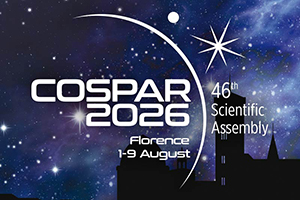
Includes ~150 meetings covering the fields of COSPAR Scientific Commissions / Panels / Task Groups, such as SC B: The Earth-Moon System, Planets, and...
At the Palais des Nations and online. Outer space is entering a renewed phase of strategic importance, defined by rapid innovation, growing competition and deepening...
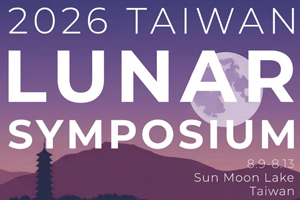
This international lunar science meeting has two objectives: to provide a platform for leading experts to review recent advances across lunar research, from the...
At CSIR International Convention Centre. Key topics are Earth Observation, Developing Space Tourism, Space Supply Manufacturing. Cultural tours are offered.
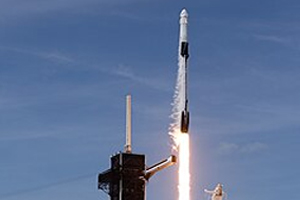
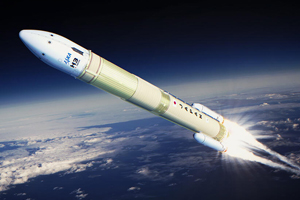
(No earlier than 10 Aug) Japan to launch the MICHIBIKI No. 7 | Quasi-Zenith Satellite System (QZS-7) navigation satellite. Launch window remains open through...
Participants will receive theoretical and hands-on training in electron imaging and X-ray spectroscopy for application to planetary samples. This training opportunity is targeted at...
"Leading Australia’s Space Future for Our Strategic Advantage". Southern Space 2026 brings together decision-makers who set the direction for Australia’s space sector. It is...
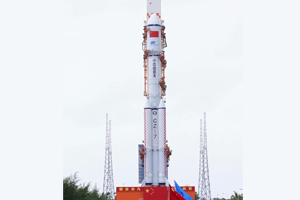
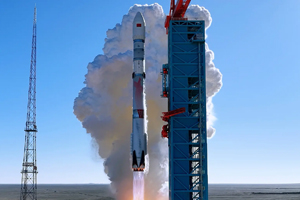
The second test launch of LandSpace's ZQ-3 rocket with undisclosed test payloads. Zhuque-3 first stage booster will attempt to land on its downrange landing...
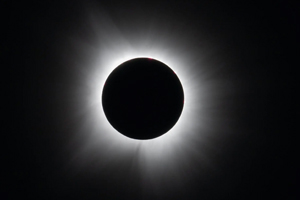
A total solar eclipse with a magnitude of 1.0386 (greatest eclipse 17:47:06 UTC) will be visible in parts of Greenland, Iceland, northern Russia, the Atlantic...
Includes presentation of the Neil Armstrong Award of Excellence, activities for the new class of Astronaut Scholars, 2-day Technical Conference where Scholars present their...
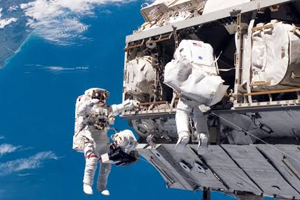
During U.S. spacewalk 97, two astronauts will replace a Space-to-Ground antenna on the orbital complex. The antenna is a critical communication system NASA uses...
Key themes include: Characterizing exoplanet-host solar-like stars; Star-planet interactions; Planet populations around solar-like stars. At University of Liège.
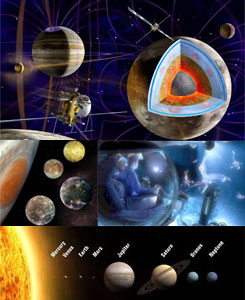 2012, year of the Dragon and beginning of a new cycle of the Mayan Calendar, promises to be an auspicious year to advance an appropriately ambitious vision for human exploration of the cosmos. With over 70% of the Solar System’s planetary mass and 4 planet-sized Moons (3 of which could host extraterrestrial life in liquid oceans beneath icy crusts), Jupiter deserves attention as an inspirational destination for 21st Century exploration. After a successful launch in August 2011, NASA’s Juno spacecraft is now on the way to becoming the 8th probe to visit the Jovian system and only the 2nd to orbit the giant planet. The solar-powered spacecraft is set to peer beneath the planet’s clouds, map its gravity field and atmospheric structure once it arrives in July 2016. ESA and Roscosmos are collaborating on the early stages of a mission that would land a probe on the Jovian moon Ganymede in the next decade. A group known as the International Europa Task Force is currently working to convince government and space agency leaders worldwide that a mission to the moon Europa could be one of humanity’s most glorious achievements. The logic of Solar System geography makes the Jupiter System a strategic center for 21st Century exploration and development. (Image Credit: NASA, Disney)
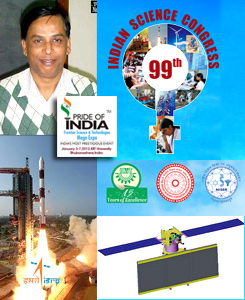 India is on trajectory for a successful 2012 start with a major national conference and launch of its all-weather, Earth observation satellite. On January 3-7, the Indian Science Congress Association and the National Institute for Science Education and Research (NISER) will host the ‘99th Indian Science Congress’ (ISC) at KIIT University in Bhubaneshwar, India. Over 18,000 participants from India and abroad will converge to discuss climate change, clean energy from renewable sources, space technology, human welfare, nano-science and nano-technology. NISER Director T K Chandrasekhar (TL) notes that science and technology are powerful tools to help bridge the divide in India. New to the conference this year will be the ‘Children Science Congress’ which will be attended by over 10,000 children and the ‘Women in Science Congress.’ The ‘Frontier and Science Technologies Mega Expo,’ held concurrently with the ISC will feature India products, technologies, research and services. The Indian Space Research Organization (ISRO) will begin preparations for the projected 1st quarter 2012 launch of Risat-1 aboard a Polar Satellite Launch Vehicle (PSLV). The 1780-kg radar imaging satellite will be the 1st satellite imaging mission of ISRO that uses an active C-band SAR (Synthetic Aperture Radar) imager for agriculture, forestry, soil moisture, geology, sea ice, coastal monitoring, object identification, and flood monitoring. (Image Credit: ISCA, ISRO)
 = All times for terrestrial events in local time unless noted.
 = All times for international terrestrial events in local time unless noted.
 = All times for space events, and…
 = All times for international space / astro events in Hawaii Standard Time unless noted. Add 10 hours to obtain UT (‘Universal Time;’ Greenwich, England).
 Dec 26 — International Space Station, LEO: E-30 crew members continue to perform a variety of experiments and maintenance duties aboard the ISS.