Fleet of USA Orbiters Enhancing Human Understanding of Moon
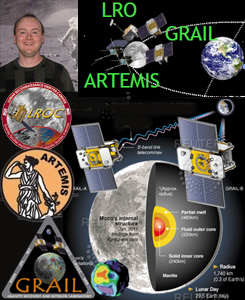
Five of the most advanced USA planetary spacecraft continue to gather valuable data about the Moon. NASA twin GRAIL spacecraft’s extended science mission is expected to run from Aug 30 – Dec 3, 2012. In the extended mission the craft have halved their average operating altitudes to 23km, taking them within 8km of the highest lunar areas. This lower altitude is allowing GRAIL to provide researchers with unprecedented data of the gravitational influence of the Moon’s surface and subsurface features. On Friday, Sep 21, Sam Lawrence (TL) of Arizona State University will be giving a LPI Seminar Series lecture in Houston TX on ‘New Insights Into Lunar Geology from the Lunar Reconnaissance Orbiter Camera’. In mid September, LRO is completing the 2nd year of its Extended Science mission. The probe, and its 7 science payloads, are expected to continue operating from its 30 X 216-km quasi-frozen commissioning orbit for at least another year before finally running out of fuel and crashing into the surface. The twin Artemis orbiters are expected to continue studying the lunar magnetic field for another 6-9 years. (Image Credit: NASA, Olaf Frohn)
12th Australian Space Science Conference in Melbourne Next Week
Presented by the National Committee for Space Science and the National Space Society of Australia on September 24-26, the 2012 Australian Space Science Conference (ASSC) is intended to provide the primary venue for Australian space scientists, engineers, educators and workers in industry and government to discuss ongoing fundamental and applied research related to space technologies. The conference is also being held in association with Engineers Australia 16th National Space Engineering Symposium and the National Committee for Radio Science with its Workshop on Applications in Radio Science. The conference covers space science, space engineering, space industry, space archeology, government / international relations and law, as well as education / outreach. Wayne Short and Iver Cairns are the Co-Chairs, representing the National Space Society of Australia and the University of Sydney respectively. The launch of WRESAT from the Woomera Test Range in 1967 made Australia the seventh nation to launch a satellite into orbit, and only the third to achieve this from its own soil. The ASSC signals the continuing resurgence of Australian interest, energy and action in space exploration and enterprise. Australia is preparing to send a strong delegation to the 63rd International Astronautical Congress in Naples, Italy this October, which will include representatives from government, industry, individuals, teachers and over 20 Australian students. (Image Credit: ASSC, ASSA)
= All times for terrestrial events in local time unless noted. = All times for international terrestrial events in local time unless noted. = All times for space events, and… = All times for international space / astro events in Hawaii Standard Time unless noted. Add 10 hours to obtain UT (‘Universal Time;’ Greenwich, England).
Sep 17 — ISS, LEO: Center for the Advancement of Science in Space (CASIS) is collaborating with Merck to conduct ISS research on therapeutic monoclonal antibodies – engineered proteins designed to increase specificity and decrease side effects of treatments.
Sep 17 — Curiosity, Gale Crater, Mars: The odometer clicking past 142 meters; the Mastcam instrument has made observations of the Martian moon Phobos passing in front of the Sun.
Sep 17 — FiberDyne Advanced Composites, Tukwila WA: Company to manufacture wing strake assemblies for the XCOR Aerospace Lynx Mark 1 suborbital reusable launch vehicle.
Sep 17 —Liftport, Uwingo, Online: Crowdfunding, a new source of engagement, optimism for NewSpace enterprises; Lofty ambitions of Liftport backed by netizens more than tenfold (goal – $8,000; pledged $110,354); Uwingu, a proposed private sector funding stream for Space grants raised over US$50,000 to get started.
Sep 19 —Starsem Launch Soyuz / MetOp B, Baikonur, Kazakhstan: Rocket to launch the MetOp B weather satellite for the ESA and the European Organization for the Exploitation of Meteorological Satellites, or Eumetsat.
Sep 17-26 — International Space Weather Initiative, International Center for Space Weather Science and Education, Space Science Center (LAPAN), Bandung, Indonesia: ‘2012 ISWI & MAGDAS School on Space Science‘
Sep 17 — Moon: 1.3° WSW of Spica, 17:00.
Sep 17 — Jupiter: Central for ongoing Solar System census. Sightings of comet or asteroid impacts like the one seen Monday, Sep 10 at 01:35 provide valuable census data, particularly of hard-to-study objects 100 meters across and smaller.
Sep 17 — Asteroid 48575 Hawaii: Closest Approach to Earth (2.167 AU).
Sep 18 — Celestis, Houston TX: Launch Announcement of ‘The Centennial Flight‘ at a ribbon cutting ceremony for new exhibit featuring Celestis at The National Museum of Funeral History.
Sep 19-21 — French National Research Agency – COSINUS, Astro-Particle and Cosmology Laboratory, Paris, France: ‘Big Bang, Big Data, Big Computers – Workshop on Computer Science and Statistics of the Contemporary Cosmic Microwave Background Data Analysis.’
Sep 21 — Arianespace, Launch Ariane-5 / GSAT-10 / Astra 2, Kourou, French Guiana: India GSAT-10 and Luxembourg Astra 2F communication satellites set to launch on Ariane-5 rocket from Spaceport ELA-3 launch complex.
Sep 22— Langley Research Center, NASA, Hampton, VA: ‘Langley Open House;’ Meet an astronaut, watch a splash test, tour more than a dozen labs; 10:00am-4:00pm EDT; free and open to the public.
Sep 23-28 — Royal Aeronautical Society Australian Division, Engineers Australia, International Council of the Aeronautical Sciences, Brisbane, Australia: ‘The ICAS 2012 Congress.’
Includes ~150 meetings covering the fields of COSPAR Scientific Commissions / Panels / Task Groups, such as SC B: The Earth-Moon System, Planets, and...
From 02 to 07 August 2026, a few thousand geoscientists across diverse disciplines will gather at the 23rd annual meeting of the Asia Oceania Geosciences...
At the Palais des Nations and online. Outer space is entering a renewed phase of strategic importance, defined by rapid innovation, growing competition and deepening...
This international lunar science meeting has two objectives: to provide a platform for leading experts to review recent advances across lunar research, from the...
At CSIR International Convention Centre. Key topics are Earth Observation, Developing Space Tourism, Space Supply Manufacturing. Cultural tours are offered.
(No earlier than 10 Aug) Japan to launch the MICHIBIKI No. 7 | Quasi-Zenith Satellite System (QZS-7) navigation satellite. Launch window remains open through...
Participants will receive theoretical and hands-on training in electron imaging and X-ray spectroscopy for application to planetary samples. This training opportunity is targeted at...
"Leading Australia’s Space Future for Our Strategic Advantage". Southern Space 2026 brings together decision-makers who set the direction for Australia’s space sector. It is...
The second test launch of LandSpace's ZQ-3 rocket with undisclosed test payloads. Zhuque-3 first stage booster will attempt to land on its downrange landing...
A total solar eclipse with a magnitude of 1.0386 (greatest eclipse 17:47:06 UTC) will be visible in parts of Greenland, Iceland, northern Russia, the Atlantic...
Includes presentation of the Neil Armstrong Award of Excellence, activities for the new class of Astronaut Scholars, 2-day Technical Conference where Scholars present their...
During U.S. spacewalk 97, two astronauts will replace a Space-to-Ground antenna on the orbital complex. The antenna is a critical communication system NASA uses...
 Five of the most advanced USA planetary spacecraft continue to gather valuable data about the Moon. NASA twin GRAIL spacecraft’s extended science mission is expected to run from Aug 30 – Dec 3, 2012. In the extended mission the craft have halved their average operating altitudes to 23km, taking them within 8km of the highest lunar areas. This lower altitude is allowing GRAIL to provide researchers with unprecedented data of the gravitational influence of the Moon’s surface and subsurface features. On Friday, Sep 21, Sam Lawrence (TL) of Arizona State University will be giving a LPI Seminar Series lecture in Houston TX on ‘New Insights Into Lunar Geology from the Lunar Reconnaissance Orbiter Camera’. In mid September, LRO is completing the 2nd year of its Extended Science mission. The probe, and its 7 science payloads, are expected to continue operating from its 30 X 216-km quasi-frozen commissioning orbit for at least another year before finally running out of fuel and crashing into the surface. The twin Artemis orbiters are expected to continue studying the lunar magnetic field for another 6-9 years. (Image Credit: NASA, Olaf Frohn)
 Presented by the National Committee for Space Science and the National Space Society of Australia on September 24-26, the 2012 Australian Space Science Conference (ASSC) is intended to provide the primary venue for Australian space scientists, engineers, educators and workers in industry and government to discuss ongoing fundamental and applied research related to space technologies. The conference is also being held in association with Engineers Australia 16th National Space Engineering Symposium and the National Committee for Radio Science with its Workshop on Applications in Radio Science. The conference covers space science, space engineering, space industry, space archeology, government / international relations and law, as well as education / outreach. Wayne Short and Iver Cairns are the Co-Chairs, representing the National Space Society of Australia and the University of Sydney respectively. The launch of WRESAT from the Woomera Test Range in 1967 made Australia the seventh nation to launch a satellite into orbit, and only the third to achieve this from its own soil. The ASSC signals the continuing resurgence of Australian interest, energy and action in space exploration and enterprise. Australia is preparing to send a strong delegation to the 63rd International Astronautical Congress in Naples, Italy this October, which will include representatives from government, industry, individuals, teachers and over 20 Australian students. (Image Credit: ASSC, ASSA)
 = All times for terrestrial events in local time unless noted.
 = All times for international terrestrial events in local time unless noted.
 = All times for space events, and…
 = All times for international space / astro events in Hawaii Standard Time unless noted. Add 10 hours to obtain UT (‘Universal Time;’ Greenwich, England).
 Sep 17 — ISS, LEO: Center for the Advancement of Science in Space (CASIS) is collaborating with Merck to conduct ISS research on therapeutic monoclonal antibodies – engineered proteins designed to increase specificity and decrease side effects of treatments.