Commercial Human Spacecraft Systems Advancing through CCiCap Program
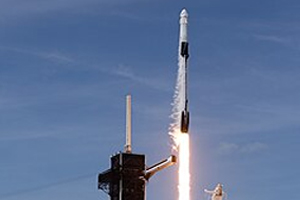
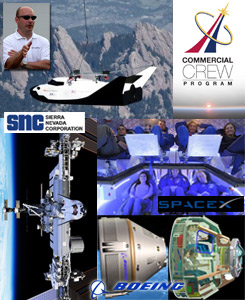
With the USA purchasing US$60M seats from Russia to launch its astronauts to space, a trio of American aerospace enterprises is advancing systems that will provide the country with this important capacity that was once a source of national pride. Boeing, SpaceX and Sierra Nevada Corp are all on track to complete their Commercial Crew integrated Capabilities (CCiCap) milestones by mid-2014, and potentially begin launch of crews around the middle of this decade. Boeing, which is receiving $460M of NASA seed money through the CCiCap program, is targeting a 3-day test flight of its CST-100 capsule in 2016. Sierra Nevada Corp, on track to receive $227M from NASA, recently conducted successful tests of its guidance, navigation and landing systems, and will soon begin atmospheric drop tests of its Dream Chaser spacecraft. SpaceX ($440M from NASA), which has already been using a human-rated version of their Dragon capsule in its ISS missions, appears to be the closest to achieving human space flight. According to Garrett Reisman (TL), the company’s Commercial Crew project manager, SpaceX could be ready for its 1st crewed test flight in mid-2015. The CCiCap program follows the successful COTS program which is nearing completion after the recent launch of the Orbital Sciences Corp Cygnus spacecraft. (Image Credit: SpaceX, Boeing, SNC, NASA)
World Space Week 2013 Focuses on Beyond Earth Exploration Benefits & Technologies
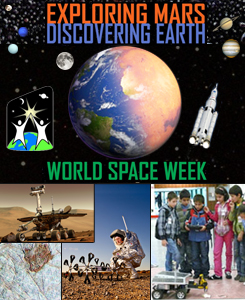
The 2013 World Space Week October 4-10 highlights 21st Century Solar System exploration capabilities and a new frontier for Human exploration – the planet Mars. Significant private / public enterprises are working toward various missions including a Human return to the Moon, Mars flyby and Mars settlement within a decade. So far, about 50 nations have scheduled events including 117 events in 12 Pakistan cities, 53 events in 20 India cities, 9 events in 8 Mexico cities, and 4 events in 4 South Africa cities. The WSW Association, Space Generation Advisory Council, Mars Society, Austrian Space Forum and KiwiSpace Foundation have organized WSW 2013 Mission to Mars, a 4-day Mars expedition simulation at MDRS in Utah, and a series of public analog research demonstrations including tests of rovers and spacesuits at locations worldwide. Beyond Mars, Juno and JUICE will study the Jupiter system after arriving July 2016 and January 2030 respectively, Cassini continues providing valuable data about Saturn and its moons, New Horizons will give us long-overdue insight into Pluto and the Kuiper Belt starting mid-2015, and numerous groups continue advancing beyond-LEO Human exploration technologies and Starship concepts / support. Discovering more about the Moon, Mars, Jupiter and the Solar System, and venturing out into space improves life on Earth and increases chances of survival for our species. (Image Credit: WSW, NASA, K. Zanella-Kux)
= All times for terrestrial events in local time unless noted.
= All times for international terrestrial events in local time unless noted.
= All times for space events, and…
= All times for international space / astro events in Hawaii Standard Time unless noted. Add 10 hours to obtain UT (‘Universal Time;’ Greenwich, England).
Sep 30 — ISS, LEO: Expedition 37 6-member crew transferring 589 kg of supplies from Cygnus freighter, exercising at least 2 hours daily to counteract effects of microgravity; Hopkins, Kotov, Ryazansky continue ISS orientation.
Sep 30 — Mars Express, Mars Orbit: As comet ISON flies by Mars at range of 10.4M km, will take photos, analyze the composition of brightening coma – atmosphere that surrounds comet’s nucleus.
Sep 30 — XCOR Aerospace Inc., Mojave CA: NewSpace company to begin integrated testing of liquid hydrogen demonstrator engine fed by liquid hydrogen, liquid oxygen piston pumps in development of cost-effective upper-stage rocket engine.
Sep 30 — Moon Express, Inc., Huntsville AL: Under Reimbursable Space Act Agreement with NASA MSFC, testing company’s Guidance, Navigation and Control flight software on Mighty Eagle lander.
Sep 30 — zero2infinity S.L., Cerdanyola del Vallès, Spain: Testing ‘microbloon 3.0’ manufactured by Thin Red Line Aerospace at 27-km altitude for behavior, strength, inflatable pressurized payload capsule suitability; aiming for commercial operations 2015.
Sep 30 — International Launch Services, Launch Proton / ASTRA 2E, Baikonur Cosmodrome, Kazakhstan: Proton rocket set to launch ASTRA 2E satellite to provide Ku-band & Ka-band broadcast / broadband services to Europe, Middle East, Africa; 03:38 local time.
Sep 30 – Oct 2 — National Space Society of Australia, National Committee for Space Science, Sydney, Australia: 13th Australian Space Science Conference; at University of New South Wales.
Sep 30 – Oct 3 — National Institute for Astrophysics, University of Naples, Naples, Italy: Conference: Multi-Spin Galaxies; US$270-337 (€200-250).
Sep 30 — Moon: 6.4° SSW of Mars, 16:00.
Sep 30 — Asteroid 2002 NV16: Near-Earth flyby (0.036 AU).
Continued from…
Apr 4 – Oct 25 — NASA HQ, Online / Washington DC:2014 Night Rover Challenge; for researchers to create energy storage system allowing simulated lunar rover to operate at average 85 W throughout 14-day-long lunar night, exceed a minimum of 300 W-hrs/kg.
Aug 26 – Oct 10 — GLXP Team Puli, Online / Budapest, Hungary: IndieGoGo Campaign; requesting funds to send rover to Mauna Kea in Hawai`i to simulate Moon mission and test / control systems from 12,552 km away.
Sep 6 – Dec 4 — Johnson Space Center, NASA, Seattle WA:Destination Station exhibit; for public to learn about living in space aboard the ISS; at Museum of Flight.
NET Oct — Boeing Company,Chicago IL: Developing CST-100 7-person spacecraft for NASA CCiCap, Spacecraft Primary Structure Critical Design Review and Emergency Detection System Standalone Testing to occur this month.
NET Oct — Sierra Nevada Corp.,Louisville CO: Developing 7-person Dream Chaser suborbital / orbital vertical-takeoff, horizontal-landing spaceplane for NASA CCiCap, Integrated System Safety Analysis Review #2 to occur this month.
NET Oct — SpaceX, Cape Canaveral AFS FL: Upgrading Dragon spacecraft to carry humans to space for NASA CCiCap, Safety Review to occur this month.
Oct 1 — Deep Space, Interstellar Space: About 19B km from Sun with one-way signal delay of 17 hours, 36-year-old Voyager-1 spacecraft is first human object to reach interstellar space according to NASA and Project Scientist Ed Stone; first entered in Aug 2012.
Oct 1 — Johnson Space Center, NASA, Houston TX:Johnson Safety and Mission Assurance Contract with total potential of US$202.5M & Human Health and Performance Contract with total potential of US$1.76M goes to Science Applications International Corp. of McLean VA to provide support to ISS, Orion MPCV, EVA Office, services for all human spaceflight programs.
Oct 1 — The Space Show, Online / Tiburon CA: Host Dr. Jim Benford talks with Dr. James Hansen about his book Forever Young: A Life of Adventure in Air and Space (John W. Young).
Oct 1-6 — European Commission,Tallinn, Estonia:European Space Tech Expo; to show how space and its applications provide benefits to Europe’s citizens; at Cathedral Square.
Oct 1 — Moon: 5.3° SSW of Regulus, 10:00.
Oct 1 — Asteroid 2008 SZ150: Near-Earth flyby (0.065 AU).
Oct 4 — Johnson Space Center, NASA, Houston TX:Lunch with an Astronaut, Leroy Chiao; US$49.95 adult.
Oct 4-5 — Magnetic North Nonprofit, Traverse City MI:Midwest Space Fest; at Traverse City State Theatre and ECCO Event Space.
Oct 4-5 — Metropolitan State University of Denver, SEDS, Uwingo, SpaceUp, Denver CO: SpaceUp Denver: Costume Party and Conference; the “unconference” where participants decide space issues / topics to discuss, schedule and structure of event.
Oct 5 — British Interplanetary Society, York, United Kingdom: BIS North; public meeting with popular and technical topics; at Hilton York hotel.
Oct 5-6 —The Dutch Ministry of Education, Culture and Sciences (OCW), ESA, Noordwijk City, Royal Air Force,Noordwijk, The Netherlands: Netherlands’ National Weekend of Science.
SUNDAY
Oct 6 — Lunar Atmosphere and Dust Environment Explorer (LADEE), Moon Trajectory: Expected to perform Lunar Orbit Insertion (LOI-1) 3-minute engine burn to achieve Moon orbit today; will place spacecraft in elliptical retrograde equatorial orbit with orbital period of about 24 hours, then series of maneuvers will reduce orbit to become nearly circular with 250-km altitude.
Oct 6 — Goddard Space Flight Center, NASA, Greenbelt MD:Model Rocket Launches; up to 609-meter altitude; 13:00 – 14:00 EDT.
Oct 6 —ESA,Noordwijk, The Netherlands: ESTEC Open Day; at European Space Research and Technology Centre.
Includes ~150 meetings covering the fields of COSPAR Scientific Commissions / Panels / Task Groups, such as SC B: The Earth-Moon System, Planets, and...
From 02 to 07 August 2026, a few thousand geoscientists across diverse disciplines will gather at the 23rd annual meeting of the Asia Oceania Geosciences...
Virtual Series 2026 will offer deeper conversations on why PQC matters and the practical steps businesses should be taking; starts 1:00 pm AEST. Featuring:...
This international lunar science meeting has two objectives: to provide a platform for leading experts to review recent advances across lunar research, from the...
At CSIR International Convention Centre. Key topics are Earth Observation, Developing Space Tourism, Space Supply Manufacturing. Cultural tours are offered.
(No earlier than 10 Aug) Japan to launch the MICHIBIKI No. 7 | Quasi-Zenith Satellite System (QZS-7) navigation satellite. Launch window remains open through...
Participants will receive theoretical and hands-on training in electron imaging and X-ray spectroscopy for application to planetary samples. This training opportunity is targeted at...
"Leading Australia’s Space Future for Our Strategic Advantage". Southern Space 2026 brings together decision-makers who set the direction for Australia’s space sector. It is...
The second test launch of LandSpace's ZQ-3 rocket with undisclosed test payloads. Zhuque-3 first stage booster will attempt to land on its downrange landing...
A total solar eclipse with a magnitude of 1.0386 (greatest eclipse 17:47:06 UTC) will be visible in parts of Greenland, Iceland, northern Russia, the Atlantic...
Includes presentation of the Neil Armstrong Award of Excellence, activities for the new class of Astronaut Scholars, 2-day Technical Conference where Scholars present their...
During U.S. spacewalk 97, two astronauts will replace a Space-to-Ground antenna on the orbital complex. The antenna is a critical communication system NASA uses...
 With the USA purchasing US$60M seats from Russia to launch its astronauts to space, a trio of American aerospace enterprises is advancing systems that will provide the country with this important capacity that was once a source of national pride. Boeing, SpaceX and Sierra Nevada Corp are all on track to complete their Commercial Crew integrated Capabilities (CCiCap) milestones by mid-2014, and potentially begin launch of crews around the middle of this decade. Boeing, which is receiving $460M of NASA seed money through the CCiCap program, is targeting a 3-day test flight of its CST-100 capsule in 2016. Sierra Nevada Corp, on track to receive $227M from NASA, recently conducted successful tests of its guidance, navigation and landing systems, and will soon begin atmospheric drop tests of its Dream Chaser spacecraft. SpaceX ($440M from NASA), which has already been using a human-rated version of their Dragon capsule in its ISS missions, appears to be the closest to achieving human space flight. According to Garrett Reisman (TL), the company’s Commercial Crew project manager, SpaceX could be ready for its 1st crewed test flight in mid-2015. The CCiCap program follows the successful COTS program which is nearing completion after the recent launch of the Orbital Sciences Corp Cygnus spacecraft. (Image Credit: SpaceX, Boeing, SNC, NASA)
 The 2013 World Space Week October 4-10 highlights 21st Century Solar System exploration capabilities and a new frontier for Human exploration – the planet Mars. Significant private / public enterprises are working toward various missions including a Human return to the Moon, Mars flyby and Mars settlement within a decade. So far, about 50 nations have scheduled events including 117 events in 12 Pakistan cities, 53 events in 20 India cities, 9 events in 8 Mexico cities, and 4 events in 4 South Africa cities. The WSW Association, Space Generation Advisory Council, Mars Society, Austrian Space Forum and KiwiSpace Foundation have organized WSW 2013 Mission to Mars, a 4-day Mars expedition simulation at MDRS in Utah, and a series of public analog research demonstrations including tests of rovers and spacesuits at locations worldwide. Beyond Mars, Juno and JUICE will study the Jupiter system after arriving July 2016 and January 2030 respectively, Cassini continues providing valuable data about Saturn and its moons, New Horizons will give us long-overdue insight into Pluto and the Kuiper Belt starting mid-2015, and numerous groups continue advancing beyond-LEO Human exploration technologies and Starship concepts / support. Discovering more about the Moon, Mars, Jupiter and the Solar System, and venturing out into space improves life on Earth and increases chances of survival for our species. (Image Credit: WSW, NASA, K. Zanella-Kux)
 = All times for terrestrial events in local time unless noted.
 = All times for international terrestrial events in local time unless noted.
 = All times for space events, and…
 = All times for international space / astro events in Hawaii Standard Time unless noted. Add 10 hours to obtain UT (‘Universal Time;’ Greenwich, England).