India Launch Vehicles, Human Spaceflight and Planetary Missions
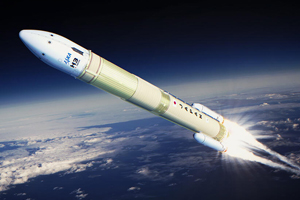
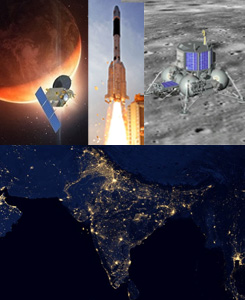
The space program in India is energetically advancing and propelled by unique expertise in frugal engineering and innovative enterprise. The total budget allocated for the India space program ISRO is US$1B, constituting just 0.34% of the total annual budget of the country and only 5.6% of the annual NASA budget. With these modest resources India is progressing on a variety of projects. High priority is given to continuing development of the Geostationary Satellite Launch Vehicle (GSLV), which made a triumphant return to flight January 5, after long delays and a string of failures. The next test scheduled for May-June will constitute an experimental flight of the GSLV MKIII configuration designed to lift 4-5-tonne payloads into geostationary transfer orbit. It will also carry a mock up of the human crew module being developed by ISRO. The proposed 2020 human space flight mission is undergoing initial studies and prototyping, including instrumentation on the crew module structure delivered by Hindustan Aeronautics Limited (HAL) and parachute systems for reentry and landing, but has yet to gain final approval from the government. There are also significant preparations underway for the Chandrayaan-2 mission set to land on and explore the surface of the Moon in 2016, following up on the successful Chandrayaan-1 orbiter and South Pole impactor (2008-9; US$62M). India also recently launched its 1,360-kg Mars orbiter mission Mangalyaan toward the Red Planet with a suite of 5 instruments and a price tag of about US$75M. (Image Credit: ISRO)
China and Japan Advancing Moon Science, Planning Future Moon Missions
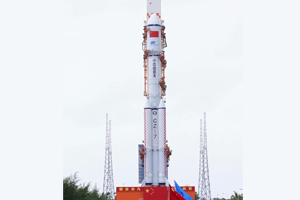
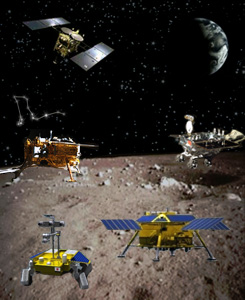
China is the only country operating on the surface of the Moon with the Chang’e-3 (CE3) Lander and Yutu Rover currently in their third Lunar night. Situated at Sinus Iridum / Mare Imbrium, 44.12°N 19.51°W, Yutu reaches its 3-month projected lifetime mid-March and CE3 is expected to operate until at least mid-December. CE4 Rover (2015) and CE5 Sample return mission (2017) will build upon successes of CE3: first image of Earth from Moon in over 40 years, chemical and depth analysis of lunar soil, astronomy from the Moon. Construction of the Wenchang Satellite Center in Hainan, the fourth and lowest latitude launch facility in China at 19° N, should be complete by June. It will utilize Long-March 5 and 7 rockets, and launch CE5, deep-space probe missions and space station components. Japan is also aiming for the Moon again with SELENE-2 orbiter, lander, rover mission (2018). The JAXA, NAOJ ‘Selene Symposium 2014: International Symposium of Lunar Science and Exploration using data from Multi-Instruments’ convened by Dr. Takahiro Iwata will occur on Mar 4-5 in Mitaka, Tokyo. As additional countries join the ‘Lunar Club’ and mining / territorial claims are realized, addressing the question of who owns the Moon becomes more urgent. (Image Credit: CCTV, CNSA, JAXA)
= All times for terrestrial events in local time unless noted.
= All times for international terrestrial events in local time unless noted.
= All times for space events, and…
= All times for international space / astro events in Hawaii Standard Time unless noted. Add 10 hours to obtain UT (‘Universal Time;’ Greenwich, England).
Mar 3 — ISS, LEO: Expedition 38 members Kotov, Ryazansky, Hopkins reviewing Soyuz descent procedures, preparing for return to Earth Mar 10; transferring trash to Progress 54P set to undock Mar 25, burn up in Earth atmosphere.
Mar 3 — Tiangong-1, LEO: Material science payload that examines crystal growth in space being observed through still imagery and video downlink.
Mar 3 — Curiosity, Kimberly (KMS-9) Trajectory, Mars: Heading to science waypoint Kimberly (formerly known as KMS-9) about 1 km away to investigate, use sample-collecting drill.
Mar 3 — Juno, Jupiter Trajectory: Spacecraft to reach Jupiter in 854 days, traveling at 83,880 kph with one-way radio signal travel time of about 12 minutes; has traveled 1.983B km (13.25 AU).
Mar 3 — SpaceX, Multiple Locations: NewSpace company with 5 milestones remaining for NASA CCiCap: delta ground systems review, Dragon capsule pad abort test, structure qualification, design review, in-flight abort test.
Mar 3 — Spaceport Sweden, Kiruna, Sweden: Establishing commercial human spaceflight tourism in Sweden; commissioned 3-month feasibility / concept study for the development of Space Visitor and Science Center now complete.
Mar 3 — Saber Astronautics, Austin TX: Developing Compact Microgravity Liquid Storage Container to allow for ‘natural’ drinking of liquid in space (i.e. from bottle, not squeeze tube), and ‘DragEN’ Cubesat Deorbit System.
Mar 3-5 — National Research Council Space Studies Board and Board on Physics and Astronomy, the National Academies, Washington DC: Space Science Week 2014; at National Academy of Sciences Building.
Feb 1 – Dec 31 — Stratospheric Observatory for Infrared Astronomy (SOFIA), Multiple Locations: Cycle 2 of science flights to observe universe consists of 47 science flights grouped into multi-week observing campaigns totaling about 350 research flight hours.
Mar 1-8 — IEEE, AIAA, Prognostics and Health Management Society, Aerospace and Electronic Systems Society, Big Sky MT: 2014 IEEE Aerospace Conference; at Yellowstone Conference Center.
Includes ~150 meetings covering the fields of COSPAR Scientific Commissions / Panels / Task Groups, such as SC B: The Earth-Moon System, Planets, and...
From 02 to 07 August 2026, a few thousand geoscientists across diverse disciplines will gather at the 23rd annual meeting of the Asia Oceania Geosciences...
Virtual Series 2026 will offer deeper conversations on why PQC matters and the practical steps businesses should be taking; starts 1:00 pm AEST. Featuring:...
This international lunar science meeting has two objectives: to provide a platform for leading experts to review recent advances across lunar research, from the...
At CSIR International Convention Centre. Key topics are Earth Observation, Developing Space Tourism, Space Supply Manufacturing. Cultural tours are offered.
Participants will receive theoretical and hands-on training in electron imaging and X-ray spectroscopy for application to planetary samples. This training opportunity is targeted at...
"Leading Australia’s Space Future for Our Strategic Advantage". Southern Space 2026 brings together decision-makers who set the direction for Australia’s space sector. It is...
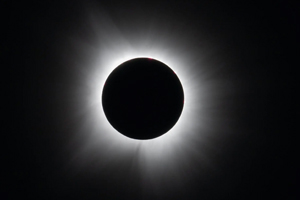
A total solar eclipse with a magnitude of 1.0386 (greatest eclipse 17:47:06 UTC) will be visible in parts of Greenland, Iceland, northern Russia, the Atlantic...
Includes presentation of the Neil Armstrong Award of Excellence, activities for the new class of Astronaut Scholars, 2-day Technical Conference where Scholars present their...
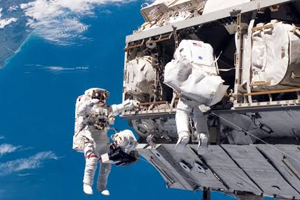
During U.S. spacewalk 97, two astronauts will replace a Space-to-Ground antenna on the orbital complex. The antenna is a critical communication system NASA uses...
Key themes include: Characterizing exoplanet-host solar-like stars; Star-planet interactions; Planet populations around solar-like stars. At University of Liège.
India orbiter surpasses another full year in lunar polar orbit since reaching the Moon in 2019; Chandrayaan-2 lander and rover were unsuccessful in lunar...
 The space program in India is energetically advancing and propelled by unique expertise in frugal engineering and innovative enterprise. The total budget allocated for the India space program ISRO is US$1B, constituting just 0.34% of the total annual budget of the country and only 5.6% of the annual NASA budget. With these modest resources India is progressing on a variety of projects. High priority is given to continuing development of the Geostationary Satellite Launch Vehicle (GSLV), which made a triumphant return to flight January 5, after long delays and a string of failures. The next test scheduled for May-June will constitute an experimental flight of the GSLV MKIII configuration designed to lift 4-5-tonne payloads into geostationary transfer orbit. It will also carry a mock up of the human crew module being developed by ISRO. The proposed 2020 human space flight mission is undergoing initial studies and prototyping, including instrumentation on the crew module structure delivered by Hindustan Aeronautics Limited (HAL) and parachute systems for reentry and landing, but has yet to gain final approval from the government. There are also significant preparations underway for the Chandrayaan-2 mission set to land on and explore the surface of the Moon in 2016, following up on the successful Chandrayaan-1 orbiter and South Pole impactor (2008-9; US$62M). India also recently launched its 1,360-kg Mars orbiter mission Mangalyaan toward the Red Planet with a suite of 5 instruments and a price tag of about US$75M. (Image Credit: ISRO)
 China is the only country operating on the surface of the Moon with the Chang’e-3 (CE3) Lander and Yutu Rover currently in their third Lunar night. Situated at Sinus Iridum / Mare Imbrium, 44.12°N 19.51°W, Yutu reaches its 3-month projected lifetime mid-March and CE3 is expected to operate until at least mid-December. CE4 Rover (2015) and CE5 Sample return mission (2017) will build upon successes of CE3: first image of Earth from Moon in over 40 years, chemical and depth analysis of lunar soil, astronomy from the Moon. Construction of the Wenchang Satellite Center in Hainan, the fourth and lowest latitude launch facility in China at 19° N, should be complete by June. It will utilize Long-March 5 and 7 rockets, and launch CE5, deep-space probe missions and space station components. Japan is also aiming for the Moon again with SELENE-2 orbiter, lander, rover mission (2018). The JAXA, NAOJ ‘Selene Symposium 2014: International Symposium of Lunar Science and Exploration using data from Multi-Instruments’ convened by Dr. Takahiro Iwata will occur on Mar 4-5 in Mitaka, Tokyo. As additional countries join the ‘Lunar Club’ and mining / territorial claims are realized, addressing the question of who owns the Moon becomes more urgent. (Image Credit: CCTV, CNSA, JAXA)
 = All times for terrestrial events in local time unless noted.
 = All times for international terrestrial events in local time unless noted.
 = All times for space events, and…
 = All times for international space / astro events in Hawaii Standard Time unless noted. Add 10 hours to obtain UT (‘Universal Time;’ Greenwich, England).