Astronomy from the Moon: NAOC and ILOA on the Frontier of 21st Century Astrophysics
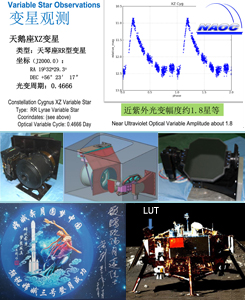
The International Lunar Observatory Association (ILOA) is receiving images from key partners at National Astronomical Observatories – Chinese Academy of Sciences (NAOC) in Beijing, comprising data from the Lunar near-Ultraviolet / Optical Telescope (LUT) aboard the China Chang’e-3 (CE3) spacecraft currently operating on the surface of the Moon. Professor Jianyan Wei the principal investigator of LUT indicates that the instrument has captured over 22,000 astronomical images to date. The 150-mm diameter, near ultraviolet telescope is the CE3 payload that has operated the longest and obtained the most data since the 14 December 2013 landing. ILOA will utilize the CE3 pioneering and historic data to enhance its Galaxy Forum 21st Century Education program. Founding Director Steve Durst says the dynamic Galaxy Forum architecture “should allow ILOA to advance human understanding of the Cosmos from the Moon and help identify support for the ILOA missions.” Astronomer and Explorer Dr. Yuki Takahashi noted that “these UV observations of the XZ Cygni (RR Lyrae type) variable star cannot be done from the Earth’s ground, and the lunar surface provides a stable platform that should make it easier to operate a long-lasting telescope. Studies of variable stars like this in the UV will help us measure distances in our Galaxy, providing humans with a more 3-dimensional visualization of our home Galaxy.” Aerospace Engineer, Medical Doctor and co-author of The Moon, Dr. David Schrunk explains that “similar measurements enabled Edwin Hubble to establish the fact that the Milky Way is not an ‘Island Universe’ but merely one of billions of other galaxies in a vast universe.” (Image Credit: ILOA, NAOC, Jian Huang)
Simulating Long Duration Space Missions on Mauna Loa, Hawaii
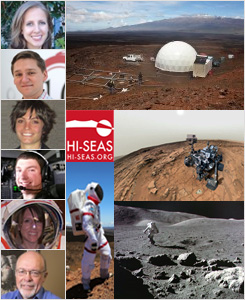
Moon and Mars mission studies continue on Hawaii Island slopes of Mauna Kea and Mauna Loa, near-perfect analog sites for Lunar and Martian environments to test life support systems, robotic prototypes, dust mitigation tactics and in-situ resource utilization. Hawai`i Space Exploration Analog and Simulation (HI-SEAS) Mission 2, lead by University of Hawaii Manoa under a US$1.2M award from NASA, will have (T-B) Anne Caraccio, Ross Lockwood, Lucie Poulet, Casey Stedman, Tiffany Swarmer and Dr. Ronald Williams live at ~2,500-meter (8,200-foot) altitude in an abandoned quarry on the northern slope of Mauna Loa from March 28 to July 28. The dome habitat (used in HI-SEAS Mission 1 food study) is 11-meters in diameter enclosing a volume of 384 cubic meters. Researchers, including co-investigator Kim Binsted, will monitor crew communications, workload, job-sharing and conflict resolution over the course of the mission to recommend strategies for crew composition and support during long duration space missions. Each crew member will also complete a personal research project which may involve biological or geological field research, engineering design and technology evaluation, scholarly writing or artistic endeavors. An 8-month space analog mission is being planned for August 2014 and a 12-month study June 2015. (Image Credit: UH Manoa, S. Proctor, NASA)
= All times for terrestrial events in local time unless noted.
= All times for international terrestrial events in local time unless noted.
= All times for space events, and…
= All times for international space / astro events in Hawaii Standard Time unless noted. Add 10 hours to obtain UT (‘Universal Time;’ Greenwich, England).
Mar 24 — ISS, LEO: Exp 39 preparing for arrival of 3 additional crew members, working with SAMS study of ISS vibrations & accelerations resulting from hardware, crew exercise, dockings, debris avoidance maneuvers.
Mar 24 — Spitzer, Heliocentric Orbit: GLIMPSE360 twenty-gigapixel mosaic panorama of Milky Way Galaxy constructed from ~2M infrared snapshots over the past 10 years now available online.
Mar 24 — Juno, Jupiter Trajectory: Trajectory Control Maneuver (TCM10) scheduled for Apr 9 has been canceled due to well-aimed course trajectory following Earth flyby Oct 2013; next TCM slated for Feb 2016.
Mar 24 — Cassini, Saturn Orbit: Likely to receive mission funding through 2017, spacecraft collecting data on inner structure, temperatures, gravity & magnetic field of Titan; studying Saturn rings, south pole auroral region, atmosphere.
Mar 24 — Planet Labs Inc., San Francisco CA: NewSpace company planning to launch 72 satellites to LEO within 12 months to complete 100-satellite constellation, collect images of entire Earth every 24 hours.
Mar 24 — Space Generation Advisory Council,Vienna, Austria: Running 2014 Emerging Commercial Space Paper Competition to develop new ideas on opportunities, challenges facing space entrepreneurs & investors.
Mar 24 — Space Frontier Foundation,Nyack NY: Settlement Enabling Test expands on previous Frontier Enabling Test allowing user to determine whether a national policy will ensure sustainability of / develop capabilities for space settlement.
Mar 24 — RSA, Launch Soyuz / Glonass M, Plesetsk Cosmodrome, Russia: Soyuz rocket to launch Glonass M navigation satellite.
Mar 24 — Asteroid 2014 DG80: Near-Earth flyby (0.040 AU).
Mar 24 — Asteroid 325102 (2008 EY5): Near-Earth flyby (0.079 AU).
Continued from…
Mar 22-25 — Large Binocular Telescope Observatory,Tucson AZ: LBTO 2014 Users’ Meeting; first in a long series of intended triennial meetings entirely dedicated to LBTO and its users.
Mar 22-29 — Astrophysics Institute of Paris, Rencontres de Moriond, La Thuile, Italy:Cosmology 2014.
Mar 25 — ISS, Undocking of Progress 54P, LEO: The 54th Progress cargo ship scheduled to undock, burn up during Earth atmosphere reentry; live coverage available.
Mar 25 — United Launch Alliance, Launch Atlas 5 / NROL-67,Cape Canaveral AFS FL: ULA to launch classified spacecraft payload for U.S. National Reconnaissance Office.
Mar 26 — RSA, Launch Soyuz TMA-12M / ISS 38S, Baikonur Cosmodrome, Kazakhstan: An RSA Soyuz rocket set to launch members of Expedition 39/40: Steve Swanson of NASA, Aleksandr Skvortsov of RSA, Oleg Artemyev of RSA; 03:17 local time, will dock with ISS about 6 hours later, live coverage available.
Mar 26 — NASA HQ, Washington DC:Asteroid Initiative Opportunities Forum; public forum to provide status on NASA asteroid initiative planning, 12:30 – 16:40 EDT.
Mar 27 — Moon: At perigee (distance 365,313 km), 08:37.
FRIDAY
Mar 28 — NASA HQ, Solar System Exploration Research Virtual Institute, Online / Washington DC:Asteroid Grand Challenge: Virtual Seminar Series; Alan Harris speaks on NEA populations and impact frequency, 11:00 EDT.
Mar 28 — Space Center Houston, Houston TX:Lunch with an Astronaut, Don Thomas; US$49.95 adult.
Mar 28-30 — SETI Institute, Ames Research Center, Goddard Space Flight Center, JPL, NASA,Death Valley CA: MarsFest 2014; in Death Valley National Park.
Includes ~150 meetings covering the fields of COSPAR Scientific Commissions / Panels / Task Groups, such as SC B: The Earth-Moon System, Planets, and...
From 02 to 07 August 2026, a few thousand geoscientists across diverse disciplines will gather at the 23rd annual meeting of the Asia Oceania Geosciences...
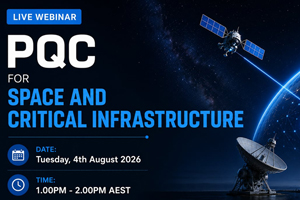
Virtual Series 2026 will offer deeper conversations on why PQC matters and the practical steps businesses should be taking; starts 1:00 pm AEST. Featuring:...
This international lunar science meeting has two objectives: to provide a platform for leading experts to review recent advances across lunar research, from the...
At CSIR International Convention Centre. Key topics are Earth Observation, Developing Space Tourism, Space Supply Manufacturing. Cultural tours are offered.
Participants will receive theoretical and hands-on training in electron imaging and X-ray spectroscopy for application to planetary samples. This training opportunity is targeted at...
"Leading Australia’s Space Future for Our Strategic Advantage". Southern Space 2026 brings together decision-makers who set the direction for Australia’s space sector. It is...
A total solar eclipse with a magnitude of 1.0386 (greatest eclipse 17:47:06 UTC) will be visible in parts of Greenland, Iceland, northern Russia, the Atlantic...
Includes presentation of the Neil Armstrong Award of Excellence, activities for the new class of Astronaut Scholars, 2-day Technical Conference where Scholars present their...
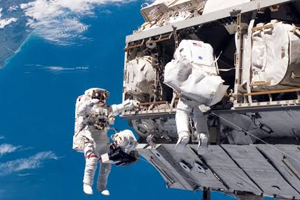
During U.S. spacewalk 97, two astronauts will replace a Space-to-Ground antenna on the orbital complex. The antenna is a critical communication system NASA uses...
Key themes include: Characterizing exoplanet-host solar-like stars; Star-planet interactions; Planet populations around solar-like stars. At University of Liège.
India orbiter surpasses another full year in lunar polar orbit since reaching the Moon in 2019; Chandrayaan-2 lander and rover were unsuccessful in lunar...
 The International Lunar Observatory Association (ILOA) is receiving images from key partners at National Astronomical Observatories – Chinese Academy of Sciences (NAOC) in Beijing, comprising data from the Lunar near-Ultraviolet / Optical Telescope (LUT) aboard the China Chang’e-3 (CE3) spacecraft currently operating on the surface of the Moon. Professor Jianyan Wei the principal investigator of LUT indicates that the instrument has captured over 22,000 astronomical images to date. The 150-mm diameter, near ultraviolet telescope is the CE3 payload that has operated the longest and obtained the most data since the 14 December 2013 landing. ILOA will utilize the CE3 pioneering and historic data to enhance its Galaxy Forum 21st Century Education program. Founding Director Steve Durst says the dynamic Galaxy Forum architecture “should allow ILOA to advance human understanding of the Cosmos from the Moon and help identify support for the ILOA missions.” Astronomer and Explorer Dr. Yuki Takahashi noted that “these UV observations of the XZ Cygni (RR Lyrae type) variable star cannot be done from the Earth’s ground, and the lunar surface provides a stable platform that should make it easier to operate a long-lasting telescope. Studies of variable stars like this in the UV will help us measure distances in our Galaxy, providing humans with a more 3-dimensional visualization of our home Galaxy.” Aerospace Engineer, Medical Doctor and co-author of The Moon, Dr. David Schrunk explains that “similar measurements enabled Edwin Hubble to establish the fact that the Milky Way is not an ‘Island Universe’ but merely one of billions of other galaxies in a vast universe.” (Image Credit: ILOA, NAOC, Jian Huang)
 Moon and Mars mission studies continue on Hawaii Island slopes of Mauna Kea and Mauna Loa, near-perfect analog sites for Lunar and Martian environments to test life support systems, robotic prototypes, dust mitigation tactics and in-situ resource utilization. Hawai`i Space Exploration Analog and Simulation (HI-SEAS) Mission 2, lead by University of Hawaii Manoa under a US$1.2M award from NASA, will have (T-B) Anne Caraccio, Ross Lockwood, Lucie Poulet, Casey Stedman, Tiffany Swarmer and Dr. Ronald Williams live at ~2,500-meter (8,200-foot) altitude in an abandoned quarry on the northern slope of Mauna Loa from March 28 to July 28. The dome habitat (used in HI-SEAS Mission 1 food study) is 11-meters in diameter enclosing a volume of 384 cubic meters. Researchers, including co-investigator Kim Binsted, will monitor crew communications, workload, job-sharing and conflict resolution over the course of the mission to recommend strategies for crew composition and support during long duration space missions. Each crew member will also complete a personal research project which may involve biological or geological field research, engineering design and technology evaluation, scholarly writing or artistic endeavors. An 8-month space analog mission is being planned for August 2014 and a 12-month study June 2015. (Image Credit: UH Manoa, S. Proctor, NASA)
 = All times for terrestrial events in local time unless noted.
 = All times for international terrestrial events in local time unless noted.
 = All times for space events, and…
 = All times for international space / astro events in Hawaii Standard Time unless noted. Add 10 hours to obtain UT (‘Universal Time;’ Greenwich, England).