Chandrayaan-2 & -3 Amplify Moon Knowledge, Are Celebrated This Week
India celebrates accomplishments on August 20 of its Chandrayaan-2 achieving 6 years in polar orbit 100km above the Moon, and August 23, National Space Day, of Chandrayaan-3 Vikram Moon lander arriving 2 years ago at Statio Shiv Shakti, ~69°S. These and other projects of India Space Research Organization (ISRO) continue to spur innovation in technology, science, communications and commercial opportunities. These advancements improve the lives of citizens, boost national pride, attract international partnerships, give investment opportunities and contribute to a robust economy. Chandrayaan-2 provides the highest-resolution imaging of the Moon, 0.25 of a meter, and shows IM-2 Athena lander position on Moon. As comparison, NASA LROC resolves to 0.50-m. The CHACE-2 instrument on Chandrayaan-2 provides the first map of Argon-40 in the lunar exosphere, helping to understand resource potential / possible hazards for upcoming Artemis missions. Pragyan rover of Chandrayaan-3, operating for one lunar day and able to communicate with Chandrayaan-2 orbiter, confirms South Pole-area presence of sulfur, aluminum, calcium, iron, chromium, titanium, manganese, silicon and oxygen. Sulfur may signal presence of water ice and can be used as plant fertilizer or fuel component. September will commemorate 16 years from first confirmation of lunar surface water molecules by NASA M3 instrument carried on Chandrayaan-1 Moon orbiter. ISRO is propelled by superlative expertise in frugal engineering with annual budget US$1.6B, about 6% of NASA typical US$25.4B. (Image Credits: ISRO)
MONDAY
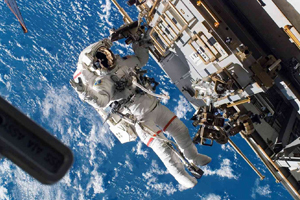
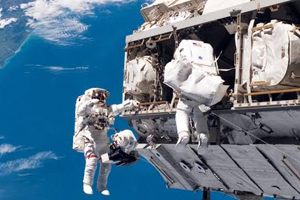
☆Aug 18 — International Space Station, ~415-km LEO: Expedition 73 seven members preparing for Dragon CRS-33, launching NET Aug 21, 03:55 EDT and docking ~28 hours later with its 6,000+ kg of supplies; science projects include stem cell bone loss prevention, 3D bioprinting of liver tissue and ESA Atomic Clock Ensemble in Space; meanwhile, they are focusing on blood and its circulatory system, with ultrasound scans, sensors measuring extremity / capillary flow, and a doppler analyzing cerebral artery flow.
☆Aug 18 — Tiangong Space Station, ~390-km LEO: Shenzhou 20 three-member crew are looking at the affect of microgravity on the blood-brain barrier and on brain function, researching bone metabolism, using throat swabs to investigate respiratory microbes, installing a specialized refrigerator and test equipment for a microbial fuel cell-based wastewater purification system, and moving new spacesuits to the spacewalk preparation area.
☆ Aug 18 — Hubble Space Telescope: Visible pass of spacecraft over the Hawaiian Islands, rises 04:13:35 from ENE and sets 04:18:35 in ENE, brightest magnitude 1.5.
☾ Aug 19 — Moon: 4.7° NNE of Jupiter, 13:00; 5.7° S of Castor, 21:00.
☆ Aug 19 — Mercury: 2.20° S of Beehive Cluster, 04:00.
☆ Aug 19 — Apollo Asteroid 2025 NH3: Near-Earth Flyby (0.057 AU)
● = Terrestrial and o = International terrestrial events in local time; ☾ = Moon, ★ = Space and ☆ = International space events in Hawai’i time unless noted.
Hubble & Webb Observing Celestial Phenomena in Close-Old and Far-Early Space
Hubble Space Telescope, providing high-resolution images and spectroscopic data of the universe since its launch in 1990, makes about 15 passes of Earth daily (one orbit roughly every 96 minutes). A fair number of passes, such as the one occurring August 18 over the Hawaiian Islands, are considered visible passes, when the satellite is illuminated by the Sun above the observer’s horizon, and the Sun is low enough to darken the sky. Some of the more recent headlines from Hubble include: the most detailed images yet of Interstellar Comet 3I/ATLAS; observational data indicating the chance of Milky Way and Andromeda galaxies colliding is only a 50-50 chance within the next 10 billion years; and, helping to determine Uranus rotation rate. The successor to NASA / ESA Hubble Telescope is the NASA / ESA / CSA-ASC James Webb Space Telescope (JWST), which will reach its 4th full year in space on December 25 and is expected to operate for about 20 years. JWST has a primary mirror diameter of 6.5 meters, compared with Hubble at 2.4 meters, resulting in higher resolution and light-gathering power. The oldest / earliest black hole yet discovered, with estimated age of 13 billion years, was observed by JWST and is undergoing further studies. In June, 1.5TB of JWST data was made available on an interactive viewer, including images of ~800,000 galaxies. (Image credits: NASA, STSci, J. DePasquale, A. Koekemoer, A. Pagan)
o Jun 30 – Aug 22 — International Space University, Korean Federation of Science and Technology Societies (KOFST), Hanyang University ERICA Campus, Seoul, S Korea:37th Space Studies Program (SSP).
☾ Aug 20 — Chandrayaan-2,Moon Orbit: India orbiter reaches 6th full year / enters 7th year in lunar 100-km polar orbit since reaching Moon in 2019; lander and rover were unsuccessful in lunar landing.
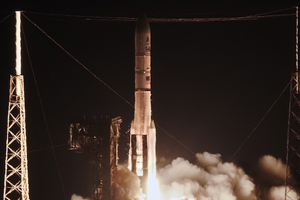
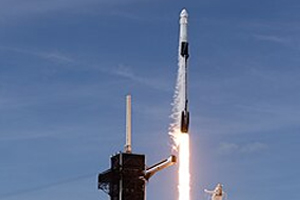
★ NET Aug 20 — SpaceX, Launch Falcon 9 / Dragon CRS-2 SpX-33, LC-40, KSC FL: 33rd commercial resupply services from SpaceX to deliver cargo, experiments to International Space Station.
☆ Aug 20 — Roscosmos, Launch Soyuz 2.1a / Bion-M No. 2, Baikonur Cosmodrome 31/6, Kazakhstan: Biological research satellite to LEO with 75 mice, 1,500 drosophila flies, plants, microorganisms.
☾ Aug 21 — Moon: 2.13° NNE of Beehive Cluster, 04:00; with Mercury and Beehive within circle of diameter 3.83°, 07:00; 3.5° NNE of Mercury, 10:00.
☆ Aug 21 — Apollo Asteroid 2025 OB3: Near-Earth Flyby (0.022 AU)
FRIDAY
☾ Aug 22 — Moon: New Moon, 20:06; 1.21° NE of Regulus, 21:00.
☆ Aug 22 — Aten Asteroid 2023 PX: Near-Earth Flyby (0.006 AU)
SATURDAY
☾ Aug 23 — Chandrayaan-3, Shiv Shakti Point, Moon (69.373°S, 32.319°E): Second annual observation of Vikram lander and Pragyan rover successfully landing on Moon in 2023 and India becoming 4th country to land on Moon, 1st near the Moon South Pole.
At the Spokane Convention Center. The meeting will have a broad scope, with a wide-ranging program of science and workforce topics, and celebrating planetary...
Convene, connect, and collaborate at the 19th annual von Braun Space Exploration Symposium! This year’s event will spotlight how bold ideas, emerging technologies, and...
Themes include: Space & the Arctic; Space & AI; Space & International Collaboration. There is a Student Session, a Technical Session, a Frontier Session,...
Oslo Spaceport Norway offers monthly a knowledgeable speaker and opportunity for networking, 17:00-20:00 local time; free entry but registration required. Ground Control is for...
45 satellites to launch for Amazon Leo, formerly named Project Kuiper. This LEO mega constellation will offer broadband internet access with 3,276 satellites.
Occurring 31 October from 09:00-11:00 local time (16:00-18:00 HST, 19:00-21:00 PDT, 22:00-24:00 EDT on 30 October), this Galaxy Forum will be in hybrid format...
Originally planned around this date for Wenchang, China -- TBC (to be confirmed); As the only professional association for astronauts, ASE supports the advancement of...
Coordinating Division Division C Education, Outreach and Heritage The IAU Symposium on Innovative Research and Techniques in Astronomy Communication will take place from November...
Change clocks back 1 hour from Daylight Saving to Standard Time; does not include Hawai’i, Arizona (except the Navajo Nation), American Samoa, Guam, Northern...
ESWW is the main annual event in the European Space Weather and Space Climate calendar. It is an international meeting organised annually within the...
IAU Symposium: IAUS409 - A Journey Towards Effective Astronomy Communication; online and at National Astronomical Observatory of Japan, 2-21-2 Osawa Mitaka, Tokyo. Topics include:...
Launch Complex 1, ~39°S, Mahia Peninsula, New Zealand
iQPS Launch 9, an Earth observation satellite with Synthetic aperture radar for Japan-based imaging company iQPS, to launch on "The Sea God Surveys" mission...
Launch window 10:34am - 2:34pm local time for the 15th batch of classified satellites for a reconnaissance constellation built by SpaceX and Northrop Grumman...