Southeast Asia Events Highlight Emerging Regional Opportunities for Pacific Space Access and Astronomy
Developing countries of Southeast Asia are actively seeking to enhance their positions, individually and cooperatively, as actors in 21st Century space access and competence. A series of events will bring regional leaders in astronomy and space development together to discuss current progress and emerging opportunities for the region to advance space access, science and education. Galaxy Forum SEA 2014 – Indonesia will take place on Feb 21 at the LAPAN office in Jawa Barat. The International Lunar Observatory Association (ILOA) and Institute of Technology Bandung (ITB)-sponsored event will feature presentations by LAPAN Head Thomas Djamaluddin (R) on Indonesia Space Activities & Ambitions, and Sabirin bin Abdullah of ANGASKA on Malaysia Space Activities. On Feb 24, another Galaxy Forum event will be held in Bangkok, Thailand with presentations from Thai astronomy and space leaders such as Boonrucksar Soonthornthum (L) of NARIT, and Narut Soontranon of GISTDA. Representatives from Indonesia, Thailand, Malaysia, Singapore, Vietnam, and Philippines will meet with ILOA Directors on Feb 26 in Singapore for the ILOA Southeast Asia Executive Meeting. The meeting will feature updates from representatives of each of the participating SEA nations, and an in-depth examination of how these countries can advance their astronomy and space ambitions through involvement in the ILO-1 mission to land an observation / communications device near the Moon South Pole. With rapidly advancing investment in space and the opening of the new Wenchang Satellite Launch Center in Hainan, China, Southeast Asia remains a prime region for the benefits of Pacific Space Access to be realized. (Image Credit: ILOA, ITB, LAPAN, Cri.cn, ME)
MONDAY
Feb 23 — ISS, LEO: Expedition 42 planning to perform 2 EVAs this week, preparing for ISS change of command & 3-person crew return to Earth Mar 10-11, transferring ~2,800 kg of cargo from Progress 58P, filling Progress 57P with waste; Soyuz TMA-14M & 15M currently docked to ISS.
Feb 23 — ARTEMIS, Moon Orbit: Two NASA spacecraft in elliptical equatorial orbits around Moon since 2007, operating nominally, observing solar wind, measuring pickup ions from exosphere, electrostatic charging of Moon surface & plasma wake.
Feb 23 — Cassini, Saturn Orbit: Mapping moon Titan with synthetic aperture radar & visible and infrared mapping spectrometer – almost half of Titan has been mapped; studying Enceladus, Dione, Rhea, Mimas, Saturn, its rings, magnetic environment, interactions with solar wind.
Feb 23 — Swiss Space Systems (S3), Payerne, Switzerland: NewSpace company working to provide orbital launches of SmallSats & human suborbital flights, planning for ZeroG flights to take place at new facility in Croatia in first half of 2016, wants to become tenant at the developing Spaceport Colorado.
Feb 23 — Spire, Singapore & San Francisco CA: Intends to launch 20 CubeSats in 2015, and 100 total by 2017 to provide nearly real-time weather data & up to 10,000 weather readings daily.
Feb 23 — Mars One, The Hague, The Netherlands: Moving forward with Astronaut selection process for one-way human missions to Mars starting 2024; new application round will open this year; Paragon mission concepts study on life support systems to be released this month.
= All times for terrestrial events in local time unless noted.
= All times for international terrestrial events in local time unless noted.
= All times for space events, and…
= All times for international space / astro events in Hawaii Standard Time unless noted. Add 10 hours to obtain UT (‘Universal Time;’ Greenwich, England).
Asteroid Exploration for Planetary Protection, Resources and Science
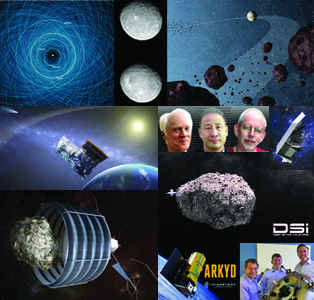
The NASA Dawn spacecraft is set to arrive at dwarf-planet Ceres (950-km diameter) on March 6 after exploring minor planet 4 Vesta (525-km diameter). Together Ceres, Vesta, Pallas and Hygiea contain about half the mass of the Main Asteroid Belt which is believed to have a total mass equal to ~4% of the Moon. The Main Belt, located between the orbits of Mars and Jupiter ~2.2 and 3.2 AU from Sun, is estimated to contain 200 asteroids larger than 100 km in diameter, 750,000+ asteroids larger than 1 km and many millions of smaller ones. The US$5M-a-year NEOWISE infrared-wavelength space telescope mission in LEO is working to locate unknown Near Earth Asteroids within 45M km of Earth, and characterize the size, albedo and thermal properties of ~2,000 known asteroids. JAXA Hayabusa 2 “Falcon” sample return mission, en route to 1999 JU3, is expected to arrive June 2018, depart for Earth December 2019 and return samples Dec 2020. The NASA ARM concept would bring a small asteroid to Moon orbit for further investigation and human exploration. Privately owned Planetary Resources is set to launch its first Earth-observation and asteroid-locating satellite Arkyd-100 to LEO August 18. The B612 Foundation, co-founded by Rusty Schweickart, Ed Lu and Piet Hut, will host a presentation on “The Sentinel Mission: Finding the Asteroid Headed for Earth” at Foothills College in California on March 4. Deep Space Industries is working to provide technologies for discovering, harvesting and processing NEOs. (Image Credit: NASA, JPL-Caltech, UCLA, MPS, DLR, IDA, William Crochot, Planetary Resources, B612, DSI)
Feb 24 — Asteroid 2015 BA511: Near-Earth flyby (0.098 AU).
WEDNESDAY
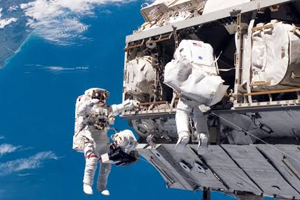
Feb 25 — ISS, U.S. EVA 31,LEO: Wilmore and Virts to perform spacewalk to install power and data cables and a communications gear, as well as grease Canadarm2, live coverage available.
Feb 25 — Kennedy Space Center, NASA, Space Florida, Tallahassee FL: Florida Space Day 2015.
Feb 27 — ATV-5, LEO: Europe final Automated Transfer Vehicle “Georges Lemaitre” to burn up in Earth atmosphere today with ISS waste; undocked from ISS Feb 14.
Feb 27 — Moon: 6.1° S of M35, 07:00.
Feb 27 — Asteroid 90416 (2003 YK118): Near-Earth flyby (0.078 AU).
SATURDAY
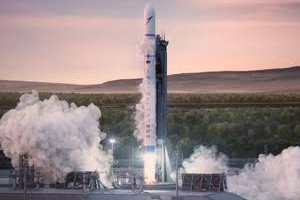
NET Feb 28 — SpaceX, Launch Falcon 9 / Eutelsat 115 West B & ABS 3A,Cape Canaveral AFS FL: SpaceX Falcon 9 rocket to launch Eutelsat 115 West B & ABS 3A communications satellites built by Boeing; are first spacecraft to launch in conjoined configuration & first payloads to use all-electric propulsion for orbit-raising.
Feb 28 — Johns Hopkins University / Applied Physics Laboratory, NASA,Online / Laurel MD:Applications due for students interested in working on projects involving NASA missions or space-related research opportunities.
Feb 28 — Asteroid 2014 YS34: Near-Earth flyby (0.098 AU).
SUNDAY
NET Mar — Chang’e 5-T1 Service Module, Moon Orbit: China service module equipped with navigation receiver compatible with GPS & GLONASS, dual-resolution camera, components for guidance, navigation & control, micro-star sensor, star-sensing anti-debris mechanism, technical experiment camera to perform second long-range guidance test for lunar orbit rendezvous & docking.
NET Mar — XMM Newton, GTO: X-ray space observatory extended mission ends this month, future mission plans to be determined.
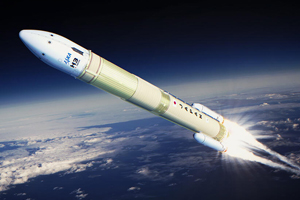
NET Mar — ISRO, Launch Reusable Launch Vehicle Technology Demonstrator (RLV-TD) / HEX (Hypersonic Flight Experiment),Satish Dhawan Space Center, Sriharikota, India: India to launch winged reusable launch vehicle on hypersonic technology demonstration mission to further its advancement of AVATAR (Aerobic Vehicle for Transatmospheric Hypersonic Aerospace TrAnspoRtation) two-stage-to-orbit fully reusable horizontal-landing launch vehicle.
Mar 1 — ISS, U.S. EVA 31,LEO: Wilmore and Virts to perform spacewalk, live coverage available.
Mar 1 — Deep Space, Interstellar Space& Heliosheath: NASA Voyager 1 & 2 are now ~130 AU and 107 AU from Earth, continuing to explore ultraviolet sources among stars, boundary between solar influence & interstellar space, and are expected to send data to Earth until ~2025 when power may run out.
Includes ~150 meetings covering the fields of COSPAR Scientific Commissions / Panels / Task Groups, such as SC B: The Earth-Moon System, Planets, and...
From 02 to 07 August 2026, a few thousand geoscientists across diverse disciplines will gather at the 23rd annual meeting of the Asia Oceania Geosciences...
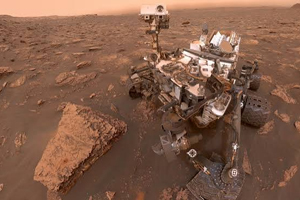
NASA Curiosity (Mars Science Laboratory) rover surpasses another full year of operations on Mars surface today; launched Nov 26, 2011 – landed Aug 5,...
Virtual Series 2026 will offer deeper conversations on why PQC matters and the practical steps businesses should be taking; starts 1:00 pm AEST. Featuring:...
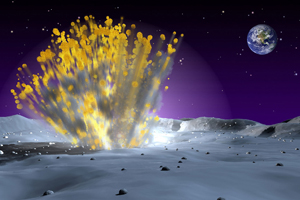
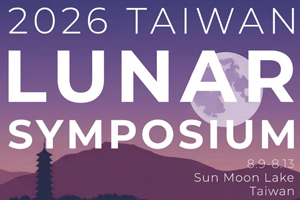
This international lunar science meeting has two objectives: to provide a platform for leading experts to review recent advances across lunar research, from the...
At CSIR International Convention Centre. Key topics are Earth Observation, Developing Space Tourism, Space Supply Manufacturing. Cultural tours are offered.
Participants will receive theoretical and hands-on training in electron imaging and X-ray spectroscopy for application to planetary samples. This training opportunity is targeted at...
"Leading Australia’s Space Future for Our Strategic Advantage". Southern Space 2026 brings together decision-makers who set the direction for Australia’s space sector. It is...
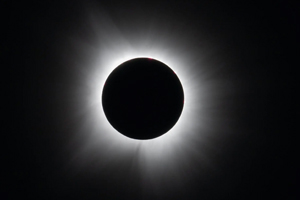
A total solar eclipse with a magnitude of 1.0386 (greatest eclipse 17:47:06 UTC) will be visible in parts of Greenland, Iceland, northern Russia, the Atlantic...
Includes presentation of the Neil Armstrong Award of Excellence, activities for the new class of Astronaut Scholars, 2-day Technical Conference where Scholars present their...
During U.S. spacewalk 97, two astronauts will replace a Space-to-Ground antenna on the orbital complex. The antenna is a critical communication system NASA uses...
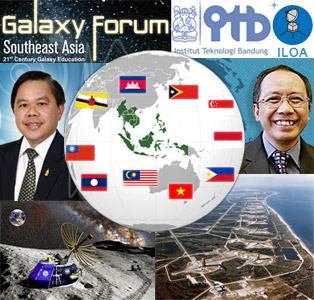 Developing countries of Southeast Asia are actively seeking to enhance their positions, individually and cooperatively, as actors in 21st Century space access and competence. A series of events will bring regional leaders in astronomy and space development together to discuss current progress and emerging opportunities for the region to advance space access, science and education. Galaxy Forum SEA 2014 – Indonesia will take place on Feb 21 at the LAPAN office in Jawa Barat. The International Lunar Observatory Association (ILOA) and Institute of Technology Bandung (ITB)-sponsored event will feature presentations by LAPAN Head Thomas Djamaluddin (R) on Indonesia Space Activities & Ambitions, and Sabirin bin Abdullah of ANGASKA on Malaysia Space Activities. On Feb 24, another Galaxy Forum event will be held in Bangkok, Thailand with presentations from Thai astronomy and space leaders such as Boonrucksar Soonthornthum (L) of NARIT, and Narut Soontranon of GISTDA. Representatives from Indonesia, Thailand, Malaysia, Singapore, Vietnam, and Philippines will meet with ILOA Directors on Feb 26 in Singapore for the ILOA Southeast Asia Executive Meeting. The meeting will feature updates from representatives of each of the participating SEA nations, and an in-depth examination of how these countries can advance their astronomy and space ambitions through involvement in the ILO-1 mission to land an observation / communications device near the Moon South Pole. With rapidly advancing investment in space and the opening of the new Wenchang Satellite Launch Center in Hainan, China, Southeast Asia remains a prime region for the benefits of Pacific Space Access to be realized. (Image Credit: ILOA, ITB, LAPAN, Cri.cn, ME)
 = All times for terrestrial events in local time unless noted.
 = All times for international terrestrial events in local time unless noted.
 = All times for space events, and…
 = All times for international space / astro events in Hawaii Standard Time unless noted. Add 10 hours to obtain UT (‘Universal Time;’ Greenwich, England).