United Nations Planetary Protection Focus May Evolve to Include Lunar Activities
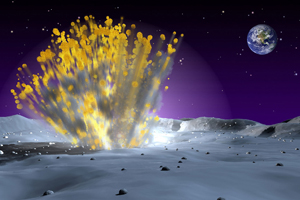
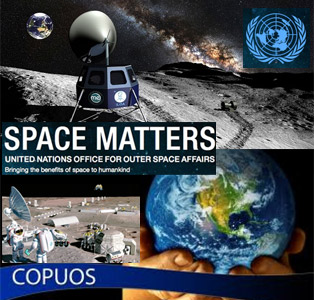
United Nations Office of Outer Space Affairs and the Committee on the Peaceful Uses of Outer Space regularly address and oversee issues of planetary protection through their focus on space weather and space debris. Long-duration Earth observations and NEO surveys from the Moon utilizing instruments, such as those proposed by the International Lunar Observatory Association, could be invaluable in studying climate change and potential threats to humanity’s home planet. The International Lunar Observatory is currently considering a means to establish a connection with the UN on its series of Moon missions. Another focus of the UN COPUOS is to support peaceful exploration of space and to ensure that the benefits of space exploration are shared by all of humanity. With all of the major space powers and several independent enterprises focused on exploring and developing the resources of the Moon, United Nations may need to revisit its lunar policy and increase its involvement in lunar matters. Sustainable exploration of the Moon could help provide energy abundance while also providing another venue to ensure the safety of the Earth community. With China actively working to secure its lunar rights and with the USA’s Federal Aviation Administration recently asserting it will regulate private lunar activities to encourage independent Moon initiatives, it is now time for the UN to make the oversight of lunar exploration and development a priority. The United Nations Committee on the Peaceful Uses of Outer Space Legal Subcommittee will meet April 13-24, and the full committee will meet June 10-19 at the UN Office in Vienna, Austria. (Image Credit: ILOA, ME, NASA, UN)
MONDAY
Mar 9 — ISS, LEO: Expedition 42 preparing for 3-member crew return to Earth with science experiments & gear; nanosatellites being deployed from Japan Kibo module; autonomously running experiments include Wireless-Sensor Network (WiSe-Net), Space Communications and Navigations (SCaN) testbed, Multi-mission Consolidated Equipment (MCE), Alpha Magnetic Spectrometer (AMS).
Mar 9 — Chandra, HEO: In highly elliptical 65-hour orbit, studying Sagittarius A*, black holes, galaxies, stars, supernova remnants; recent data suggests growth of galaxies containing supermassive black holes can be slowed down by “cosmic precipitation” – hot gas producing showers of cool gas clouds that fall into a galaxy.
Mar 9 — Juno, Jupiter Trajectory: Traveling at ~38,800 kph, NASA craft is now 483 days from Jupiter orbit insertion (July 4, 2016); scheduled to exit Quiet Cruise phase & enter Jupiter Approach phase Jan 2016.
Mar 9 — Shackleton Energy Company, Austin TX: NewSpace company through MOU with CASIS, will develop aerobraking systems / Mini Space Brakes dubbed ‘Oryx’ to enable transport of water from Moon to future propellant depots in LEO.
Mar 9 — Bigelow Aerospace LLC, Las Vegas NV: Completed Bigelow Expandable Activity Module (BEAM) to be made available for media coverage Mar 12; will be shipped to KSC for launch to ISS later this year.
Mar 9 — Asteroid 2015 DS: Near-Earth flyby (0.044 AU).
= All times for terrestrial events in local time unless noted.
= All times for international terrestrial events in local time unless noted.
= All times for space events, and…
= All times for international space / astro events in Hawaii Standard Time unless noted. Add 10 hours to obtain UT (‘Universal Time;’ Greenwich, England).
AAS 53rd Goddard Symposium Focuses on Future of Space Exploration, Science, Technology and Astronomy
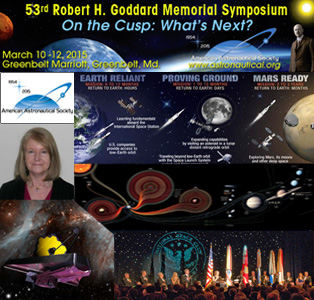
The 53rd Goddard Memorial Symposium, hosted by the American Astronautical Society (founded 1954), is being held March 10-12 in Greenbelt, Maryland. AAS President Lyn Wigbels (L) will deliver a welcome speech to ~400 attendees, followed by remarks from Harley Thronson of GSFC, Wanda Sigur of Lockheed Martin and NASA Administrator Charles Bolden. The ‘Emerging Commercial Ventures’ panel features moderator Eric Stallmer (President of Commercial Spaceflight Federation) and panelists Richard DalBello (VP of Virgin Galactic), James Muncy (Founder of PoliSpace) and Peter Marquez (VP of Planetary Resources). This year the theme On the Cusp: What’s Next is highlighted in topics including NASA Headquarters Perspectives, Cutting Edge Technology, Generation Next, What’s up with the Global Exploration Roadmap, Destination Mars Spotlights, and the Next Golden Age of Astronomy. The 58th Annual Robert H. Goddard Memorial Dinner, with nearly 2,000 attendees, will be held on Mar 13 in Washington, D.C. by the National Space Club. Some of the 2015 awards are to be given to Dr. Harold Rosen, Sophia Porter, Christopher Singer and the NASA Lunar Laser Communications Demonstration team. (Image Credit: AAS, NASA, GSFC, NSC, STScI)
NET Mar 10 — ISRO, Launch PSLV / IRNSS 1D, Satish Dhawan Space Center, Sriharikota, India: India Polar Satellite Launch Vehicle on PSLV-C27 mission to launch the IRNSS 1D navigation satellite.
Mar 10 — Mars Reconnaissance Orbiter, Mars Orbit: NASA spacecraft reaches 9 full years in orbit around Mars today, continues to monitor weather / surface conditions, potential landing sites.
Mar 12 — ISS, Undocking of Soyuz TMA-14, LEO: Expedition 41/42 members Yelena Serova (RSA), Alexander Samokutyaev (RSA), Barry Wilmore (NASA) scheduled to return to Earth.
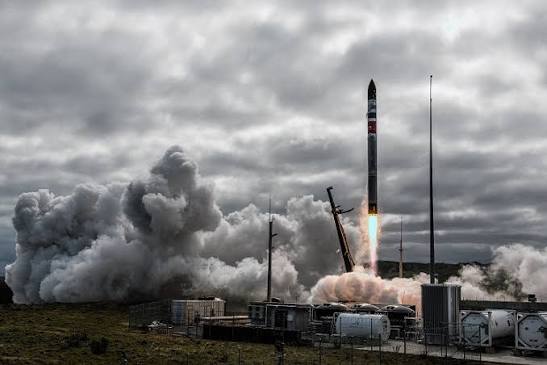
Mar 12 — United Launch Alliance, Launch Atlas 5 / Magnetospheric Multiscale (MMS) mission, Cape Canaveral AFS FL: ULA Atlas 5 rocket to launch NASA 4-spacecraft MMS mission to make 3D measurements of magnetospheric boundary regions, examine process of magnetic reconnection; launch window 22:44-23:14.
Includes ~150 meetings covering the fields of COSPAR Scientific Commissions / Panels / Task Groups, such as SC B: The Earth-Moon System, Planets, and...
From 02 to 07 August 2026, a few thousand geoscientists across diverse disciplines will gather at the 23rd annual meeting of the Asia Oceania Geosciences...
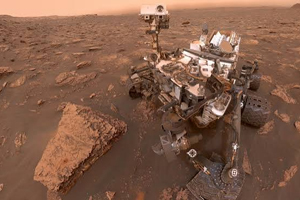
NASA Curiosity (Mars Science Laboratory) rover surpasses another full year of operations on Mars surface today; launched Nov 26, 2011 – landed Aug 5,...
Virtual Series 2026 will offer deeper conversations on why PQC matters and the practical steps businesses should be taking; starts 1:00 pm AEST. Featuring:...
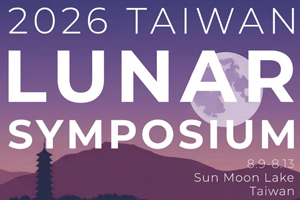
This international lunar science meeting has two objectives: to provide a platform for leading experts to review recent advances across lunar research, from the...
At CSIR International Convention Centre. Key topics are Earth Observation, Developing Space Tourism, Space Supply Manufacturing. Cultural tours are offered.
Participants will receive theoretical and hands-on training in electron imaging and X-ray spectroscopy for application to planetary samples. This training opportunity is targeted at...
"Leading Australia’s Space Future for Our Strategic Advantage". Southern Space 2026 brings together decision-makers who set the direction for Australia’s space sector. It is...
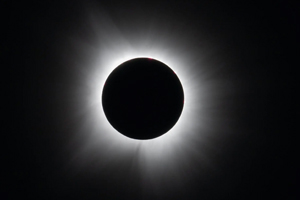
A total solar eclipse with a magnitude of 1.0386 (greatest eclipse 17:47:06 UTC) will be visible in parts of Greenland, Iceland, northern Russia, the Atlantic...
Includes presentation of the Neil Armstrong Award of Excellence, activities for the new class of Astronaut Scholars, 2-day Technical Conference where Scholars present their...
During U.S. spacewalk 97, two astronauts will replace a Space-to-Ground antenna on the orbital complex. The antenna is a critical communication system NASA uses...

 = All times for terrestrial events in local time unless noted.
 = All times for international terrestrial events in local time unless noted.
 = All times for space events, and…
 = All times for international space / astro events in Hawaii Standard Time unless noted. Add 10 hours to obtain UT (‘Universal Time;’ Greenwich, England).