Solar System Human Mission Design Project: Welcome to the Third Zone
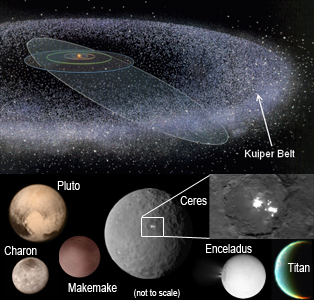
New Horizons zipping by Pluto and Charon is shedding light on a whole new region of the Solar System and has played a major role in the decades-long adoption of a much wider family of planets. A dwarf planet, not to be confused with a minor planet, is an object in direct orbit of the Sun with enough mass to achieve hydrostatic equilibrium under its own gravity, but which has not cleared its orbit of debris and is not one of the 4 terrestrial or 4 giant planets (Mercury, Venus, Earth Mars and Jupiter, Saturn, Uranus, Neptune respectively). As of early 2015, in addition to the officially recognized dwarf planets Ceres, Pluto, Haumea, Makemake and Eris there are about 150 known Trans-Neptunian Objects that likely also qualify as dwarf planets (e.g. Orcus, Salacia, Quaoar, Sedna). Recently discovered bright spots in craters on Ceres are consistent with highly reflective materials containing ice or salts. Eris at (1.67±0.02)×1022 kg or 0.23 Moons is the most massive discovered so far and was recognized briefly as the “tenth planet” before being reclassified. The Kuiper Belt is a toroidal halo structure 20 times as wide and 20-200 times as massive as the Main Asteroid Belt comprised of an estimated 100,000 objects over 100 km in diameter and more than a trillion comets — all composed mostly of frozen volatiles (methane, ammonia, water ices). Elements which in accordance with the NASA mantra “Follow the Water,” indicate the possibility of sustaining development of extra-terrestrial life and offer life support and fuel potential to future interplanetary travelers. Along with the great satellites of the outer Solar System – Jovian moons Europa, Io, Ganymede, Callisto, and Saturnian moons Titan, Enceladus – these new worlds will continue to inspire humans to reach higher, learn more, overcome challenges, transcend terrestrial concerns. In the 22nd Century, exploration, development and utilization of the raw materials and resources at this third zone of the Solar System represent our final supply depot, the ultimate boost, in the acceleration of our species for interstellar endeavor. (Image Credit: NASA, JHUAPL, SwRI, JPL-Caltech, UCLA, MPS, DLR, IDA, Space Science Institute, University of Arizona)
MONDAY
Jul 20 — ISS, LEO: Expedition 44 preparing for arrival of 3 new crew members & Soyuz TMA-17M, transferring cargo from Progress 60P, working with VEG-01 experiment, Vizir photography study, cell cultivation, radiation exposure, crew performance observations; ISS now 6,086 days in orbit.
Jul 20 — Chang’e-3 Lander & Yutu Rover, Sinus Iridum / Mare Imbrium, 44.12°N 19.51°W, Moon Surface: Only spacecraft operating on surface of Moon, now in lunar night 20; Lunar Ultraviolet Telescope, Visible / Near-Infrared Imaging Spectrometer, and cameras making observations.
Jul 20 — New Horizons, Pluto Flyby / Kuiper Belt Trajectory: Collecting data on Pluto system for ~1 more year, returning information to Earth, science data to be embargoed for ~4 months, heading toward Kuiper Belt for Jan 2019 KBO encounter.
Jul 20 — Made in Space, Mountain View CA: NewSpace company working to build zero-gravity, 3D printer ‘R3DO’ to recycle plastic into useable / useful items & eliminate waste in space; printing technique advances could be applied to future space missions, lunar / habitat settlements.
Jul 20 — Planetary Resources Inc., Redmond WA: Arkyd-3R in LEO testing avionics, control systems & software technologies; Arkyd-6 to be launched in 19 weeks to ISS will test attitude control, power, communication, avionics systems; Consulting with NASA on its OSIRIS-REx (Origins, Spectral Interpretation, Resource Identification, Security and Regolith Explorer) mission.
Jul 20 — Swiss Space Systems (S3),Payerne, Switzerland: Plans to invest US$16M in 30-kg CleanSpace One technology demonstrator satellite intended to identify, rendezvous with & de-orbit decommissioned SwissCube satellite; will launch payload to LEO aboard SOAR suborbital reusable shuttle (currently under development) in 2018.
Jul 20 — Apollo 11 46th Observation, Nationwide USA / Global: First Human mission to land on Moon in 1969; 1st steps by humans on another planetary body taken by Commander Neil Armstrong and Lunar Module Pilot Buzz Aldrin.
Jul 20 — Viking 1 Mars Lander 39th Observation, Nationwide USA / Global: First spacecraft to successfully land on another planet; originally scheduled for July 4, landing was delayed until this day in 1976 due to rough landing site.
for terrestrial events in local time unless noted.
= All times for international terrestrial events in local time unless noted.
= All times for space events, and…
= All times for international space / astro events in Hawaii Standard Time unless noted. Add 10 hours to obtain UT (‘Universal Time;’ Greenwich, England).
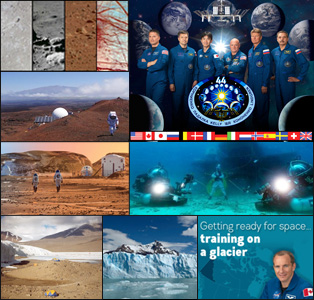
Preparations for advanced Human Space exploration continue with crew habitation and science on the International Space Station, and extreme environment research and analog testing on Earth. On July 22 Kjell Lindgren of NASA, Kimiya Yui of JAXA and Oleg Kononenko of RSA are set to join Expedition 44 Commander Gennady Padalka, Mikhail Kornienko and Scott Kelly, after a 6-hour, 4-orbit journey. Kelly and Kornienko are now 115 days into their 1-year space mission; data and observations collected on their performance and health will help determine countermeasures and risks associated with long-term space missions. NASA Extreme Environment Mission Operations (NEEMO) 20, two-week space analog mission will begin July 20 in the Aquarius underwater laboratory 5.6 km off the coast of Key Largo, Florida and 19-meters below sea level. ESA Astronaut Luca Parmitano will lead a group including NASA Astronaut candidate Serena Aunon, JAXA Astronaut candidate Norishige Kanai, and NASA ‘spacewalk specialist’ David Coan to test communications equipment and EVA methods for deep space missions. Canadian Space Agency Astronaut David Saint-Jacques will join Gwenn Flowers and a team from the Simon Fraser University Glaciology Group July 25 – August 2 on the Kaskawulsh Glacier in Yukon, Canada to learn geological fieldwork techniques which could be applied to exploration of planetary bodies. Other isolated, extreme-environment analog test sites on Earth include the Mars Desert Research Station in Utah, Lunar Mars Analogue Site in France, McMurdo Dry Valleys / Concordia Station in Antarctica, Kīlauea Volcano / Mauna Kea / Mauna Loa in Hawai`i USA, Atacama desert in Chile. (Image Credit: NASA, ESA, CSA, G. Flowers, G. Ugarkovic, JPL, Cornell, M. Malaska NEEMO, L2, HI-SEAS, Mars Society MRDS, P. West, NSF)
Jul 20 — The Space Show, Online / Tiburon CA: Dr. David Livingston talks with Rand Simberg and Bill Simon on ‘Evoloterra: The Story of When We First Left Earth’ a celebration held on July 20th of each year recognizing the positive achievements of human beings.
Jul 20 – Aug 3 — NASA, NOAA, Aquarius Reef Base, Key Largo FL:NASA Extreme Environment Mission Operations (NEEMO) 20; space analogue mission 19 meters below sea level to test tele-mentoring operations for ESA & simulate Moon / Mars EVAs; ESA astronaut Luca Parmitano (to command mission), Serena Aunon, Norishige Kanai, David Coan.
Jul 20 — Mercury: 5.4° S of Pollux, 03:00.
Jul 20 — Asteroid 2013 BQ18: Near-Earth flyby (0.020 AU).
Jul 21-23 — NASA Solar System Exploration Research Virtual Institute (SSERVI), Moffett Field CA: 2015 NASA Exploration Science Forum; scientific discussions of exploration targets of interest (Moon, near-Earth asteroids, moons of Mars); at Ames Research Center.
Jul 21 — Moon: At apogee (distance 404,367 km), 01:00.
Jul 21 — Asteroid 2010 PR66: Near-Earth flyby (0.063 AU).
Jul 23 — Chandra X-ray Observatory, HEO: NASA spacecraft in extended mission phase enters 17th year of operations in Space; instruments able to detect X-ray sources 100 times fainter than any previous X-ray telescope.
Jul 23-26 — Intrepid Sea, Air and Space Museum, NYC NY: 4th Annual Space & Science Festival; featuring Astronauts, satellites in real time, discussions on the future of space exploration.
Jul 23 — Moon: 3.9° NNE of Spica, 04:00; at first quarter, 18:08.
Jul 23 — Mercury: At superior conjunction (distance 1.337 AU from Earth), 09:00.
Jul 25 – Aug 2 — Canadian Space Agency, Kaskawulsh Glacier, Yukon, Canada: Astronaut Training Mission; CSA Astronaut David Saint-Jacques & team participating in training expedition to explore methods & techniques for conducting geological fieldwork that could be applied to future missions to Moon, Mars, Asteroids.
Includes ~150 meetings covering the fields of COSPAR Scientific Commissions / Panels / Task Groups, such as SC B: The Earth-Moon System, Planets, and...
From 02 to 07 August 2026, a few thousand geoscientists across diverse disciplines will gather at the 23rd annual meeting of the Asia Oceania Geosciences...
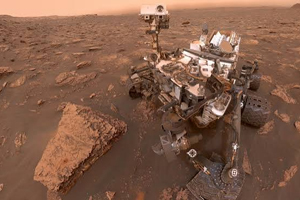
NASA Curiosity (Mars Science Laboratory) rover surpasses another full year of operations on Mars surface today; launched Nov 26, 2011 – landed Aug 5,...
Virtual Series 2026 will offer deeper conversations on why PQC matters and the practical steps businesses should be taking; starts 1:00 pm AEST. Featuring:...
This international lunar science meeting has two objectives: to provide a platform for leading experts to review recent advances across lunar research, from the...
At CSIR International Convention Centre. Key topics are Earth Observation, Developing Space Tourism, Space Supply Manufacturing. Cultural tours are offered.
Participants will receive theoretical and hands-on training in electron imaging and X-ray spectroscopy for application to planetary samples. This training opportunity is targeted at...
"Leading Australia’s Space Future for Our Strategic Advantage". Southern Space 2026 brings together decision-makers who set the direction for Australia’s space sector. It is...
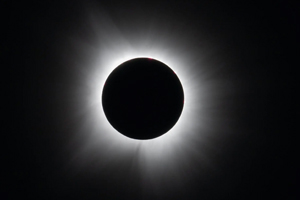
A total solar eclipse with a magnitude of 1.0386 (greatest eclipse 17:47:06 UTC) will be visible in parts of Greenland, Iceland, northern Russia, the Atlantic...
Includes presentation of the Neil Armstrong Award of Excellence, activities for the new class of Astronaut Scholars, 2-day Technical Conference where Scholars present their...
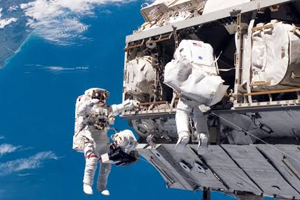
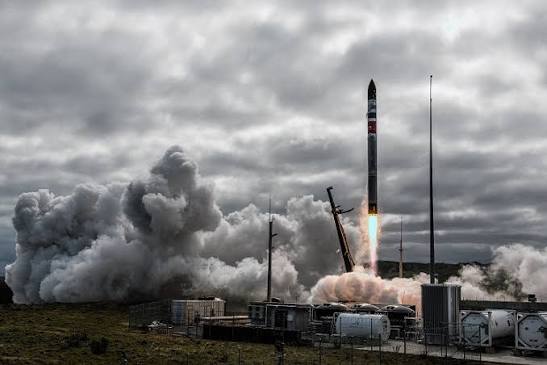
During U.S. spacewalk 97, two astronauts will replace a Space-to-Ground antenna on the orbital complex. The antenna is a critical communication system NASA uses...

 = All times
 = All times for international terrestrial events in local time unless noted.
 = All times for space events, and…
 = All times for international space / astro events in Hawaii Standard Time unless noted. Add 10 hours to obtain UT (‘Universal Time;’ Greenwich, England).