Galaxy Forum Architecture:
21st Century Science, Education,
Enterprise and Development
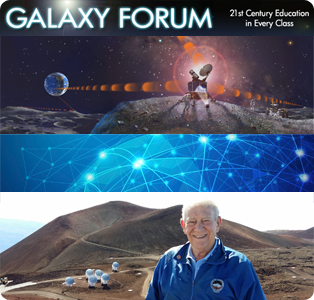
As the primary education and outreach initiative of the International Lunar Observatory Association, the Galaxy Forum program continues advancing 21st Century Education worldwide to provide greater global awareness, capabilities and action in Galaxy science, exploration and enterprise. Galaxy Forums are public events specifically geared towards high school teachers, educators, astronomers of all kinds, students and the general public. Presentations are provided by experts in the fields of astrophysics / galaxy research, space exploration and STEM education, as well as related aspects of culture and traditional knowledge. Interactive panel discussions allow for community participation and integration of local perspectives. Sixty-five Galaxy Forums with a total of almost 300 presentations have been held in 26 locations worldwide (since Galaxy Forum USA, July 4, 2008) including Hawaii, Silicon Valley, Canada, China, India, Southeast Asia, Japan, Europe, Africa, Chile, Brazil, Kansas and New York. The 2016 schedule includes Galaxy Forum Hawaii 2016 — Kona Saturday 23 January at Astronaut Onizuka Space Center; Galaxy Forum Japan 2016 — Tokyo Saturday 20 February at NAOJ Mitaka Campus, Tokyo, Japan; Galaxy Forum Southeast Asia 2016 — Indonesia Wednesday 24 February at SkyWorld, Jakarta, Indonesia; and Galaxy Forum Southeast Asia 2016 — Malaysia Saturday 27 February at Space Science Centre, Universiti Kebangsaan Malaysia (UKM), Kuala Lumpur, Malaysia. ILOA invites Space Calendar readers across the world to contribute ideas, information, contacts or time toward launching the next Galaxy Forum near you. (Image Credit: ILOA)
MONDAY
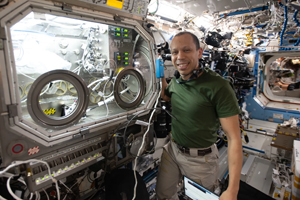
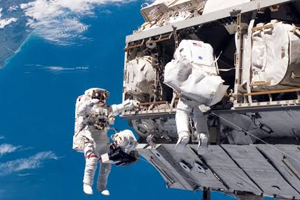
Dec 28 — ISS, LEO: Expedition 46 transferring cargo from Cygnus OA-4, Progress 61P and 62P, working on experiments for ocular & cardiovascular health; maintaining exercise equipment, computers, air / water / waste filters; keeping sleep logs to monitor alertness & ambient light exposure and journals for behavioral & station habitability studies; ISS now 6,247 days in orbit, human EVAs total 1,195 hours & 20 minutes.
Dec 28 — ISS, LEO: Expedition 46 In-Flight Interviews, live coverage 15:30 UT.
Dec 28 — Tiangong-1, LEO: Now in its 5th year of operations, China laboratory collecting data via internal cameras on crystal growth experiment; selling time / data from hyperspectral imaging device to commercial customers.
Dec 28 — Chang’e-3 Lander, Guang Han Gong, Sinus Iridum / Mare Imbrium, 44.12°N 19.51°W, Moon Surface: Only craft operating on Moon, expected to receive funding to continue LUT observations / science through 2016; China Chang’e-5T1 remains in lunar orbit testing maneuvers for future lunar missions.
Dec 28 — Juno, Jupiter Trajectory: Will begin Jupiter Approach activities, instrument check outs and trajectory corrections as craft is less than 7 months (190 days) from reaching the largest planet in the Solar System with the most known moons.
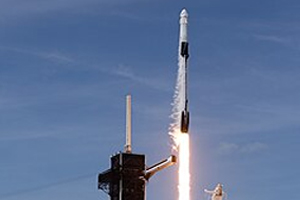
Dec 28 — SpaceX, Cape Canaveral AFS FL: Examining used Falcon 9 first stage booster that successfully returned to a vertical powered landing after launching 11 commercial satellites into orbit; recovery, servicing & re-use of first stage could substantially reduce ~$60M cost of the rocket, allowing cheaper access to Moon, Mars, Deep Space; expecting 12+ launches in 2016.
Dec 28 — Google Lunar XPrize Teams, Multiple Locations: Remaining 16 commercial teams from 13 countries are working to reach Moon surface, only 2 teams possess verified launch contracts – SpaceIL of Israel & Moon Express of USA (both launching 2017); Astrobotic carrying team Hakuto & team AngelicvM plan for SpaceX rideshare, Synergy Moon announce Interorbital launch.
Dec 28 — Virgin Galactic, Multiple Locations: Preparing for projected Feb 2016 roll-out of new SpaceShipTwo, with tests to follow, as part of its ‘Spaceline for Earth’ with goal of democratizing access to space for the benefit of life on Earth; increased competition and challenges with Blue Origin & its New Shepard spacecraft racing ahead to the boundary of space.
= All times
for terrestrial events in local time unless noted.
= All times for international terrestrial events in local time unless noted.
= All times for space events, and…
= All times for international space / astro events in Hawaii Standard Time unless noted. Add 10 hours to obtain UT (‘Universal Time;’ Greenwich, England).
Asteroid Considerations:
Resources, Security, Science
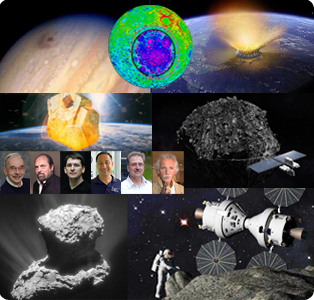
Unknown asteroids are orbiting within and around the Solar System, with undetermined compositions, origins and paths, evoking inspiration and concern. Classification systems and detection currently estimate ~11,600 Near Earth Asteroids (Apohele, Aten, Apollo, Amor, Mercury-Crosser, Venus-Crosser), while ~14,000 may inhabit the area of Mars (Mars-crosser, Mars Trojan). Several million ranging from the 975-km diameter Ceres to millimeters in size are thought to make up the Main Asteroid Belt (Hungaria, Phocaea, Alinda, Palla, Griqua, Cybele, Hilda, Thule, Jupiter Trojan & Greek). The Outer Solar System Centaurs may have 44,000 larger than 1 km. Trans-Neptunian Objects (KBOs, Resonant TNOs, Scattered Disk Objects, Detached Objects) may be in the millions with 100,000 larger than 100 km. There are only 2 known Inner Oort Cloud Objects (Sednoids). Outer Oort Cloud Objects may include trillions larger than 1 km and billions larger than 20 km. Space agencies and groups such as B612 look to detect NEAs and protect Earth. Planetary Resources and Deep Space Industries are aiming to mine asteroids. ESA with Rosetta / Philae, JAXA with Hayabusa 1, NASA with Dawn, and CNSA with Chang’e-2, have explored asteroids for scientific purposes. Planned missions include JAXA Hayabusa 2 & PROCYON, NASA OSIRIS-Rex and Asteroid Redirect Mission for humans to visit an asteroid in Moon orbit via SLS in ~2021. The advancing U.S. Commercial Space Launch Competitiveness Act (H.R. 2262) while supporting private enterprise to posses asteroid / space resources, does not give ownership to the celestial object itself. Its groundwork may be a good starting point for international, species-wide regulations for exploration and use of space. (Image Credit: NASA, ESA, JAXA, Aurich Lawson, Lockheed Martin, DSI, LPI, U of A, B612, MPS; Pictured L-R: John Lewis Author of Mining the Sky, Rick Tumlinson Deep Space Industries, Chris Lewicki Planetary Resources, Ed Lu B612, Philae Lander Lead Scientists Hermann Böhnhardt & Jean-Pierre Bibring)
Dec 29 — Apollo Asteroid 294739 (2008 CM): Near-Earth flyby (0.058 AU).
WEDNESDAY
Dec 30 — Space Center Houston, Houston TX: Last day to view Orion back-shell tile panel that protected Orion capsule during its first high orbital flight test.
Dec 31 – Jan 4 — American Mathematical Society, Yau Mathematical Sciences Center of Tsinghua University, Sanya, Hainan, China:String-Math Conference 2015.
Dec 31 — Moon: 1.7° SSE of Jupiter, 09:00.
Dec 31 — Apollo Asteroid 2011 YE40: Near-Earth flyby (0.041 AU).
Dec 31 — Apollo Asteroid 2015 YD2: Near-Earth flyby (0.056 AU).
FRIDAY / JANUARY 1, 2016
NET 2016 — CNSA, Launch Tiangong-2 Space Lab, TBD, China: Core module of China Space Station (Tiangong-2) expected to launch to LEO this year (orbit between 350-450 km).
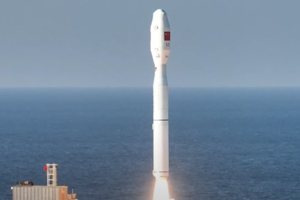
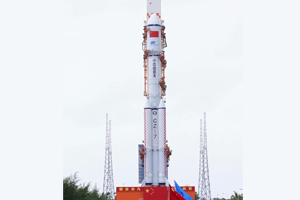
NET 2016 — CNSA, Launch Long March 7, Wenchang Satellite Launch Center, Hainan, China: China expects to conduct maiden flight of Long March 7 rocket intended to launch cargo / fuel to China future space station.
NET 2016 — Orbital Technologies Ltd., LEO: Originally planned year for Commercial Space Station / Orbiting Hotel to begin operations for this Russia commercial aerospace firm, collaborating with RSC Energia; proposed at US$800K for flight, $160K for 5-days of accommodation.
NET 2016 —Mars One, Launch of Mars Demonstration Mission & Communication Satellite,TBD: Company hopes to launch Demonstration Mission to test technologies for human mission, and place satellite in Mars orbit enabling 24/7 communication this year.
NET 2016 — NASA, TBD: Asteroid selection to occur this year as part of Asteroid Redirect Mission (ARM); 500,000-kg asteroid to be captured 2019, relocated to Moon orbit, visited by Humans via Space Launch System 2021.
NET Jan — ISRO, Launch PSLV / IRNSS 1E,Satish Dhawan Space Center, Sriharikota, India: India Polar Satellite Launch Vehicle, flying on PSLV-C31 mission, to launch Indian Regional Navigation Satellite System IRNSS 1E navigation satellite.
NET Jan — Green Bank Observatory, Parkes Observatory, West Virginia, USA & New South Wales, United Kingdom:Breakthrough Listen campaign to search for life signals around nearest million stars & 100 nearest galaxies to begin this month with US$100M funding given by Yuri Milner of Russia and expert team including Stephen Hawking, Lord Martin Rees, Geoff Marcy, Frank Drake.
Jan 1 — Deep Space, Kuiper Belt Trajectory: New Horizons, first mission to Pluto system and Kuiper Belt, continues in “departure science” phase, downloading data at 2 kilobits per second to Earth while looking back at Pluto & surrounding environment, doing various experiments; Pluto Encounter officially ends this month.
Jan 1 — Cassini, Saturn Orbit: Flyby of Methone (28,000 km), Tethys (39,000 km), Aegaeon (94,000 km), Pan (97,000 km), Pandora (110,000 km) planned for today.
Jan 5 — ISS, LEO: Expedition 46 In-Flight Interview with BBC World Service Radio and ISS Commander Scott Kelly, Flight Engineer Mikhail Kornienko, live coverage 14:30 UT.
Jan 5 — Juno, Jupiter Trajectory: Spacecraft begins Jupiter Approach phase, will last 178 days.
Jan 5 — University of Hawaii at Hilo, Hilo HI: Lecture: Lunar Laser Ranging Retroreflector Array for the 21st Century; Doug Currie from University of Maryland.
Jan 5-9 — American Mathematical Society, Yau Mathematical Sciences Center of Tsinghua University, Sanya, Hainan, China:Conference on General Relativity.
Jan 5 — Apollo Asteroid 2015 XT: Near-Earth flyby (0.080 AU).
Jan 5 — Apollo Asteroid 2015 XT: Near-Earth flyby (0.095 AU).
WEDNESDAY
Jan 6-9 — U.S. National Committee of the International Union of Radio Science (URSI), IEEE Antennas & Propagation Society (APS), Boulder CO:2016 National Radio Science Meeting.
Includes ~150 meetings covering the fields of COSPAR Scientific Commissions / Panels / Task Groups, such as SC B: The Earth-Moon System, Planets, and...
From 02 to 07 August 2026, a few thousand geoscientists across diverse disciplines will gather at the 23rd annual meeting of the Asia Oceania Geosciences...
2:45 pm EDT from Johnson Space Center, NASA astronaut Chris Williams will recap his recent eight-month mission aboard the International Space Station. Williams returned to...
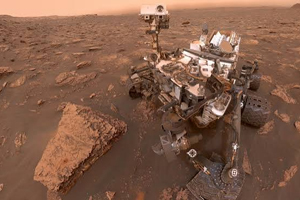
NASA Curiosity (Mars Science Laboratory) rover surpasses another full year of operations on Mars surface today; launched Nov 26, 2011 – landed Aug 5,...
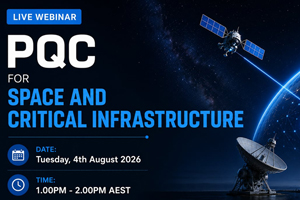
Virtual Series 2026 will offer deeper conversations on why PQC matters and the practical steps businesses should be taking; starts 1:00 pm AEST. Featuring:...
This international lunar science meeting has two objectives: to provide a platform for leading experts to review recent advances across lunar research, from the...
At CSIR International Convention Centre. Key topics are Earth Observation, Developing Space Tourism, Space Supply Manufacturing. Cultural tours are offered.
Participants will receive theoretical and hands-on training in electron imaging and X-ray spectroscopy for application to planetary samples. This training opportunity is targeted at...
"Leading Australia’s Space Future for Our Strategic Advantage". Southern Space 2026 brings together decision-makers who set the direction for Australia’s space sector. It is...

 = All times
 = All times for international terrestrial events in local time unless noted.
 = All times for space events, and…
 = All times for international space / astro events in Hawaii Standard Time unless noted. Add 10 hours to obtain UT (‘Universal Time;’ Greenwich, England).